
By Komari Machida
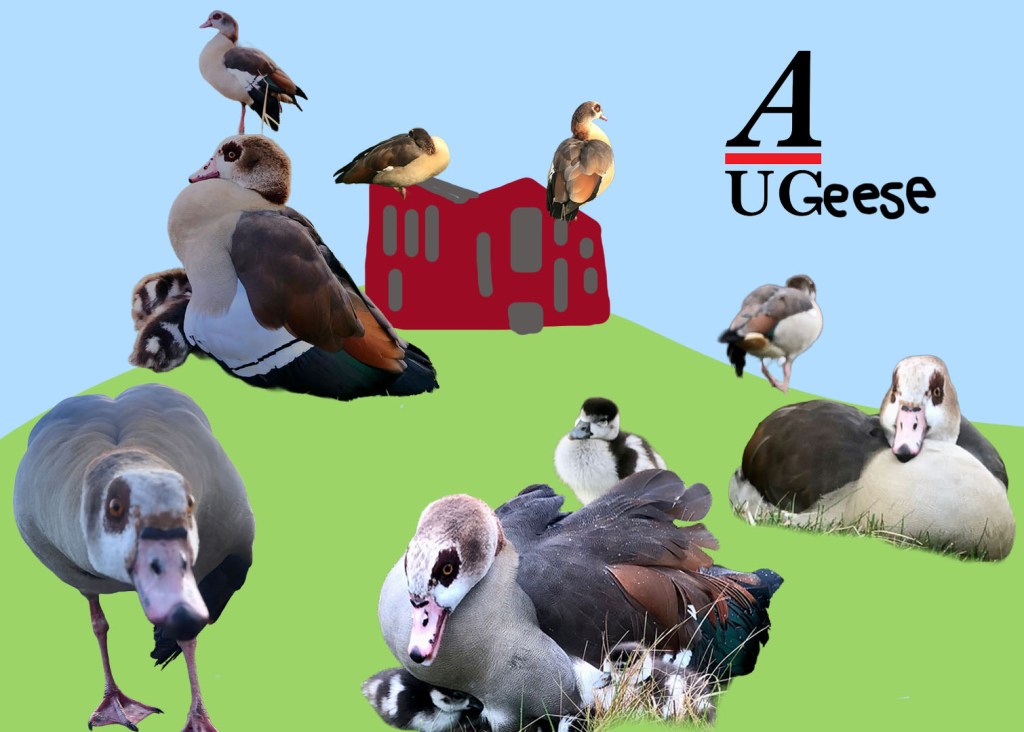
Every year, Amsterdammers are welcomed into springtime with crisp, blue skies, abundant sunshine, and colorful flowers on the streets. For AUC staff and students, it’s the loud gawkings of the Egyptian geese family living next door that announce the beginning of the season. Lovingly known as the “AB Geese”, or a million different names personally given by students, they have unfailingly brought joy to the AUC community over the years. But where did they come from, and why have they chosen the AB as their home? The Herring investigated the goose family’s history, their role in local ecosystems, and what they mean to students.
Although the clear origin of the Geese is unknown, Marcus Smit, AUC’s Head of Communications and long-time employee, recalls first finding them after he returned from the COVID-19 quarantine. The original couple has had many offspring every year: this year, five goslings were observed, while last year there were eight. During breeding season (February to June), he often sees the grown Egyptian geese fly on top of buildings around Science Park, such as Lab42, and gawk to find mates, which is the origin of the characteristic noise heard during class time. The goose family living across the street from the AB (near the UvA Campus) is a completely different family.
According to Madvin Mexi, a second-year Humanities student and bird enthusiast who helped nurture their goslings last year, Egyptian geese are known to move in couples and settle down in a place permanently. The second-year believes that when the couple first arrived, there were other ducks, but no geese family in the waterway, as Egyptian geese are territorial in nature. They must have found the area suitable to build their home, as it has abundant grass and proximity to clean water.
One still wonders why the geese choose to settle down near the AB, when they are known to generally avoid humans. Mexi suspects that they were used to being surrounded by people to some extent before arriving at the AB. However, information from Smit suggests that the geese may have arrived before knowing that the AB was usually a busy place: after all, the building and its premises were devoid of any humans during quarantine. When the students came back, the geese may have needed to adapt to encountering humans on a regular basis.
The Egyptian geese are not new or rare in Amsterdam, and have in fact become a staple in European cities over the past decades. They were first introduced to the Netherlands in 1967 and successfully “took over” the landscape, often displacing native species in the process. Thus, they are classified by the EU as an “invasive species”. This definition resonated with Smit, who stated that, because of the aggressiveness of the geese, “the native brown ducks are gone”.
Joris Buis, a UvA professor and instructor for the course “Birds: Our Shared History, Habitats, and Future”, explained that invasive species can pose a real threat to vulnerable ecosystems (e.g., island populations) that have never encountered predators before. However, he believes this distinction becomes ambiguous in urban ecosystems, where “it’s already such a melting pot”. In such cases, he supposes that the integration of such species and the changes they bring should be “better [left] to the natural process”. In this view, the Egyptian geese, although foreign when initially introduced, have become a part of the natural process over decades. Elias den Otter, another UvA professor and “Birds” instructor, agreed with Buis. “It doesn’t sit right with me that we kill certain birds to make space for other birds. They’re just birds”.
Otter also cast doubt on the concept of invasive species as a whole, believing it to be a result of “humans wanting to put nature and animals into boxes” in order to control them. He elaborated that once humans inevitably bring “invasive species” with them to other environments, they believe they can “control nature” and “turn back time” to “fix [the ecosystem]”. However, Otter believes aiming to control nature is misguided, as nature is dynamic, not static.
The professor brought up an intriguing point that the static label of “invasive species” may not be useful at all. He stated that, if humans view everything foreign to the natural environment as invasive, then “humans [who inhabit previously protected/untouched natural environments] are also…invasive”, advocating for people to coexist with nature instead of trying to control it.
When it comes to interacting with the geese, Mexi recounted that he came to care for them by regularly feeding them seeds. Although tempting, he warns students not to feed the geese bread, as it is unhealthy, “like junk food”, for them. Otter also advises students to keep interactions to a minimum and observe fondly from afar. If birds are fed, “they may have too much time on their hands”, as they don’t need to hunt anymore, which can cause them to become more aggressive, he told us. To support this point, the professor reported that some chicks can die due to male birds becoming aggressive.
Smit stated that AUC has “nothing against [the geese]”: though he understands his colleagues and AUC students find them “cute”, he expressed annoyance at the “poo” they leave around the AB, which sometimes travels with students’ shoes onto the carpets of the building. To manage this issue, AUC sometimes hires extra cleaning services before students return from summer break, as the geese are more active on campus when it is quieter.
Smit also informed us that AUC has no legal jurisdiction or claim to the geese, as they usually move between land owned by the UvA, Science Park, and the municipality. Nevertheless, students have shown great love for the birds, with Mexi stating that the geese are “truly the highlight of the AB”. This sentiment was echoed by the abundance of messages and pictures shared on the Dorm Pets group chat and those the author personally received during the investigation. Some have named the entire family and constructed backstories for them.
Alex Weeren, a first-year Sciences student, expressed that the geese “really make [their] day”, especially when confronted with Amsterdam’s turbulent weather. Weeren believe the geese family perfectly symbolizes the concept of a “silly goose”, claiming that “it’s not just a saying, it’s a lifestyle. It’s about being whimsical”. An ode to enjoying the little things and to not take life too seriously — a much-needed, heartwarming reminder for the AUC community.
 The Herring
Nice!
LikeLike