
By Cadence Chua and Komari Machida
This article is the second part of a piece on the No Kings protests in Amsterdam, published here.
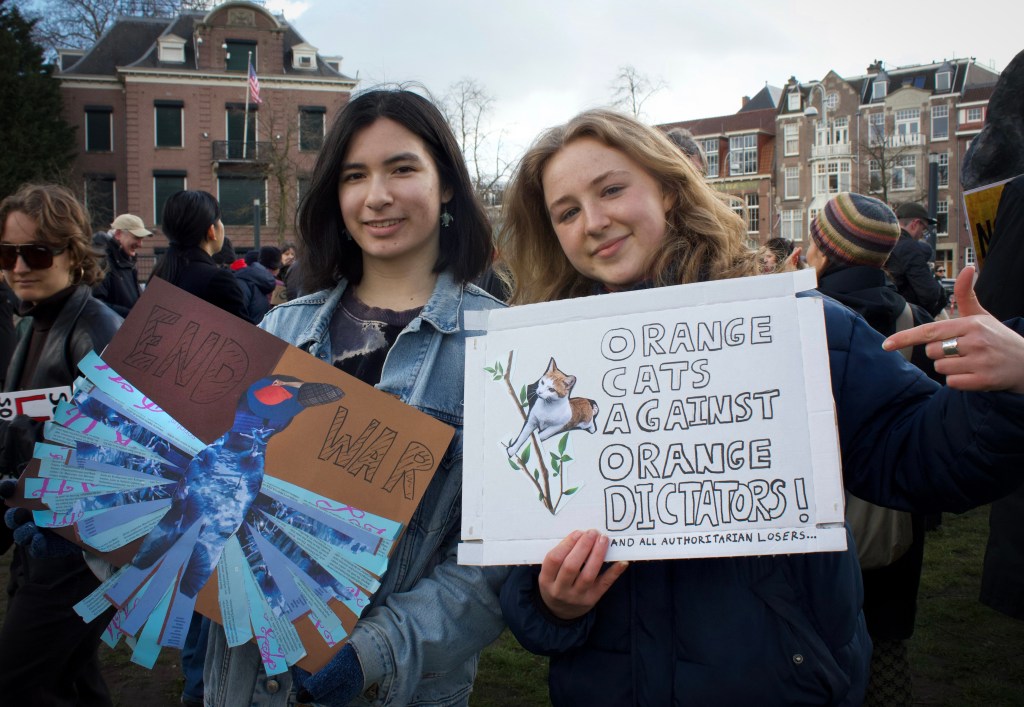
Photo by Penelope Valenti
Protests against the Trump administration, also known as the No Kings protests, were held on 28 March around the world, including in Amsterdam. A few hundred demonstrators had gathered at Museumplein to voice their opposition to Trump’s policies. The Herring spoke to the AUC students who attended the protest, Zachary Paskalev and Rebecca Groß, and the organisers of the protest, Hayley Hughes and Autumn Dukich of Indivisible Netherlands.
For Paskalev, a first-year Sciences student from Oregon, the No Tyrants protest meant an opportunity to “stand up against a system that is serving very, very few people”. Groß, a first-year Social Sciences major from Germany and California, echoes this sentiment. She points to “just the hope of there still being people who are standing up and showing up to show [their] support for those that can’t be on the street” as a touching experience. “Despite how grim everything feels, especially just on the topic of politics in general, I think it was a very hopeful, positive thing,” says Paskalev. The duo emphasises that they view the protest as a symbol of communal spirit amongst those standing up against Trump.
Hughes, one of the organisers of the protest, walked The Herring reporters through the process of getting involved with Indivisible Netherlands and staging the demonstration. Hughes had decided to start a Dutch chapter of Indivisible, the “parent group of the No Kings movement”, in October 2025, with a few other volunteers. When asked why she decided to do so at that time, Hughes says that the momentum was there due to current events. “There’s so much at stake. Not just in the US, but globally. Freedom, democracy, these are things that don’t have borders.” Having a chapter in the Netherlands also allows for more organised activities, to “network with […] Americans here, but also with local Dutch organising groups, to build solidarity with their movements”.
Elaborating on her work in community organisation, Hughes says that she also helped stage a No Kings protest in Amsterdam in October 2025. When asked about tips on organising, she says, “Don’t reinvent the wheel. People have done this before.” She also highlights the impact of “looking to elders for guidance” and “finding people in your networks”.
In addition, Hughes breaks down the purpose of protesting abroad into two main factors. First, to “show solidarity with people back home” and “stand up for democracy”. She points out that some Americans living in the US are risking more to protest, and protesting abroad shows them that others are also supporting them. The next factor is to form connections with like-minded people. “It’s easy to feel isolated and just watch the news and feel sad,” she comments, “but [it’s important to] get together to actually do something.” She also discusses the importance of collaborating with progressive activists here to counter “global issues and a shift towards the far right in Europe”.
As for what international students can do to support Americans and those affected by American policies, Hughes, who is also a university teacher, pointed to reduced freedoms in universities in the US and globally. “The university is more important than ever,” she states. “It’s good if students abroad can stand up in solidarity with [those who are affected], but also to realise that fascism and authoritarianism always go after the universities and the free press.” She encourages students to “make connections [with communities] while they can” to avoid isolation and strengthen their voices. Quoting Timothy Snyder’s On Tyranny, she remarks, “Do not obey in advance.”
Autumn Dukich, part of Indivisible Netherlands and the chant leader at the protest, explains that she got involved in activism in 2016, after Trump’s election. She says that her grandparents are Trump supporters, and “it was a very weird time, because I couldn’t believe that he actually got elected”. This disbelief “fired [her] up against Trump, realising […] that he can actually come into power and people are voting for him”. As a university student back then, Dukich started attending any protests she could.
Despite this experience, she acknowledges that it may be “intimidating” to take part in protests and activism for those without prior experience. She says that this may be due to violence against demonstrators, as well as “really scary rhetoric that makes you not want to use your voice”. To counter this, she advises students to engage with the resources available to them, whether it is boycotting, protesting, writing articles, or discussing their values with others. She also tells students to value their safety, saying it is of utmost importance.
When asked about her history of political participation, Groß recounts her decade-long work with Democrats Abroad and explains that she became more involved with fundraising and the youth wing in her high school years. During the protest, Groß wore a Democrats Abroad t-shirt with a message for Americans to register to vote. That was also a key theme of the demonstrations, with the Safeguard American Voter Eligibility (SAVE) Act being proposed in the US. It is a law proposed by the Trump administration and the Republican Party that would require American voters to provide a document, such as a US passport or photo identity card, in order to vote. Under the current policy, citizens are able to vote by just showing a valid driver’s license or state identity card. Opponents of the SAVE Act hence believe that if passed, the Act will constitute voter suppression and reduce turnout.
Groß explains that the number of Americans voting from abroad made a difference in the last presidential election. She is concerned that the SAVE Act might take this right away from Americans. Groß hence points to the popular, patriotic phrase amongst Americans, “no taxation without representation”. She strongly urges American students to “fight against the Act” by registering to vote every year, because “[they] want the best state that there can be for the country” and they can easily be pulled off the list of voters registered.
As for Paskalev, it was his first time attending a physical protest of his own volition. The “welcoming” atmosphere and participating with a group of friends helped form his biggest takeaway: “[Protesting] was a lot more fun than I thought it would be. It felt like the right place to be.”
Groß calls on AUC students who may feel apprehensive about joining protests abroad to attend peaceful demonstrations: “What’s the worst that can happen at a peaceful protest?” Paskalev also encouraged joining protests if students have the means, and jokingly warns, “Just don’t do anything illegal.”
 The Herring