
By Cadence Chua and Komari Machida
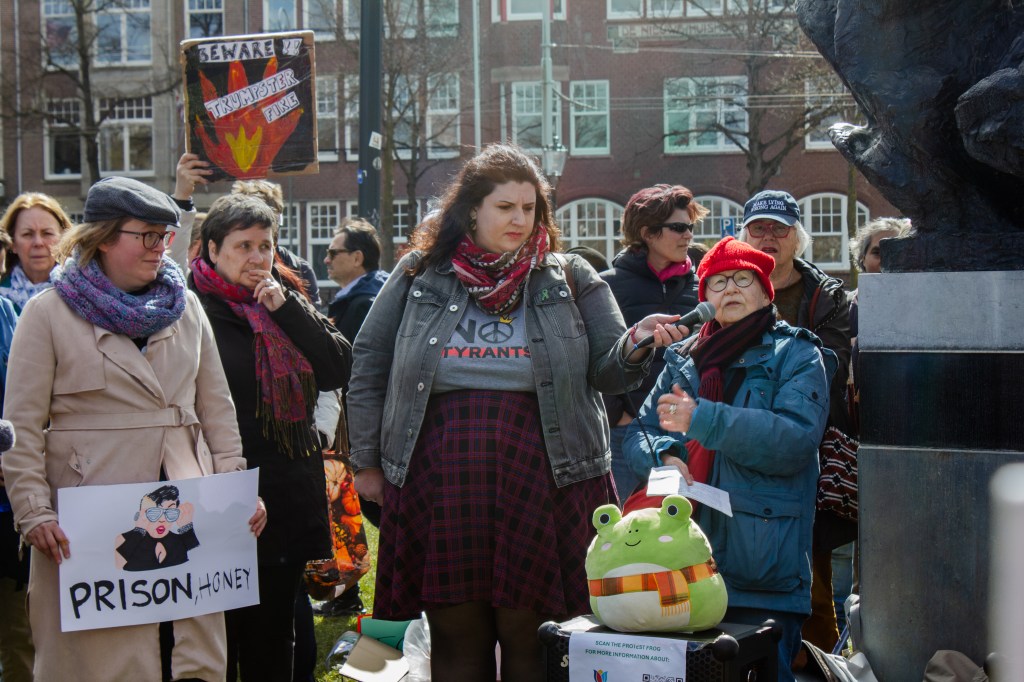
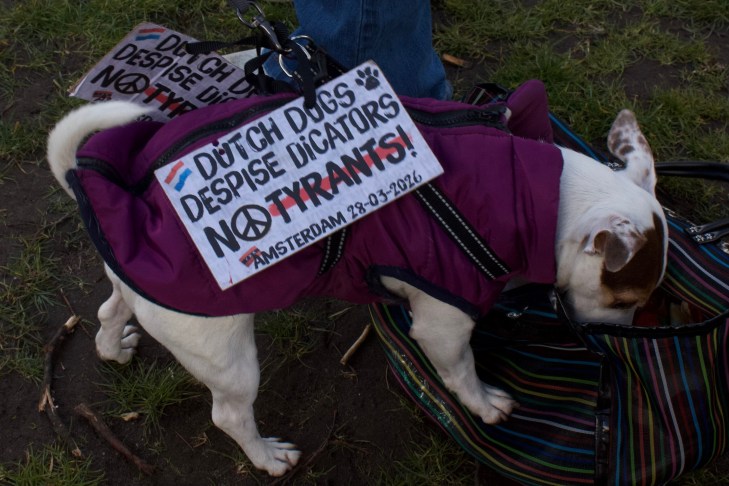
On 28 March, protests were organised globally against the Trump administration in the US, including here in Amsterdam. Known as the No Kings protests, the Dutch iteration brought together hundreds of demonstrators in front of the US Consulate General at Museumplein. They used homemade signs and raised voices to make their cause heard. As Americans and non-Americans alike chanted against fascism and authoritarianism, the organisers invited speakers to share stories of solidarity, the importance of speaking up, and practical steps that can be taken against Trump’s policies.
The demonstration in Amsterdam was organised by the Netherlands’ chapter of Indivisible, an American nonprofit known as one of the main coordinators of the No Kings protests. For the third time since its start in June 2025, this series of marches rallied Americans, who united against the policies of Trump’s administration. The protests on 28 March were the third iteration. Indivisible aimed to garner at least 12 million demonstrators nationwide and globally, representing 3.5 percent of the American population. In political science, if at least 3.5 percent of a population mobilises against an authoritarian government in a nonviolent manner, it is the critical mass needed to topple said government.
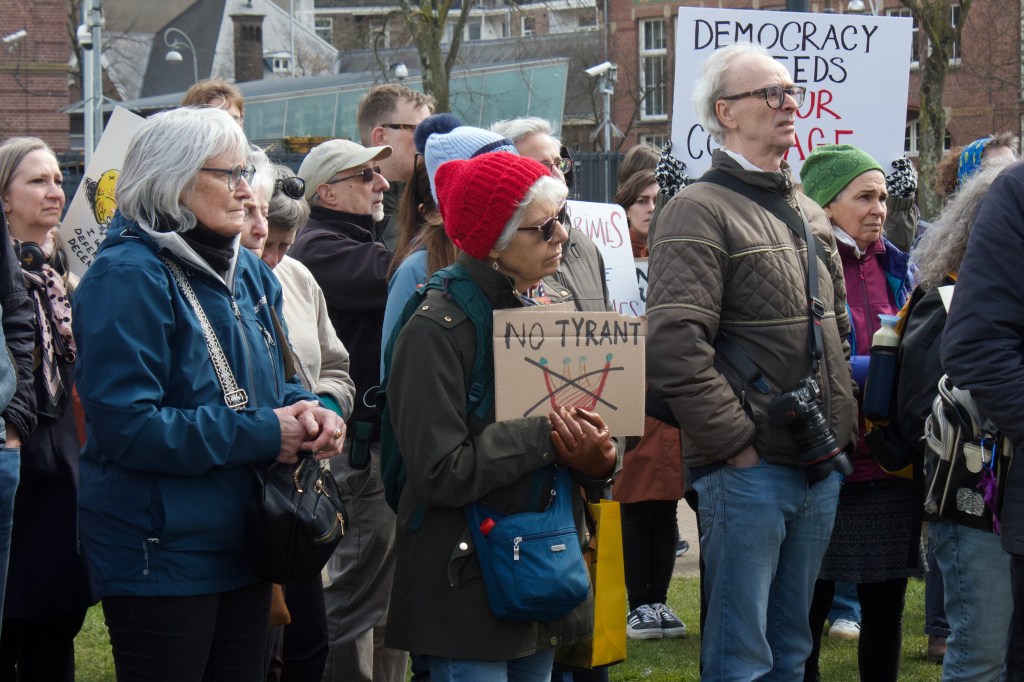
The protest started at 13:00 with an opening speech by Hayley Hughes, the co-founder of Indivisible Netherlands. The Cincinnati native thanked participants for joining the demonstration and stated that, even though it was taking place outside of the US, “democracy has no borders”. She then urged those present to think of what they want America to look like, in terms of “fairness, justice, and peace”. Following that, an interlude of chants was led by Autumn Dukich, a part of the organising team. The crowd shouted out what they did not want America to be, including “mass ICE [US Immigration and Customs Enforcement] in our cities – not my America”. The chants ended with “Show me what democracy looks like! This is what democracy looks like”, referring to the demonstrations against Trump.
Next, Hughes spoke about domestic issues in the US and the American government’s intervention in Venezuela and Iran, criticising the Trump administration. As she read out the names of immigrants who had died in ICE detention and where they were from, a sombre mood fell upon the crowd. Drawing parallels between the 2020 George Floyd / Black Lives Matter protests and the anti-ICE demonstrations, Hughes stated, “The violence might wear a different face or go by a different name, but it is the same. It says, ‘I matter, and you don’t.’”
Attention then turned to Minnesota, where incidents involving ICE agents killing American citizens in the major city of Minneapolis have drawn widespread attention and protests within the state. Three older Minnesotans, Shelley Anderson, Lizette Bartholdi, and Lynn Kaplanian-Buller, spoke in front of the crowd. As they shared stories about the state and the Twin Cities of Minneapolis and St. Paul, Anderson stated, “They [ICE agents] came armed with guns and chemical weapons. […] They were met by citizens armed with mobile weapons and whistles. Two days later, Renee Good was killed.” Good was an American citizen who was fatally shot by ICE agents in Minneapolis when she drove away from them. The “Minnesota sub-group”, as dubbed by Hughes, also drew attention to the importance of mutual aid and community. They narrated how residents shared resources with each other amidst the protests and ICE actions. Kaplanian-Buller, who also runs the American Book Center in Amsterdam, closed the segment with anecdotes reflecting “Minnesotan grit”.
Following the Minnesotans, Dutch activist Douwe van Domselaar, part of Extinction Rebellion Netherlands and founder of Hou de Wereld Trumpvrij (Keep the world Trump-free), drew parallels between the Nazi occupation of the Netherlands during World War 2 and the ICE agents in the US. As the grandson of a resistance fighter, van Domselaar stated, “The uniforms might be different and the language might be different, but the mechanisms are disturbingly familiar.”
After another round of chants, Jeremy Bierbach, a self-described anti-fascist lawyer who immigrated from the US in 2001, spoke about the history of monarchies and the importance of the rule of law. “If you want to say No Kings, say No Kings!” he declared. He pointed out that in the Dutch constitutional monarchy system, the king would be powerless to stop a far-right government. The lawyer recounted his experience assisting with a case of the Netherlands deporting a citizen, saying that it was brought to the European courts, and that “Democracy without the rule of law is useless.” In the middle of his message, Bierbach also mentioned far-right political parties in the Netherlands, as he pointed out that Ongehoord Nederland (ON!), a news broadcaster supported by these entities, was also present at the protest. “They’re trying to get soundbites to make you look stupid,” Bierbach claimed. The ON! journalists left shortly after some booing by the crowd. At the end of his speech, he emphasised the privilege of having the freedom to protest in the Netherlands, and to make use of this right to speak up: “Use the system to be a pain in the ass, to be ongezellig!”
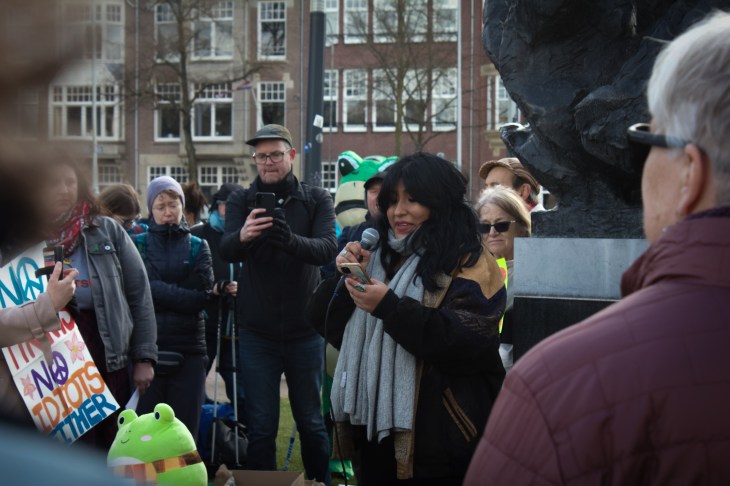
Following Bierbach’s speech, the floor was opened up to spontaneous messages by members of the crowd. The speakers included regular protestors, Indivisible Netherlands’ representatives, and even a tourist. They each raised issues that concerned them and urged the audience to speak out against Trump and fascism in various ways, such as “filling [the congresspeople’s] voicemails” and performing kindness. To wrap up the segment, Ilsa Gallagher, the Public Relations manager of Indivisible Netherlands, voiced the importance of active participation in upholding democracy. “Democracy is not a spectator sport,” she stressed, “it’s a struggle that requires us to speak up every day.
After another round of chants, Taylor Smith, a women’s march organiser who writes about resistance, class solidarity, and global movements, spoke about boycotts. She argued that economic resistance can “restore power to the 99 percent”. She criticised politicians for treating people as “consumers, not constituents,” and claimed that every purchase may indirectly fund harmful actions around the world. Calling for a boycott of major American corporations, Smith aimed to show how they are effective by citing the Montgomery bus boycott and the recent QuitGPT movement, which resulted in 4 million users walking away from ChatGPT. She emphasised the need for global solidarity, telling the audience, “Our money is our weapon, and we have to use it.” Bringing attention to Europe’s abundance of local communities and shops, she encouraged the crowd to redirect their spending to local shops and community initiatives.
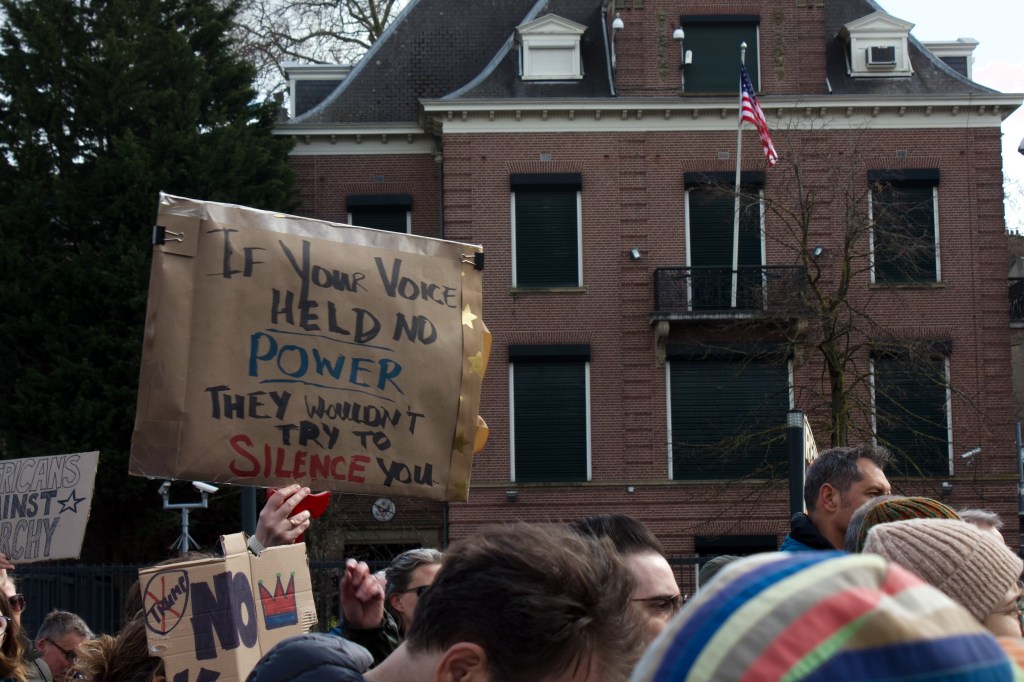
Following that, cheers greeted Greg Shapiro of Boom Chicago, a well-known Trump impersonator whose voiceover of a Dutch late night talk show segment went viral in 2017. With many tongue-in-cheek comments, he also referenced World War 2 during his performance, and concluded it with, “You’re very mean to me. I’ll see you in Nuremberg 2.0.”
Democrats Abroad Netherlands secretary Audrey Tolbert then took to the stage and emphasised the importance of voter registration and voting from abroad, amidst the administration’s moves to pass the Safeguard American Voter Eligibility (SAVE) Act, which she said may threaten voting rights for Americans residing abroad. Pointing to a booth to register, she stated that voting is “the best way to make your voices heard”.
After two hours of the protest, it was time for the concluding speech by Hughes. She raised the idea of hope as repeated concrete actions, and requiring active participation. Quoting Rebecca Solnit, a renowned American writer and political activist, she stated, “Hope is not a lottery ticket you can sit on the sofa and clutch, feeling lucky. It’s an axe you break down doors with in an emergency.” She called on the audience to vote and get registered, boycott, and keep protesting, stating, “This is a global fight.” Hughes also brought attention to the power of joy, concluding her speech with, “Make something. Make art. Make good trouble”. Then followed the last chants, a series of statements ending with “That’s my America,” a contrast to the beginning of the protest. The event ended on an optimistic note with the audience singing the song “We Shall Overcome,” a gospel song associated with American activist movements.
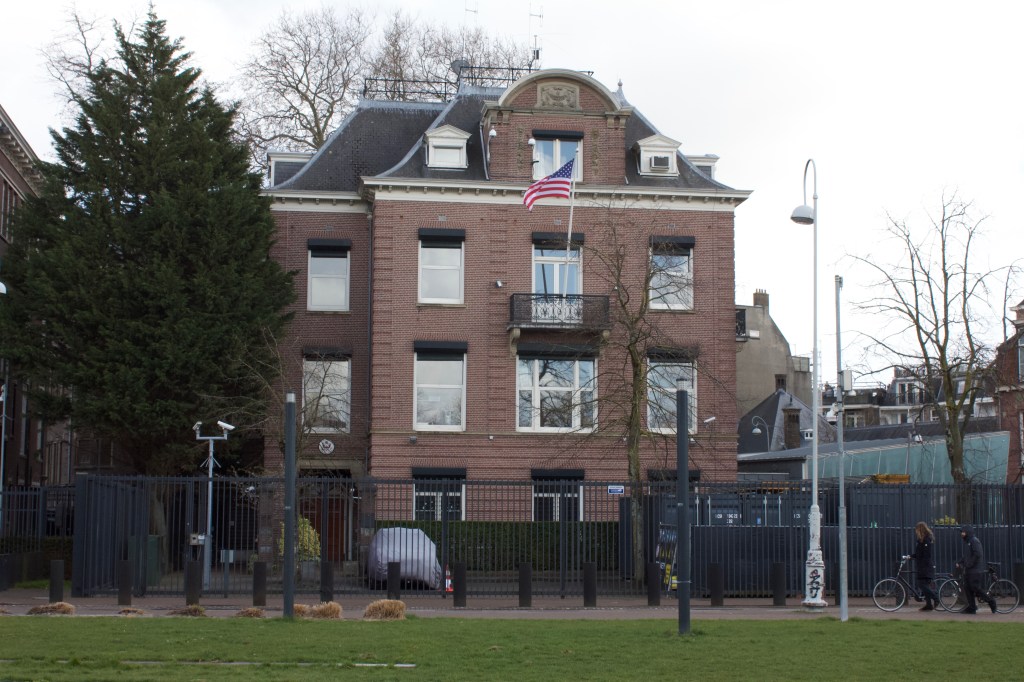
As the crowds began to scatter, the blinds of the U.S. General Consulate, which had remained closed during the demonstration, were raised.
 The Herring