
By Rose Carmichael
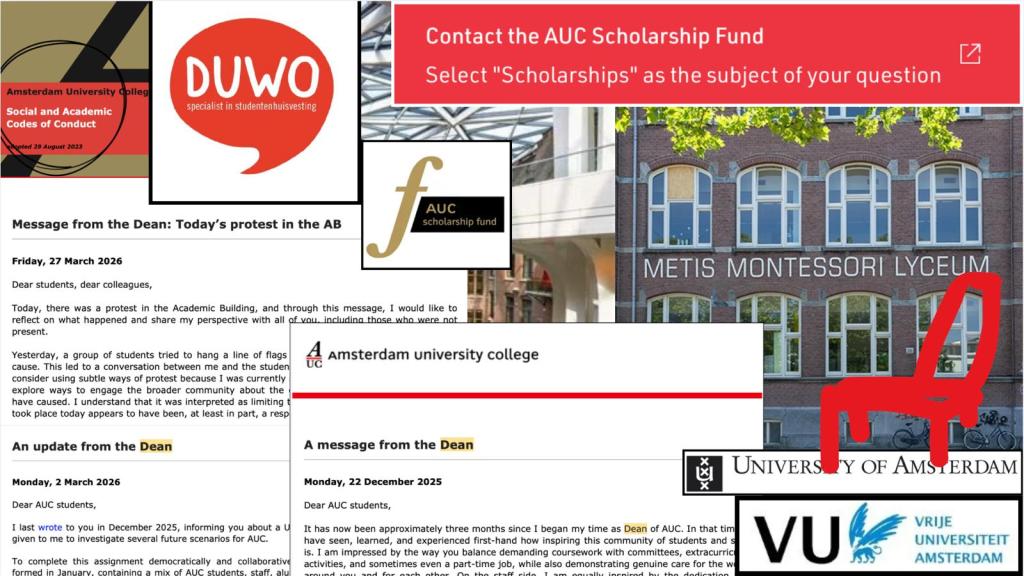
On May 8, the Taskforce assigned to gather data for the future scenarios assignment will present their findings to the Dean. With AUCNext due to end in 2026, UvA and VU have asked the Dean to develop a new strategic vision that outlines what AUC will look like in the next five to ten years. However, this time, it feels different. With added sociopolitical pressures on liberal arts and sciences programs, AUC’s financial deficit, and AUC’s Palestine activist association (AUFP) claiming in a recent protest that their political activity is stirring dissent among the Colleges van Bestuur (CvBs), these strategic visions could lead to radical change or pose an existential threat. “It’s a high-stakes situation,” says Willemijn Eijsink, a third-year science student, chair of the student council, and member of the Taskforce.
When asked what form these scenarios might take, the Dean said he still has no firm direction. He has opted for a bottom-up approach, meaning he plans to develop the future scenarios based on the data the Taskforce provides next week. However, he suggested that when coming up with scenarios, you typically want a scenario of change, a conservative scenario, and an existential scenario: “Generally, you have to think about maybe a scenario of change, radical change. For example, a change to the curricular.” At the 9 March general assembly, the Taskforce reported that AUC is considering placing greater emphasis on science and technology moving forward, with the Head of the Sciences department noting that the executive boards of UvA and VU would likely support this shift. The Dean continues: “There’s also a baseline scenario which says, as a UC, we are doing quite well, and we don’t want to change. I mean, these are examples of scenarios. For example, if our finances are not showing that we can sustain ourselves, there could be a scenario where we say we’re closing. But it’s too soon, it’s too early to say that.”
A CvB is the executive board of a Dutch university. UvA and VU each have a CvB, and those two executive boards together will review AUC’s future scenarios. “They’re basically our bosses,” explains Willemijn. The Dean’s task is to provide possible avenues for AUC that the CvBs can choose from.
When AUFP held an emergency protest on March 27, they posted on their Instagram, “We are told AUC will be shut down because students are ‘spoiled brats’—these are the words of the UvA board.” When I asked the Dean about our relationship with UvA and VU, he said, “I don’t think that there is a person you can pinpoint and say, they have these views about AUC.” However, he goes on to stress that perceptions are important: “I think you cannot ignore people’s perceptions, because we are a public institution. So either we need to find a way to change a negative narrative about us, or we need to drive a new positive narrative that shows the work that we do. That may change that perception.” When I followed up by asking what perception he meant, he said that the CvBs do not have a negative perception. Regarding the future scenarios assignment, he considers the assignment a routine step that our parent universities, which he likens to business leaders, have asked for in order to assess what is working and what is not.
The Dean says his main task has been the future scenarios assignment, but he’s also been active in securing scholarships for AUC.
In a September consultation meeting, Marianne Riphagen, AUC’s Director of Education, told the student council that, for legal reasons, government funding canno’t pay for student scholarships directly anymore, and now sponsors and fundraising efforts need to be prioritised. “The government funds institutions, anything that goes towards the quality of education. It’s argued that funding individual students is not contributing to the quality of education, so the way AUC used to do scholarships is now confirmed to be unlawful,” explains Willemijn. On the AUC Scholarship Fund webpage, only one scholarship is available to prospective students starting in September 2026: the Talent Fellowship. This scholarship is reserved for students who are Dutch or completing their secondary education in the Netherlands. Royal Schiphol Group funds the Talent Fellowship, and the Dean announced that AUC has retained the funding for 2026. The Talent Fellowship sponsored a student from 2023 to 2026, but the cycle is coming to an end. The Dean expressed that he finds it very important to retain AUC’s only current scholarship for another three-year cycle.
That said, the Dean is currently looking for more scholarships and wants funding opportunities for non-EU students as well. “We have to tap into private funding because that’s where the money is,” he shares. Alongside companies, the administration is considering asking parents for funding and asking AUC alumni to reach out through their networks. The Dean is also trying to fill the vacant spots on the AUC Scholarship Fund’s board, which fell apart last year. He stresses that filling the spots is very important: “If you want to go and ask for money, people want to see who is on the ASF board because it brings legitimacy.”
Discussions about student recruitment also provide the administration with the opportunity to address diversity at AUC. The university website’s Missions and Values page highlights their commitment to “diversity,” “inclusivity,” and “global perspectives.” However, in her article, “Diversity and inclusion are hard to find at AUC,” Thaïs Michon, a third-year Humanities student, writes that “the AUC website and application process still promise a multicultural utopia that stands in stark contrast to reality.”
“I will take the criticism on diversity,” says the Dean, “but there is a lot of work going on behind the scenes which many may not be aware of.” He shares that Monika Kirloskar-Steinbach, AUC’s diversity advisor, is currently talking with a Montessori school in Amsterdam whose students primarily come from immigrant backgrounds. The Dean reports, “We had people from the Metis Montessori school come here. We want to work with them. We want to recruit students from this school, with the opportunity to explore a potential scholarship for those students.” However, he explains that, through the Metis school’s contacts, he’s learning that most students don’t know what a liberal arts and sciences university is, so the administration is investing in outreach initiatives to recruit, what he calls, non-traditional students. The Dean has a wide understanding of what a non-traditional student is, saying, “It is not only about ethnicity, but diversity in its broadest sense.”
The Dean states that AUC wants to recruit international students, but he’s also been directed to reach out to non-traditional students in Amsterdam: “That was really the mandate that I was given, to go into the so-called poor neighbourhoods of Amsterdam and market AUC there.” He also said, “I actually think that charity starts at home.”
The nationality mix of students AUC recruits also affects AUC’s finances. Willemijn explains that, unlike UvA faculties, which receive funding through UvA’s central pot of money that’s distributed proportionally to the number of students they’ve taken in, AUC does not get any money from that central pot. Instead, AUC gets its money from students’ tuition payments and various government grants. “That means that student recruitment is very strongly tied to AUC finances,” says Willemijn. Given that the Dean’s been mandated to tap into the Dutch student demographic, the tuition fees AUC would collect are smaller than if he were mandated to recruit more international students. That said, the Dean shares that “our finances are looking pretty stable at the moment.” He reports that the last quarter of 2025 showed that AUC had over 600.000 euros in the reserve, which they are using to help pay back AUC’s past financial deficit.
Together with the management team, the Dean is also reviewing the student council’s proposed revisions to the Social Code of Conduct, which they aim to release next school year. The revisions were spurred two years ago amid tense negotiations between the student council at the time and management about the pro-Palestinian protests. Management agreed that the Social Code of Conduct, which includes expectations of behaviour at a protest, could be revised if the student council spearheaded the revisions. Officially, writing policy is the responsibility of the management team.
At the beginning of his term, the Dean proposed adding a section titled “The Rights and Responsibilities at a Protest at the Academic Building,” which the student council is integrating into the revised Social Code of Conduct. However, while this section suggests an effort to be concrete about the conduct of protestors, in a 9 March internal meeting, the student council recognized that some vague phrasing might be necessary when revising the procedure.
The other main revision the student council proposes includes introducing a Conduct Panel. Willemijn shares that the Conduct Panel aims to widen the number of voices that decide the consequences imposed on students, curtailing the decision-making power of the Dean. Legally, the Dean still has to make the final decision, but the Conduct Panel will first provide their recommendations for the Dean to assess.
The Dean also stressed that AUC’s code of conduct legally needs to fit within UvA’s guidelines: “The other tension here is that this building is an UvA building, meaning even if we have to come up with revised procedures, we are ultimately guided by UvA’s guidelines.” The revisions still need to pass UvA’s legal team before they can be implemented at AUC.
The last topic the Dean and I discussed was the hot water shortages in the AUC dorms. After being personally contacted by some parents, the Dean began negotiations with the students’ landlord, DUWO: “I think my job is really about diplomacy. Perhaps I should be a diplomat,” the Dean jokes. The way AUC’s partnership with DUWO is structured doesn’t give the university a stake in how DUWO runs its operations. The Dean explains it like this: “Even if students have not had hot water, DUWO can simply say, sorry, but good luck.” Nevertheless, he reports that AUC has been meeting with DUWO and the university’s legal affairs department on the matter, and shares that they have been making some progress.
Willemijn adds that the details of AUC’s housing agreement could be reconsidered in the future scenarios assignment, but notes that “at the same time, you don’t really want to lose your housing.” The Dean expressed a similar sentiment, saying, “I actually think that based on what the students tell me, if we don’t have the dormitories, then you wonder if there is still AUC to talk about?” The university’s dependence on DUWO makes negotiating with the national entity more difficult.
Alongside negotiating with DUWO, reviewing the changes to the Social Code of Conduct, recruiting non-traditional students in Amsterdam, and securing scholarships, AUC’s new interim Dean is mainly focused on the future scenarios assignment. He shares that he wants input from students, staff and alumni when formulating potential paths for AUC, but this bottom-up approach has not been universally embraced. Willemijn reports that there has been some strong feedback about the feasibility of conducting such in-depth research in a short time frame, and she’s concerned about how all the perspectives collected in the research stage can be translated into one strategic plan. She shares that when the previous Dean formulated the strategic plan AUC currently operates on, AUCNext, he also gathered many voices, only for stakeholders to feel their input was left out in the final document. The current Dean claims that his ongoing communications with the Taskforce’s Strategic Advisory Group will help keep him accountable: “I am working with the Strategic Advisory Group, I’ll provide them with my scenarios in every stage of the process until the 30 June. So in that case, you could say there’s plenty of checks and balances there.” On May 8, the Taskforce will present their collected data on the various forces impacting AUC, and the Dean will start formulating potential avenues for the CvBs to choose from. While he wrote in his 22 December email to students that “trust and transparency are important to me,” the true test of those values lies in the coming weeks. As he prepares to submit his final scenarios on 30 June, the Taskforce’s data presentation offers the Dean a final opportunity to show that student voices are the foundation of AUC’s roadmap, rather than just a footnote.
 The Herring