
By Cadence Chua
This article is part of a series of portraits of graduating students.
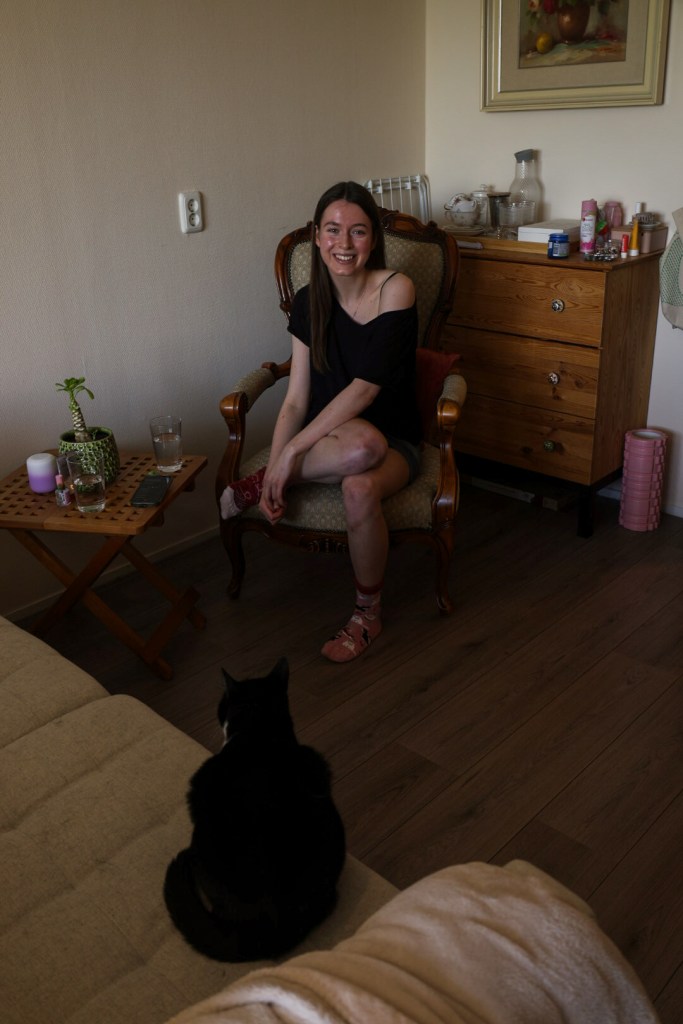
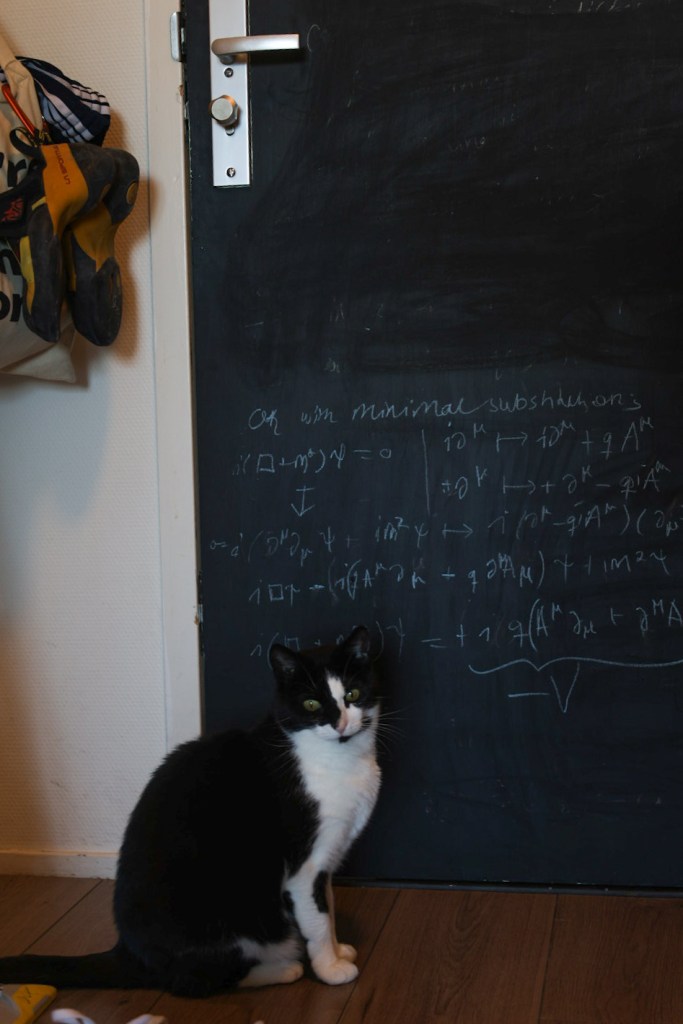
The first thing one will notice when arriving at Mirja Buijserd-van Nifterik’s dorm room is that her door has a mathematical formula on it. The second thing is that the back of the door, conveniently functioning as a chalkboard, is decorated with math equations, graphs, and the like. The third thing is an affectionate tuxedo cat coming to greet you. “Her name is Oreo,” Buijserd-van Nifterik, a third-year Sciences student, says helpfully.
Buijserd-van Nifterik’s story of how she got to AUC is unconventional. In her own words, “I’m autistic. Of course, there are a lot of other neurodivergent people at AUC, but I was diagnosed relatively late.” Because of this, she had to go to therapy sessions four or five times a week, which “didn’t really go well with normal regular education”. She then transferred to a special education school for the last few years of high school.
“I did get held back twice in high school,” she points out. “You just have to imagine, growing up autistic and not knowing that I was autistic, a lot of the time I would be told, ‘just be normal’, or ‘why are you making a big deal out of this’.” Special education helped her feel more accepted. However, it came with a downside. She was unable to take physics, chemistry, or higher maths.
“I ended up doing applied mathematics at Inholland in Amsterdam,” the soon-to-be graduate tells The Herring. Inholland is an applied sciences university, and unlike research universities like the University of Amsterdam (UvA), its degree programme is a four-year one. After a year at the institution, Buijserd-van Nifterik decided to apply to AUC. “I just didn’t have a clue what exactly I wanted to do, academically. So in that sense, AUC was a very good fit.” She also did a lot of math and programming courses at Inholland, and when she encountered formulas, she was curious about their origins. “It’s not in the books; we don’t really talk about it,” her lecturers would tell her. “That was when I felt like going to a research university was a cool idea,” she sums up.
“I remember when I got the email, I called my mum and she didn’t pick up, so I called my brother, who also didn’t pick up, and then I called my dad, and he picked up,” Buijserd-van Nifterik recounts about her acceptance to AUC, laughing. At AUC, the Dutch student is in the physics track, but is doing her capstone in the maths department at Vrije Universiteit (VU). “So maybe mathematical physics is a better term [for what I specialise in].” She also follows the Logic and Computation minor at the UvA.
“I really, really enjoy theoretical physics, and I’d like to continue doing that, probably in academia,” Buijserd-van Nifterik says candidly. She hopes to start the UvA/VU double master’s programme in physics and maths next year. About her interest in physics, she comments that “it just makes sense to me”. However, when she started at AUC, she needed to take the Introduction to Physics course, and she wasn’t very good at it, and also didn’t like it that much. The same went for all the physics courses she did in her first year. “Then, in the first semester of my second year, I took quantum physics, and that’s kind of when I was like, okay, this is what I want to do,” she smiles.
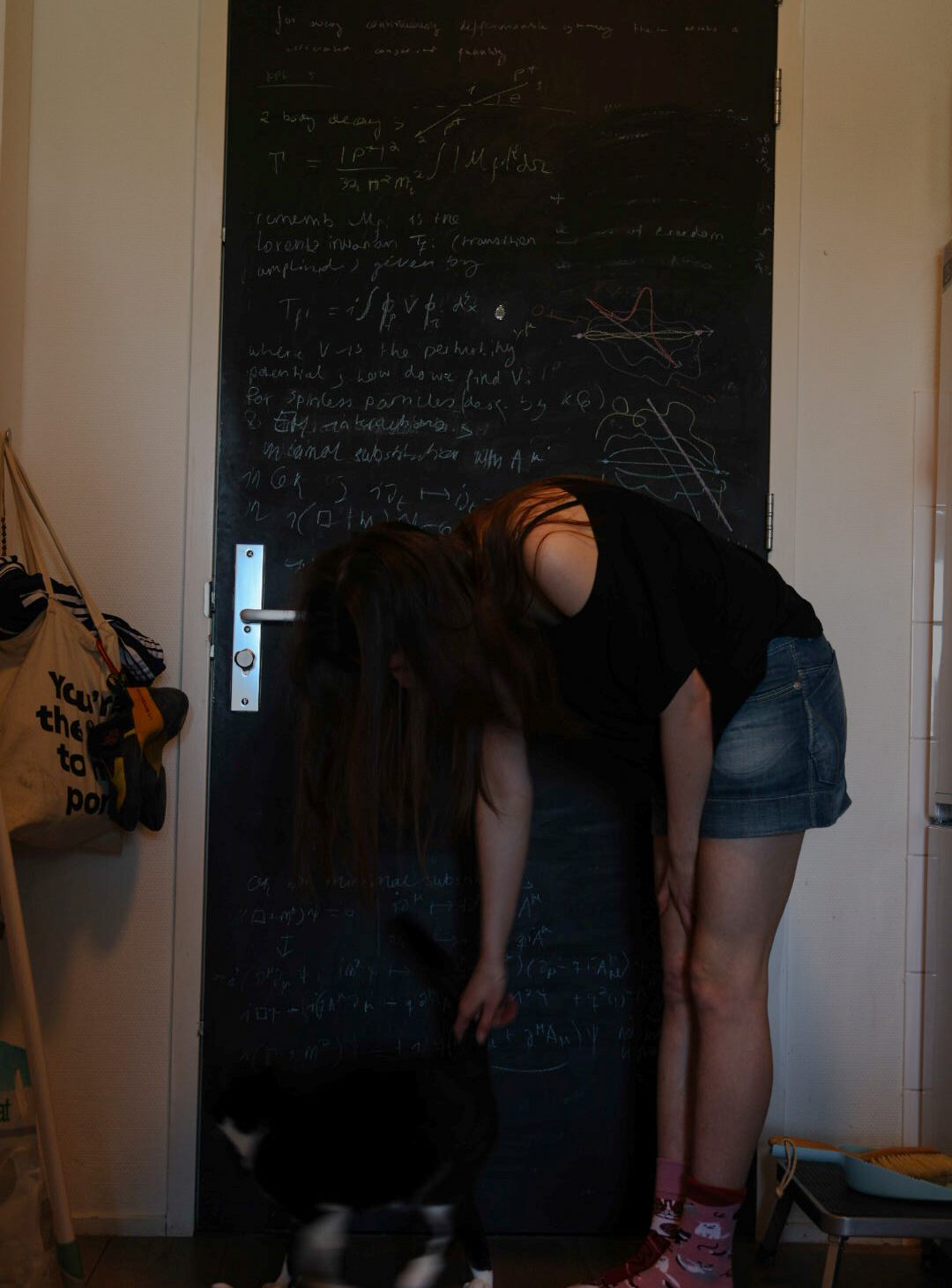
The aspiring academic hopes to study symmetry breaking, a key phenomenon in both particle physics and condensed matter. “They are fields that are generally considered unconnected,” Buijserd-van Nifterik explains. “And I would be lying if I said that I wasn’t a little bit charmed by quantum gravity attempts and theories.” When asked to elaborate in layman’s terms, she says, “Currently, we have quantum physics and general relativity, and those are the theories that describe the small and big things very well, respectively. But we don’t have a theory that accounts for both quantum physics and general relativity. Like the theory of everything.” On a similar note, her capstone is about rewriting quantum mechanics so that classical physics can be used. As for how it is going, she says that it’s been tough balancing workload, as the capstone requires her to have good stress management.
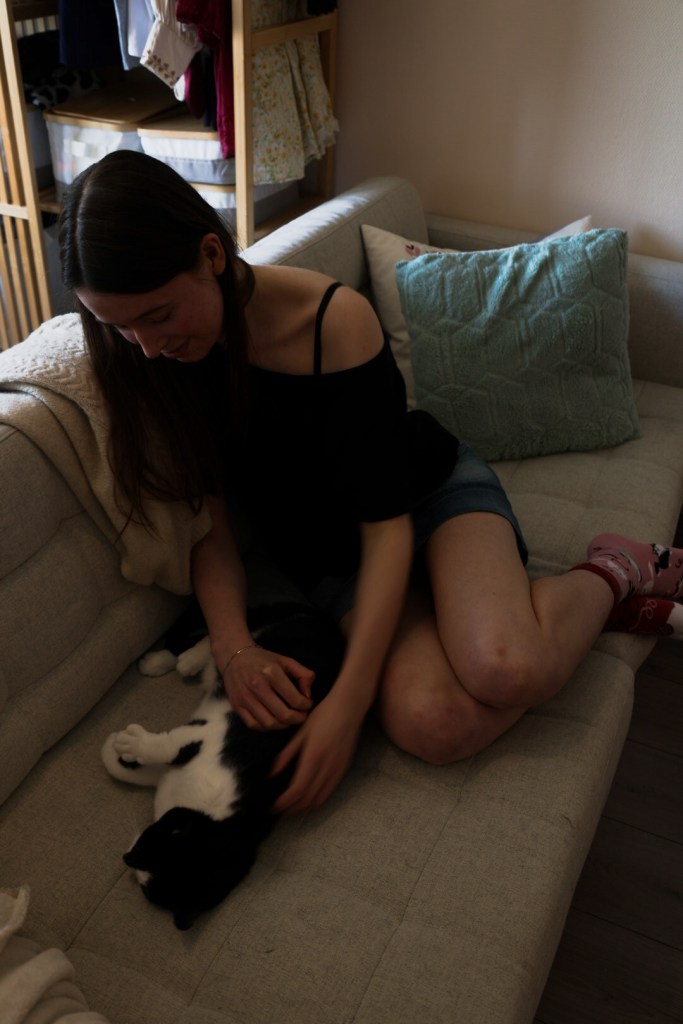
Her cat Oreo, who moved into the dorms in December, has helped with that. The feline-lover explains, “I think in general, being with cats kind of helps me not overthink a lot, because when I’m with Oreo, I really have to pay attention to how she behaves and what she likes, what she doesn’t like.” She also believes that cats can help autistic children with developing social skills, as it is a way to practise social interactions in a safe environment. “I’m sure they also help with emotional regulation in some capacity,” Buijserd-van Nifterik adds.
Reading has also been useful in helping Buijserd-van Nifterik destress. As the co-founder of TopShelf, AUC’s reading committee, “reading is mostly like escapism” to her. One of her favourite authors, Brendan Sanderson (who, Buijserd-van Nifterik emphasises, she “doesn’t like as a person”), writes great high fantasy books. Her favourites of his are The Stormlight Archive and the Mistborn series. “Sometimes I get quite overwhelmed with everything that I have to do for school, for life, and then it’s nice to get into a fantasy book and forget about everything for a little bit,” she elaborates.
When asked about general advice she would give to first- and second-years, she emphasises focusing less on grades. “I wish I had loosened up a bit earlier […] I think the only situation in which your grades are really important is if you’re applying to schools like Cambridge, Oxford, or the Ivy League [institutions]. But otherwise, especially for Dutch universities, […] they really just care about whether or not you passed your degree.”
In Buijserd-van Nifterik’s words, “I think what is most interesting about my story is the way I still perceive myself as the person that got held back a bunch and didn’t do well in school in general, […] but [my friends and I] were reminiscing about our first year and before AUC. And [my friend] said that I’m basically unrecognisable. […] Now I want to pursue an academic career.”
 The Herring