
Correction 11.06: Snacks in the second intermission were originally written as sponsored by the CREA Café, which is incorrect. They were paid for by the TEDxAUCollege team.
Correction 16.06: Speaker Lara Gleim stated that almost a million people above the age of 70 live alone in the Netherlands. This was initially written as over a million.
By Cadence Chua
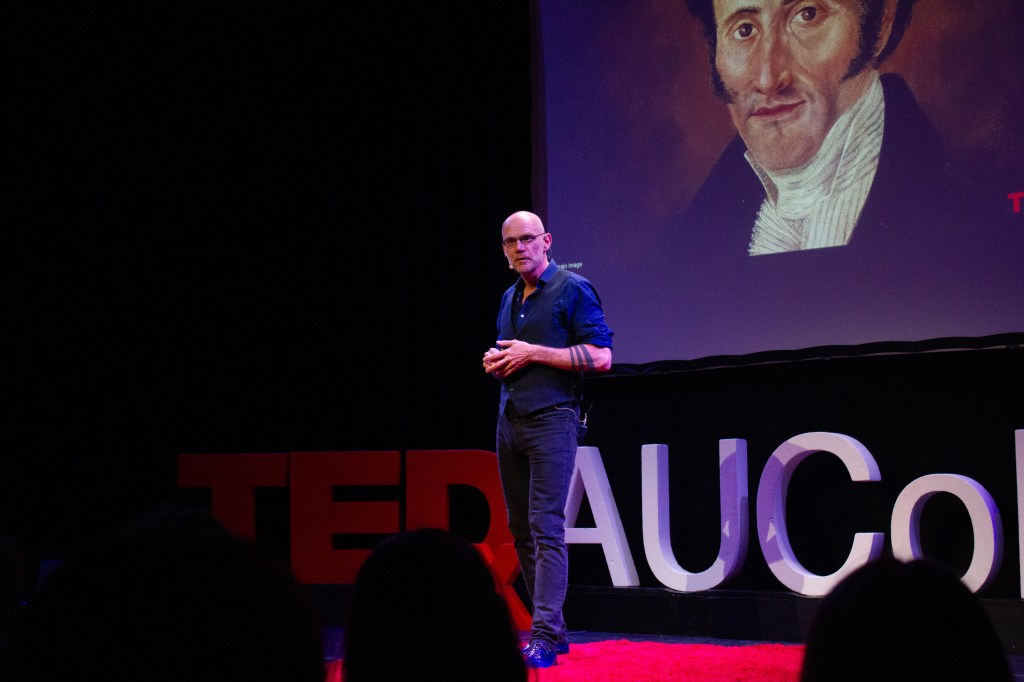
On 6 June, TEDxAUCollege, a yearly conference designed to spark thoughtful conversations around a given theme, was organised at CREA Amsterdam. TED is a non-profit organisation that posts free talks online, with the slogan “Ideas Change Everything”. According to their website, TEDx events are “planned and coordinated independently”, and TEDxAUCollege is one such event. This year, AUC’s 20-strong TEDx team, supported by AUCSA, envisioned the conference around the theme “What’s Next?”, with eight academics and AUC students taking the stage to share their ideas.
The conference was divided into three sections: Power and Self, Systems, and Community. The first part saw three speakers: Byron Adams, Joyeeta Gupta, and Franka Baum.
Adams, a self-described “Interdisciplinary Identity Psychologist”, is an Assistant Professor in the Department of Work and Organisational Psychology at the University of Amsterdam (UvA). The South African native’s talk, titled “Who gets to define you? Identity in a world that classifies”, pointed out that identities are shaped and partially written by systems that “do not consult us”. He cited his lived experience of growing up in South Africa during apartheid, stating that “some children are worth more than others”. To counter this issue, Adams urged the audience to consider three ways to shift their thinking. Firstly, the what: to question the labels they use in the stories they tell, and start noticing how we categorise others. Next, the who: to expand who tells the stories and ask who is in the room. Lastly, the how: to allow for complexity and not simplify or reduce others.
Following Adams’ talk, Gupta was welcomed to the stage. Gupta, a Spinoza prize winner and Professor of Environment and Development in the Global South at the University of Amsterdam, highlighted that “it’s time for a global constitution”. After outlining the economic, social, technological, and financial issues that currently plague the world, she proposed “a system of principles that can deal with these sectors at the same time”. She underlined four governance options that can be taken against them: a neoliberal capitalist system, a hegemonic one, a polycentric, bottom-up system, or global multilateralism. The Spinoza laureate suggested that the first three ways are insufficient to counter complex issues of our time, and that the last option, or a global constitution, is needed. “We are in a crisis moment right now with the biodiversity and climate emergency, major inequality crisis, debt problem, and AI.”
AUC student and first-year Social Sciences major, Franka Baum, then closed off the segment with her speech “Beyond the Optimised Self”. She opened with the question, “What if trying to improve yourself is the problem?” Baum brought up the phenomenon of ‘looksmaxxing’, an online trend of enhancing your looks by any means possible, as an example. “We are not projects,” she said. She also questioned how to make the world a better place without self-optimisation. She then posited that self-optimisation and realising one’s potential are actively opposing one another, and that the former creates a loop of competition that leads to us forgetting “how to build real community because it’s not rewarded by the system.” She suggested that being more spontaneous and doing things for the sake of it instead of for “improvement” could give us energy for community again.
Following an intermission with second-year Social Sciences student Tijmen Schik on the piano, the host, third-year Sciences student Greta Boccaletti, welcomed the audience back for the second part of the event. This next segment focused on Systems, with speakers Vitor Vasconcelos, Mark Deuze, and Jonas Dornieden.
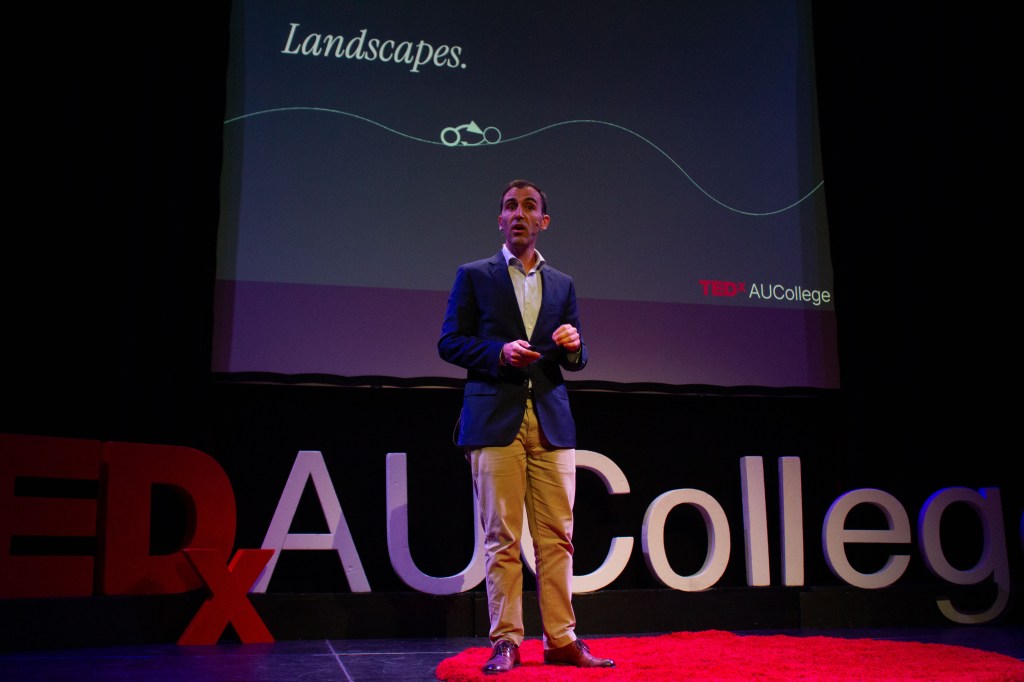
Vasconcelos, Associate Professor at the UvA’s Computational Science Lab, spoke about “unravelling complexity”. His field of work, complexity science, “helps us understand what might be changing when the behaviours that we want to change are not”. The academic then suggested that computational models of collective human behaviour, used to plot out complex systems, could point us to solutions to complex problems. These models produce “landscapes”, which collective behaviours navigate, and which let us see beyond where we are. When we intervene in complex systems, we have to be cognisant of two possible effects. One is that we might not affect behaviour we want to change and only slightly change the landscapes, and the other that there are always unintended consequences. This, Vasconcelos pointed out, is why we build models. He closed off by saying that we need more sophisticated models to anticipate whether the landscapes we built are changing, and we need to broaden our vision through inter- and transdisciplinary collaboration.
The second speaker in this part, Deuze, UvA Professor of Media Studies, explored “how to live a good life in media”. He highlighted that “we don’t live with media, we live in media, and there’s no outside to it”. Three perspectives about this were then brought up: war against media, surrender to media, and become the media. The first, Deuze outlined, included worrying about screen time and trying to unplug. The second is an attitude of acceptance that the media is here to stay and that we have to find literate ways to deal with it. The final one is related to building our own internet and platforms. The professor believes all three are valid, and that we need to think about the media in five different ways: firstly, to forgive ourselves and the people around us for using it. Secondly, to understand that the media is as magical and messy as we are, and that we cannot control it. Thirdly, to think about it like food and achieve a balance of different media usage. Fourth, to invest in media literacy and appreciation, as it develops at a breakneck speed. Finally, to figure out what’s next, listen to artists and invest in art.
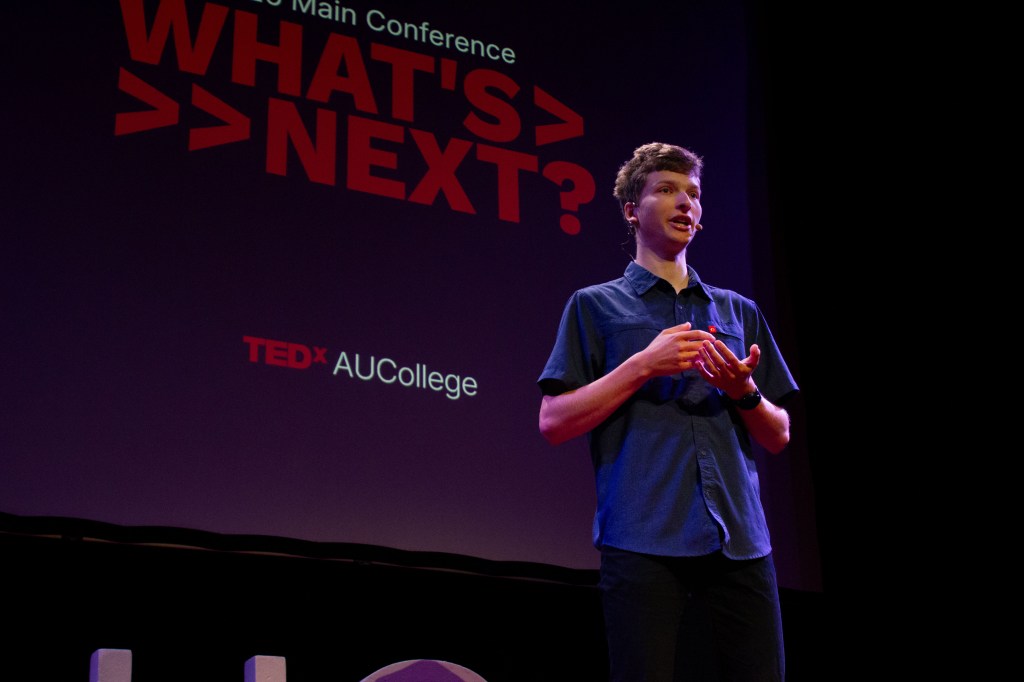
Finally, third-year sciences major Jonas Dornieden compared education to chess and suggested possible visions of “the future of education”. In chess, losing is completely expected, and even top chess players do not have win rates higher than 65 per cent. In the game, players will usually know they’ve made a mistake before their next move, and this immediate feedback allows for learning. However, in schools, feedback is delayed. He believes that the structure of feedback in schools could be improved. The student also said that we need to “rethink the matrix we use to judge learning”, and think about failure as “feedback, and not a verdict”, and about “the self, and not comparison”, just like in chess. Serious reforms might be needed to achieve this, such as the eradication of standardised tests. To close, Dornieden said that “humans learn best through feedback and adaptation”, just like modern AI. Yet, machines can fail without judgment while humans attach feelings of embarrassment to our mistakes. The chess player then asked the audience to question if we “want students who avoid mistakes or those who can recover from them […] if intelligence is measured by minimising mistakes, machines will always win”.
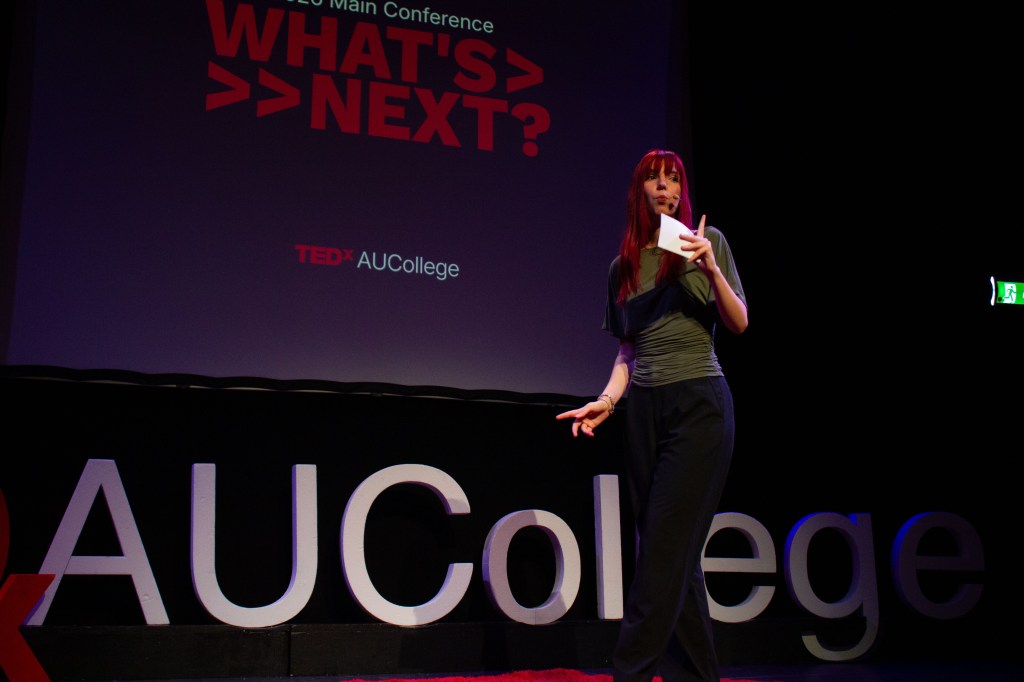
After a second intermission with snacks from the CREA Café, the final speakers, Lara Gleim and Bernet Elzinga, shared their ideas related to community. Gleim, a third-year sciences major at AUC, spoke about the “potential of intergenerational living”, hypothesising that it could solve the issue of loneliness amongst the elderly and the housing crisis for students and young professionals at the same time. She suggested that intergenerational living could function as a social safety net for people of all ages. Almost a million people above the age of 70 live alone in the Netherlands, she said, and anxiety and stress are partially caused by loneliness amongst this demographic. Simultaneously, more than two million people above the age of 16 provide informal care to someone in the country, and that care is invisible until its loss. Intergenerational living could reconcile these two statistics, allowing students and young people to help care for or provide company to older people, while mitigating the issue of expensive housing in many big cities.
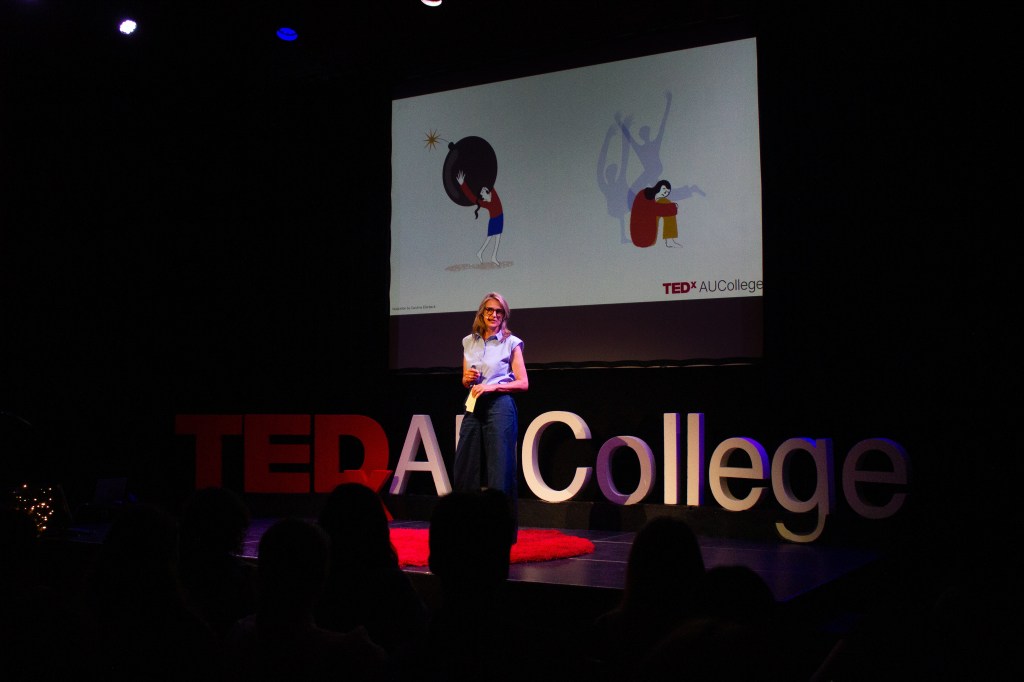
Last but not least, Bernet Elzinga, professor of clinical psychology at Leiden University and another Spinoza prize winner, presented “the ecology of mental health” and the causes and effects of intergenerational trauma. She suggested that depression is deeply ecological in nature, and through a study that she and her team did, they discovered that when families have adolescents with depression, loneliness and disconnection in the family often occur. These effects also “ripple into the future”, and lead to a higher risk factor for depression later in life. When the adolescents become parents, their children are also more likely to develop depression. Elzinga then proposed that to get back into a healthy cycle, parents could change their environment to include a safe space and a brave space, respectively, for their children. “When the parents change, the system changes and the atmosphere within families [becomes] softer,” Elzinga found. She also suggested that for those who did not grow up with present parents, they can still change the environment they are in now. This can be done by creating their own safe spaces through community and sculpting brave spaces by pushing boundaries. “Even just painting your room another colour is part of it,” she suggested. Finally, Elzinga closed off with a poignant sentence: “The question is not, ‘what is wrong with me?’, but, ‘what in my environment can I change?’”
During the event, The Herring also spoke to organisers and participants about their thoughts. Saanika Sudeep, a first-year humanities major and member of the acquisitions team, said that “the TEDx family is so inviting and wholesome, and it was such a fun experience to be a part of this club”. She shared that she developed new skills through her time as part of the team, having to reach out to companies and “walk through people’s doors and ask them for sponsorships”. Antamar Thiam, a first-year social sciences major, shared that the talks were really interesting for her, and she would “100 per cent come to TEDxAUCollege again next year”.
 The Herring