
By Komari Machida
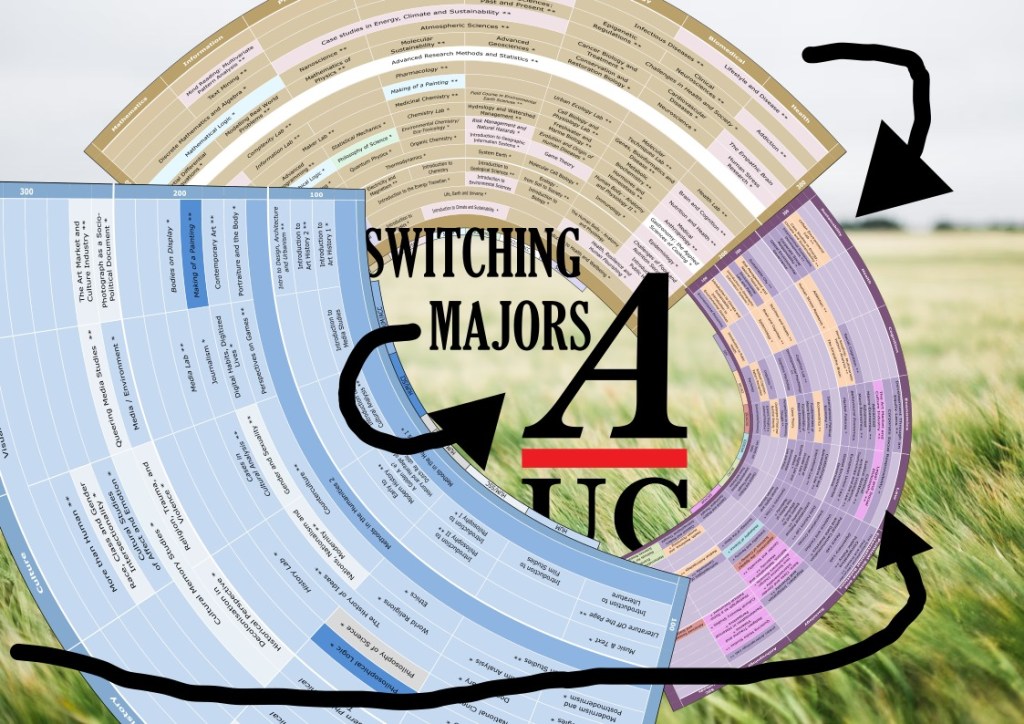
“Don’t just choose a degree. Create one.” As the AUC official website boldly claims, interdisciplinarity is central to AUC’s identity. Rarely is anyone doing just one thing.
However, some students have made more significant pivots to their educational journeys than others. The Herring interviewed four students, who have switched or are in the process of switching, to document their experiences: their thought processes, administrative hurdles, and any advice they have to offer to those who are considering switching.
Factors that Caused the Switch
First-year Humanities student Timea Hauzer came to AUC with the intention of studying philosophy. However, she started rethinking her path in her first semester after taking some courses. “I feel like I love [deep, philosophical] questions when I’m having a drink with my friends,” Hauzer remarks, “but I don’t want to actually have a diploma for it”. Now interested in law, she still looks forward to combining her love for political philosophy with her new track.
Similarly, some students, such as Asia Kutela, found new passions through interdisciplinary courses. The first-year Social Science major switching to the sciences, took “Artificial Cognition: Pattern Recognition” and “Psychology” in her first semester, and discovered that she enjoyed the first much more than the second. She still wants to pursue her interest in psychology by taking courses in the cognition track, which, seeing the advantage of being cross-listed, can now count as her Sciences credits.
Others, like Juliette Duriez, were partially prompted to switch due to a disappointment with AUC’s course offerings in the Humanities department. Though Duriez had come to AUC as a Humanities major, planning to pursue her interest in philosophy and literature, she was unable to take either of their introductory courses as they were full in her first semester. The second-year recalls not being “as excited as [she] expected” by the Humanities courses she ended up taking. Instead, she found joy in mandatory courses such as logic and programming, which helped her rediscover her love of mathematics and switch into the Science major. She also found the approach to learning in the Sciences a better fit: “There’s a joy in getting a problem right”. Similarly, first-year Bojana Sudic switched to the Social Sciences due to the vaster course offerings, shifting her focus from literature and languages to international relations.
Conversing with friends also proved to be helpful for many. In fact, Hauzier voiced the importance of AUC’s interdisciplinary environment in shaping her direction. Although she had not taken law courses, conversations with friends in the Social Sciences changed her early perceptions of law. Coming from Hungary, she expected the subject to be approached through an historical lens, and to require intensive memorisation. “I always [thought that] the law is not a creative thing, but here it feels much more focused on critical thinking”, she expressed.
Step-by-Step
Students usually researched their options and mapped out their academic plans before consulting others about their intended switch. Kutela, for instance, created multiple three-year academic plans and found that she would only need to switch two courses to change her major.
Then, students consulted their peers and family members. Surprisingly, the interviewed students did not face any pressure from the latter to stay in their majors. Bojana explained that, “in the end, it’s still the same diploma, and you graduate from the same college”, and that her parents respected her change of direction.
After the mental calculus of solidifying their course plan on Portal, passing the first method course is the only requirement of switching, according to the Academic Standards and Procedures (AS&P). As Kutela noted, method courses serve as a test of fit for the new major. It is important to note that students must have enough room to complete 11 courses for their major, 4 of which must be 300-level courses. This means there is a point where switching becomes difficult, or even impossible.
Student and Faculty Opinions
Although switching seems like a straightforward process in theory, interviewed students expressed that it is not as simple in practice. Some students reported that they received conflicting advice from tutors, the AUC Service Desk, and even the Board of Examiners, which left them confused and stressed. Duriez echoed these concerns, recalling how her friend was advised differently about when to switch. As advised by her tutor, the Sciences major submitted her request at the end of the first semester of her second year, but believes she might have waited too long. She felt like she was “in limbo” when introducing herself as a Humanities major in Sciences courses: “It felt like I lost my [academic] identity [at AUC],” she says, and recommends switching earlier if possible.
It became clear that the range of tutor advice for when to switch, or how to approach the switch, varied. Some stick to the AS&P, while others may consult their colleagues or speak from their own experiences with students. Students such as Hauzer voiced a desire for a more “unified advising process” for switching majors.
Additionally, after switching, students are not reassigned their tutors, which proved difficult for Duriez when asking for advice about specific courses and pathways. On this topic, Dr. Emma Cohen de Lara, the Chair of the Board of Studies, claimed to understand students’ perspectives. However, she expressed that it is often not feasible administratively due to shifting numbers of students in majors and the limited capacity of tutors. Instead, Cohen de Lara suggests that the supportiveness of AUC’s in-house faculties can help bring more perspective and discipline-specific insights. She advises students to seek advice from professors in their respective tracks. Duriez found this to be valuable: “I felt lost, and didn’t know what courses to select for this semester, but it was helpful [to meet with a tutor from the Sciences]”, she described.
Cohen de Lara believes that the option of major switching could serve as an opportunity for students who may not have a concrete direction when arriving at AUC. She claims this option to be especially interesting to those who may not have the necessary high school background for their major of interest. This is often the case for students wishing to move to the Sciences after being admitted to a different major, to avoid the rigorous mathematics admission requirements. Though Cohen de Lara understands this strategy, she finds it to be misleading. “AUC really is looking for a lot of science applicants. It is actually more difficult to get in as a Social Science or Humanities student because we are bound to a certain percentage”, she explained.
She is “pleased” that the option to switch is not up for debate. Although this interview was conducted before the reveal of the potential future “science and technology” direction of AUC, it was clear that AUC and its faculty viewed major switching as part of the college’s commitment to interdisciplinarity and flexible learning experience.
If you’re thinking about switching – what to do
For those who are thinking of switching, the students’ advice was consistent: take the time to reflect, evaluate potential study paths, and try out courses in your target discipline before switching. Duriez suggests trying out some classes with an optimistic mindset, even if one isn’t fully comfortable in their intended disciplines yet. She emphasised that “if you think you’re going to fail, you will never switch”. Kutela reiterated the importance of planning: “Make a plan, look at it, and see if it makes you want to do it”. Hauzer encourages students to talk to people about what they do, even if it’s outside of their interests, to better understand other fields.
As a tutor, Cohen de Lara “tries not to make [major switching] a huge decision”. She notes that AUC students pursue a broad bachelor’s degree, which can open doors to many master’s programs. Ultimately, she believes major switching is a personal decision that should be made at the end of the first year. Once decided, she aims to make the process feel more manageable through administrative support (such as choosing courses, checking graduation requirements, and filing requests) in her tutoring role.
Lastly, Sudic believes it is important to consider one’s mindset when deciding one’s academic direction. “There’s two types of sticking in life”, she claims, one of patience and one of complacency. To escape the “comfortable safety of failure”, she encourages students to take a leap of faith into the future they aspire to.
The practical, AUC-wide major-switching process is outlined in AUC’s Academic Standards and Procedures 2025-2026 (AS&P) on page 9, which can be accessed here: Downloads and publications – Amsterdam University College
 The Herring