
By Francesca Garau
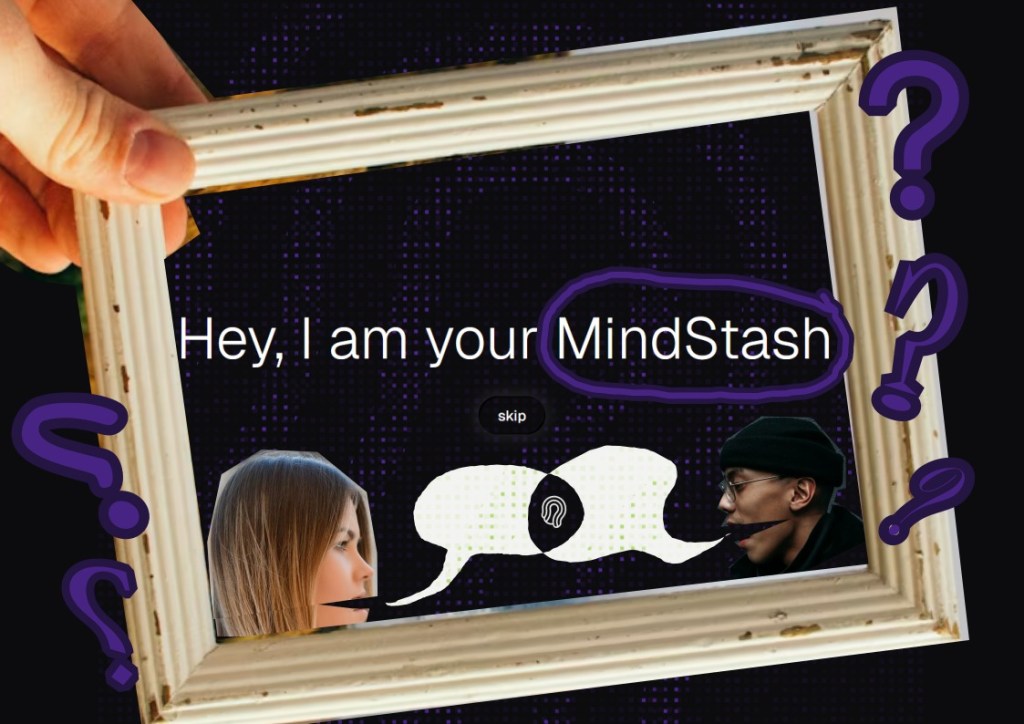
An Amsterdam startup wants to make sure curiosity doesn’t vanish into forgotten tabs and screenshots. In this interview, its co-founders explain how MindStash serves the urge to hold onto what interests us.
You screenshot an article you don’t have time to read — and will never do. You save a recipe you swear you’ll cook. You open a tab, then another, then forget why you opened any of them in the first place.
There is a specific feeling MindStash is built around, which seems to be one of the most recurrent in the digital era. It rises when you come across something online and think: I want to come back to this… not now, later. A quote, a film suggestion, a half-formed idea that feels quietly important. More often than not, it disappears into screenshots, open tabs, and notes, swallowed by the background noise of the internet.
MindStash was conceived as an attempt to break this cycle. The startup was founded by Cosimo Radler and Omer Sharon Gabay, two AUC third-year students majoring in the Sciences, both focusing on Neuroscience along with AI (Radler) and Biomedicine (Gabay). The two met in their first year, and now, with graduation only a few months away, they prepare to launch MindStash to the world this April.
To those who are unfamiliar with it, MindStash may seem no different than any other organizational tool. However, instead of simply storing content, MindStash allows users to capture the fragments of interest in different ways, and integrate them into one place, instead of leaving them scattered across platforms. It also allows users to organise content contextually, in ways that reflect their own mental associations, rather than rigid folders.
Over time, the AI-powered app can learn from what users save: “The more you stash, the more the system understands what matters to you,” Radler tells us. The system can help connections between ideas resurface and make it easier to return to them later.
When asked about the inspirations that led to the app’s development, Radler traces it back to his interest for photography, particularly in his love for analogue cameras. With analog film, each photo matters. You slow down. You notice more. And when the photos are developed, you re-experience the moment. “That’s what’s missing online,” he says. “We don’t really return to what we capture”.
The founders hope to shift the current relationship we seem to have with technology. We’re certainly not anti-tech,” Radler says. “We want [to help people] to use it better. More consciously”. They describe the app as a “second brain”, meant to support a slower, more intentional kind of engagement with online information.
At its core, MindStash aims to reframe curiosity itself: “People think curiosity is a hobby,” Gabay says, “Or something playful, not serious. But curiosity is what drives learning, work, and creativity. Almost everything in our lives.” He explains that many people are curious without even realising it. “If you’ve ever gone down a rabbit hole at 2 a.m., that’s curiosity,” Radler adds, “People underestimate how much curiosity they have”.
However, building MindStash has been anything but simple. “It looks clean from the outside,” Gabay says, “but behind it there’s data privacy, legal questions, design decisions, technical complexity — all at once”. Radler compares, “It’s like flying an airplane while reading its instruction manual at the same time”.
On this note, the founders emphasise the importance of users’ data privacy: “[the app] can learn how you think, and think like you. However, the data stays yours. We don’t have access to it”.
Beyond the app itself, MindStash aims to reach wider audiences via the organization of events, such as the Curiosity Salon. Through it, the founders wish to build a community around shared curiosity by bringing conversations back into physical spaces where people can meet and share their ideas, instead of confining them to digital feeds.
Gabay and Radler speak about 2026 as “the year of curiosity”. Not as a slogan, but as an aspiration. This year, Mindstash becomes not only an app, but a movement for people who want to engage more deeply with what captures their attention.
It began quietly, with that small human impulse to hold on to something that matters, and wish that it won’t be lost. Now, the official app is finally launching in April.
 The Herring