
By Antoni Bańkowski
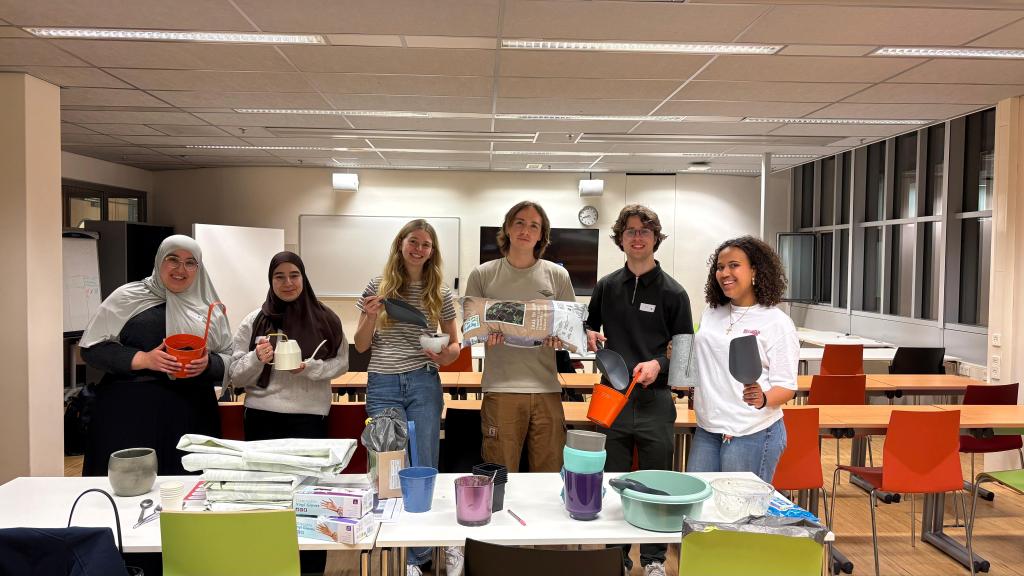
The bareness of Carolina MacGillavrylaan once again prompted UvA to make it a case study for its Placemaking course. This year, students in the program invited residents of the street to participate in a gardening workshop on Monday, 2 March. They showed the locals how to introduce more greenery to the area, while also giving them an opportunity to connect with each other.
The Placemaking course is part of UvA’s Bèta-Gamma bachelor’s degree. It tasks students with finding out what issues are faced by local communities around Amsterdam, and making small-scale interventions to demonstrate potential solutions. Carolina MacGillavrylaan has also been one of the case studies for the course’s last edition.
During the event, students presented the results of their research on the neighborhood, and explained the history of the area. Participants then got their hands dirty with planting seeds in pots, which they could take home and place on their balconies or hang outside of their windows.
The workshop’s organizers spent two days interviewing residents of the street as part of the research phase. They found out that the two issues locals mentioned the most were missing green spaces, and a lack of interaction between students living in the area and other residents.
“The word a lot of people used was ‘functional’,” said Maxine Wijnen, one of the organizers, explaining that a lot of people see Carolina MacGillavrylaan as little more than a street serving its most basic purposes.Wijnen also said that people from one group of residents rarely had anything to say about other groups, explaining that they didn’t know much about them.
The organizers also asked interviewees to point out the least pleasant part of the street on a map. Most often selected was the intersection of Carolina MacGillavrylaan and Kruislaan, next to the underpass leading to Science Park station.
During the workshop, organizers also talked about the street’s history. The land on which Science Park is built was originally a lake, which was drained in 1629. In the 18th century wealthy merchants built their country estates in the area. It became part of the city in 1921 and in 1963 the land was purchased by UvA, which then led the construction of Science Park.
For the practical part of the workshop, organizers divided participants into three groups, making sure that AUC and UvA students were matched with other residents.
Soil, pots, and seeds were provided, and participants could plant a seed of their choice and take it home. Organizers also explained how to make seed bombs, which are ping-pong-ball-sized clusters of various seeds, soil, and clay, meant to be placed in the soil around the street to hopefully result in a plant.
Suus Smid, the organizer whose role was to make sure the participants had opportunities to get to know each other, said that she was surprised by how the attendees “were naturally interested in each other.” She said she “didn’t know what to expect,” and was worried that the residents would have a hard time connecting.
Smid prepared small cards with questions to spark conversation, which participants could grab if they had trouble finding common ground with others. But most attendees didn’t end up needing the cards to chat with others, and Smid said that she noticed that people seemed to really want to interact with residents from across the divide.
Salima El Kahtaoui, also an organizer, said that the event “went a lot better than expected,” adding that a week before the workshop’s planned date only two people had signed up. But after a couple days, 14 residents responded to the invitation. The final number of attendees was 11, a result the organizers were very pleased with.
El Kahtaoui also encouraged AUC residents to start a garden at their dorms building, saying that they can get approval and assistance from the municipality through Amsterdam’s Geveltuin program.
“I am so happy with how it turned out,” said Wijnen about the event, also admitting she was nervous that the workshop wouldn’t go according to plan. “We just put up a poster, we didn’t know who would show up,” she said. In the end, she said it all went as expected, and she feels like, along with the rest of the organizers, they provided residents with “starting points,” which can be used to foster more connection along the street.
 The Herring