
Maike van de Pavoordt and Myrielle Winkelmann
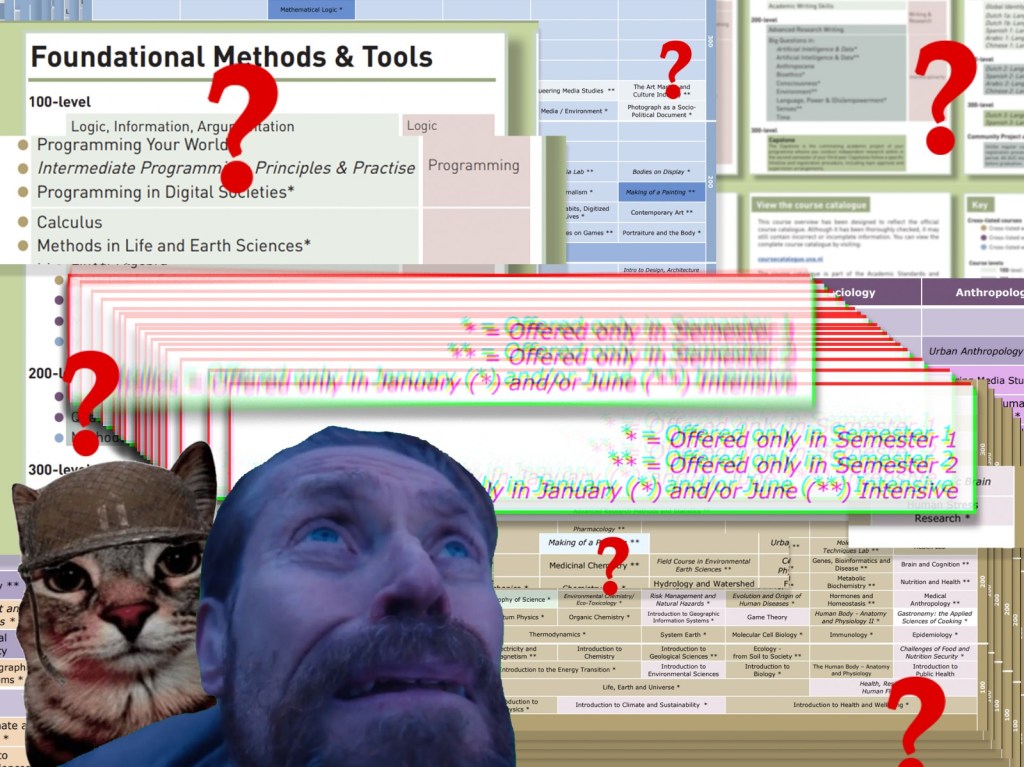
Studying at AUC comes with the promise of freedom and flexibility: design your own degree, based on your needs and interests. In practice, courses being oversubscribed or cancelled makes it stressful for students to pursue a degree that meets both students’ expectations and the requirements for further studies. When course registration results are shared, the reason behind not getting into a course often remains unknown. The question raised: what happens behind the scenes of course registration?
The Bureaucracy of Course Registration
Before student registration begins, the Head of Studies from that major first predicts how many students they expect will register for a particular course and within a specific track. Dr Daniel Kontowski, the Head of Studies for the Social Sciences, explains that predicting demand for future registration depends on several factors: first, how many students will eventually go off-campus; then, how student track preferences change over time; and finally, the distribution of first-year students across the majors.
With the emphasis on 50% Science admissions, alongside staffing complications in the Social Science track, course offerings and student preferences have changed over time. Moreover, revised graduation requirements have affected predictions, such as the cancellation of the language requirement, as well as the requirement for two rather than one course in the other majors.
Throughout the initial course registration round, a minimum of 11 students is set for a course to proceed. After this first round of registration closes, the heads of studies and the director of education have to make some important decisions, explains Dr Erinç Salor-Broberg, AUC’s Head of Studies within the Humanities, “[It] might be that we add a group to [a course] that is very oversubscribed. If it is undersubscribed, we evaluate whether or not we cancel or still run the course even with a small number of students.”
Dora Achourioti, Head of Studies of AUC’s Academic Core, stated that waiting to cancel courses is a risk, as it is deeply undesirable for a course to be “cancelled after the second registration, because then students are really left with no other choice [in courses]”.
Conversely, when certain courses are oversubscribed, students necessarily have to shift to alternative courses. This means that estimations have to be made to determine which courses are allowed for the second round. “In addition to targeting student subscription rates of 11 to 25 students, the study also considers the content and diversity of the material,” Kontowski explains, “This includes the graduation requirements and disciplinary coherence as we don’t want to disadvantage anybody’s disciplinary formation or graduation requirements.”
The Case Study of Language Courses
AUC’s language courses are in a particularly sensitive position within the curriculum due to languages no longer being a requirement. However, it seems that language courses being cancelled is often an issue of bureaucracy and perceived lack of demand, rather than true waning interest on the students’ part. As Achourioti pointed out, students often do not “choose a higher level when they have not yet completed the first level, [and] once they’ve taken the first level, it’s too late to register.”
Such premature cancellations occurred prior to the June intensive Spanish 2 in 2025. In response to the cancellation, students such as Clio Votsis, a second-year Social Sciences major, petitioned to have a Spanish 2 group opened. The reason she was initially so adamant, Votsis stated, was because the Spanish teacher had said that she would be more than willing to teach another group. What followed was a confusing process spanning weeks, as she was told by Achourioti that opening Spanish 2 would not be possible, whereas the service desk told her that as long as the teacher was available and there were a sufficient number of people interested it would be possible to open up a class. Although Votsis eventually gathered the names of 11 students interested in taking the course, Spanish 2 was not initially reinstated.
However, during the June intensive, the Contextualising Spanish 1 group was eventually split due to a discrepancy in skill. Votsis was neither informed of the reinstatement of Spanish 2, nor permitted to audit the course. This lack of communication, she said, is what frustrated her most: “All of the emails, all of that effort, just for them to run the course while excluding the people who wanted to do it first.”
Students such as Votsis tend to be frustrated less by the fact that a class is occasionally cancelled and more by the process through which it happens: “I can understand that funding might be a problem to get these classes to open up, but it just felt so frustrating – our interests were being disregarded for systematic convenience. It felt like they weren’t willing to go out of their way to accommodate what students want to study, even though that’s the whole reason we’re at AUC.”
Dealing with the Challenges
When asked about potential ways around the shared concern for undersubscription cancellations, Salor-Broberg encourages students to take slightly more adventurous course choices: “People pick the courses that everybody else picks, and they are obviously extremely good courses, but so are the other ones. From where we’re sitting as a team, we have difficulty understanding why this one has 50 students, and the other one has 12, because it is not 4 times more relevant to people’s study interests.”
These surprising registration peaks lead to, in Salor-Broberg’s perspective, an unfavourable situation: “If everybody goes into Course A, and then at the end of the first round of registration I end up cancelling two other courses that are possibly comparable, or speak to each other, then what happens? These 25 students need an alternative, but the alternatives got cancelled. So now they’re frustrated, and the people who did sign up for the ones that are cancelled are also frustrated.” As choosing ‘adventurous’ requires students to know in advance which courses are in high demand, the proposal can seem as much like reaching an impasse as the undesirable cancellation of courses with low registration, which it aims to prevent.
Regarding the language courses, Achourioti stated that “students fear that the language courses that they would like to choose will be cancelled, and therefore do not choose language courses, which is basically going to mean that they will be cancelled – a self-fulfilling prophecy.” When asked what she hoped for in AUC’s future dealings with course cancellations, Votsis remarked that she hopes to see AUC provide consistent answers across the service desk and coordinators, as well as provide “a place to look at to find out what is changing, what courses AUC is not going to have, what courses they are going to have.”
Changes and updates to the curriculum for the upcoming academic year can be found in a transitional manual on the AUC student website. However, as the document is published only once per academic year, changes made on short notice are not always reflected in the transition manual. Salor-Broberg emphasised the importance of students communicating these struggles to AUC management. As he points out: “It’s always obviously disappointing when we try so hard to compile all the information people need to know in order to make informed decisions. If there is a large body of students that are not informed about it, then that means we need to […] be a bit more communicative about where to find the information.”
 The Herring