
By Maria van Wijnen
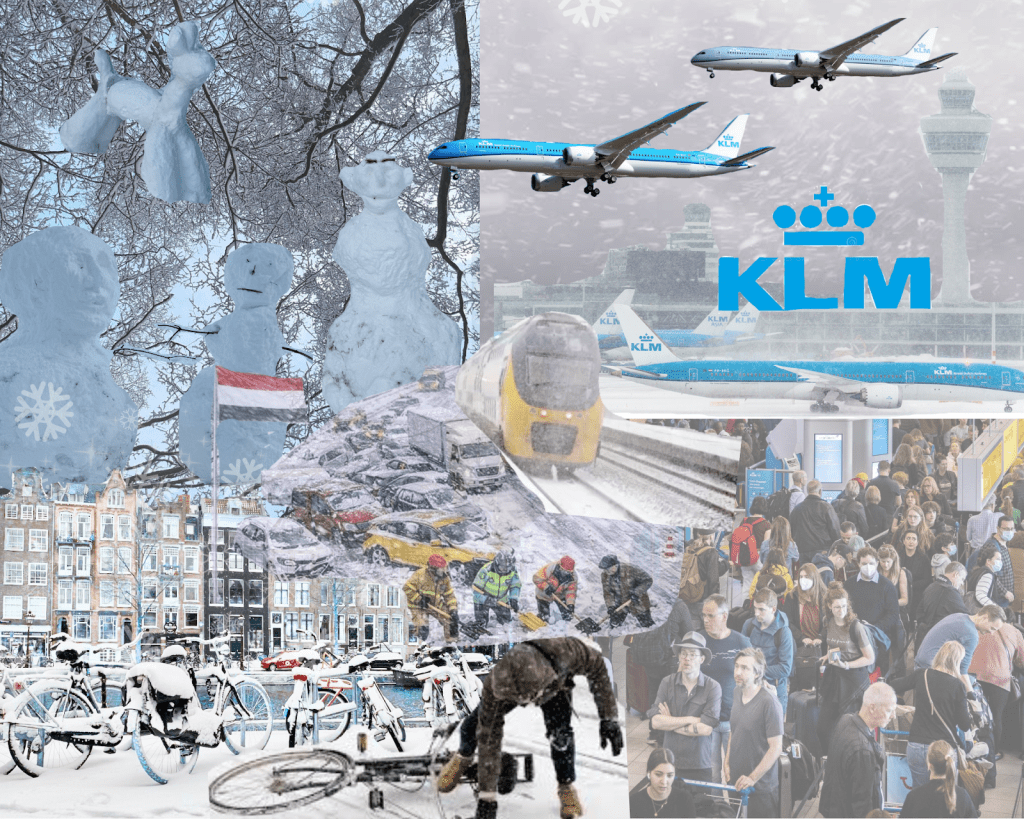
2026 began with a shocking twist as Amsterdammers woke up on January 5th to a layer of snow, which would continue to grow over the next few days. Snow has become exceedingly rare in the Netherlands, likely due to climate change trends, as indicated by the Royal Netherlands Meteorological Institute. The NL Times reported that by the 3rd day of snow, the Netherlands had already experienced the most snow days in five years. This winter wonderland led grown adults to cover Flevopark with silly snowmen, playfully throw snowballs at each other, and go sledding on various makeshift sleds, including trash bags, with childlike glee. The city centre also looked stunning as picturesque Amsterdam architecture was dusted by snow and lit up by Christmas lights, not yet taken down. However, the snow was not all fun and games, especially in a country so poorly prepared for this unexpected weather.
Many people in the Netherlands rely heavily on biking as their main form of transportation; however, the thick snow, which later turned to ice, made this quite hazardous. Several videos of cyclists and pedestrians comically slipping and sliding over canal bridges in Amsterdam have gone viral on Tiktok, Instagram and X with tens of millions of views. When paired with goofy music, such videos are quite entertaining; however, much less funny when you are the one landing on a harsh tarmac. For those unwilling to risk biking, many turned to public transportation. Unfortunately, almost all trains, trams, and buses were cancelled or delayed due to the weather conditions. These issues were consolidated by an NS IT issue. Thus, the entire week of the 5th-12th was plagued with major transportation delays and scheduling issues alongside dangerously slippery sidewalks, bike lanes, and roads.
January 5th also marked the first day back at school after the holiday break for all AUC students enrolled in intensives or CP/Is; however, many students were unable to return due to weather-related international travel disruptions. According to the Guardian, over 2,000 flights to Schiphol Airport were cancelled due to the snow, and countless others were delayed or facing additional complications. Laura Herberg Fernandez, a 2nd-year Social Sciences student, was booked on a KLM flight from Portugal to Amsterdam on the 4th of January, which was cancelled the night before with “zero alternatives.” They rescheduled another flight themselves for the 7th of January, which was once again cancelled the night before. Every alternative flight was “minimum 600 to 1000 euros one way.” When seeking a refund, Laura was simply given an error message. They booked another flight with a Portuguese airline for the following Saturday, meaning they had to miss one of four weeks of their intensive course. Despite this inconvenience, they joke about being lucky to have “enjoyed time in the sun rather than being stuck in snow and ice.” They received an apology by KLM’s CEO, Markan Pintel, which was also shared by the NL Times; “The problem, of course, is when you have to rebook 300,000 people and 70 percent of your flights are canceled because there is no capacity at the airport to fly, it’s very difficult to say: you’re going tomorrow, because tomorrow your flight might be canceled again,” Rintel said. “But …you still have to be there for all your passengers, to help them.”
Liam Macreery, a third-year Humanities student, suffered a similarly chaotic return home after the holidays. Liam had a transfer in London where their flight was cancelled, citing weather issues complicating the final landing in Schiphol. After hours of calling various airlines, an overnight stay, a series of frustrating miscommunications, and a “throbbing leg” after a suitcase was dropped on them, Liam finally arrived home 30 hours later than expected. They are also forced to “use Christmas money” to pay 70 euros for an Uber to the dorms after all trains were cancelled. Liam is spending their January working on a CP/I, and is now “basically two full days of work behind on [their]hours,” which has led them to “work extremely hard just to meet that requirement.” They expressed frustration with the situation, claiming, “No matter what you put me in press releases, you cannot tell me a northern European country is totally unprepared for this weather.” Rhea van den Bosch, a first-year Humanities student, was also a victim of the snow-induced disarray. Rhea arrived at Schiphol on time on January 5th; however, her flight spent an extended time taxiing, and visibility from the windows was extremely limited. She noted that while the airport was typically busy, it carried an unusually “agitated” atmosphere. At the baggage claim, there was an announcement that “all KLM flights were not unloading baggage,” which was met with a collective groan. She was immediately stressed because her carry-on luggage had been forced to be checked in, meaning she did not have access to her computer or charger. She spent the first week of her January intensive contacting KLM, Delta, and Schiphol in search of information about her luggage, but received none. After going to Schiphol in person, she was informed that the snow had resulted in“tens of thousands of bags not processed.” Finally, on the 13th of January, her bags were shipped to the dorms. Neither KLM nor Schiphol has given any explicit information about the compensation she is owed. This mishandling of baggage occurred less than a month after a major failure in Schiphol’s baggage return system, which resulted in more than 20,000 bags being left stranded at the airport. Both Schiphol and KLM have a long road ahead of them to regain trust and a more positive reputation. In the meantime, AUC students are catching up on work and holding on for the last week of intensives before a much-needed week of break filled with hot chocolate, fresh cookies, and (hopefully!) warm showers.
 The Herring