
By Stefania Zajdel and Cadence Chua

For no two people in the AUC community will the winter break be the same, but for many of them, it will be a chance to connect with their cultures and families. In the Netherlands December is almost synonymous with Sinterklaas and Christmas, but this isn’t the case for all corners of the world. So, as AUC gears up for the last exams of the semester, The Herring spoke to a couple of students about their plans for the upcoming winter break – a welcome break from the hustle of the academic year.
Indigo Morgenstern, a first-year Science student, looks forward to going home to San Francisco, United States, and celebrating Hanukkah. She shares that a symbol of the holiday is the menorah – a candelabra with nine candles, with one lit every night. As she will only be home a few days after the start of Hanukkah, she will miss the first part of the celebrations. However, she is still eager to celebrate it, saying that doing so “invokes the memories of all the Hanukkahs before for me.” As a child, she always got to pick the colours of the candles, and it made her feel like she played an important role, she explains.
Potato latkes, a type of pancake with grated onion and potatoes topped with applesauce, are also a special treat Morgenstern misses. She says that her friends would sometimes celebrate together on the eighth night of Hanukkah and eat the latkes together.
A native San Franciscan, Morgenstern also has plans to visit museums in the city for free before she turns 19, as museums in the city offer free entrance for visitors under the age of 19. Apart from the famous de Young Museum and the San Francisco Museum of Modern Art, she will also be going to the Exploratorium. “It’s a science museum, like no other!” she says. With tons of mini experiments and contraptions, the Science student looks forward to exploring exhibits on coastal phenomena, light, sound, astronomy, and more at this museum.
On the other side of the Pacific, Komari Machida, a first-year Science student, will be heading home to Japan for the winter. She is enthusiastic about celebrating Oshōgatsu, the Japanese New Year, with her family. In Japan, Christmas is mostly just a commercial holiday, while Oshōgatsu, which falls on the first of January, is considered to be more important. Something typically done on the day of Oshōgatsu is eating soba – noodles made from buckwheat flour, served in a broth topped with ingredients like shallots or seaweed.
Machida also shares that a lot of Japanese watch Kōhaku Uta Gassen, a New Year’s Eve television special that brings together prominent celebrities and artists, on the night itself. When explaining this, Morgenstern chimes, “Is it like America’s Got Talent?”, to which Machida responds, laughing, “Yes, but more prestigious!” Even though the show mainly brings back more veteran celebrities, she likes to watch it to culturally connect with her grandparents and her parents more familiar with the artists.
On the eve of Oshōgatsu, one will hear bells rung in temples across Japan, with the final ring marking the start of the New Year. When asked if Oshōgatsu has a religious aspect to it, Machida explains that to her it resonates as a more secular cultural practice, but, “What’s interesting about Japan is that the Shinto practices and the culture are very blended together, so we don’t know if it’s a cultural or a religious thing.”
Oshōgatsu is also a holiday where younger family members receive money, known as otoshidama, from their elders. “I now have to give my brother money,” Machida laughs. “For Hanukkah, we don’t get real money, we just get chocolate money,” Morgenstern answers in response.
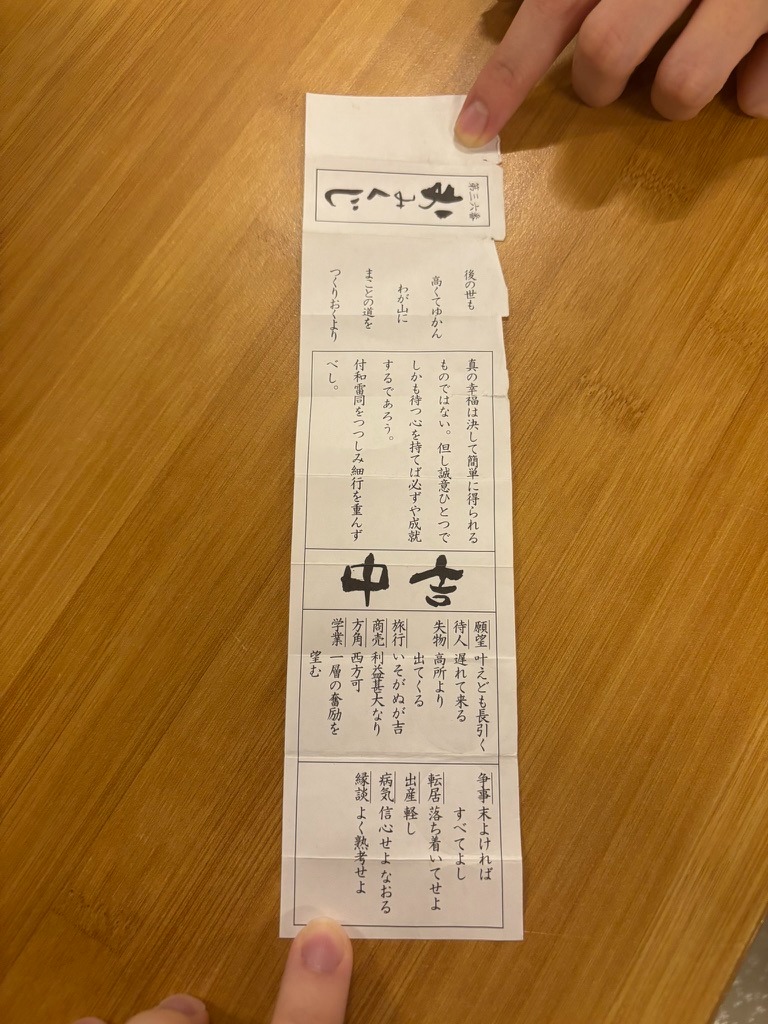
After the New Year begins, Machida’s family goes to a specific shrine near where they live every year to get omikuji – paper slips that predict what one’s year will look like. The omikuji describes one’s fortune and offers specific advice for various areas of life, such as academics, business, or family. Machida says that her omikuji tells her to work harder for her academics. “Have you [been doing so]?” Morgenstern asks. “Yes!” Machida says, laughing.
Despite going to Thailand for almost two months, Pam Pam Patthanadettrakul, a second-year Science major, faces the unfortunate situation of coming to Thailand just in time to miss all the big celebrations. She will arrive too late for both Loy Karathong, a festival annually celebrated all over Thailand, and Yi Peng, an event specific to its Northern Part. She was hoping to participate in the Lunar New Year, the exact date of which varies from year to year, but in 2026 it falls on February 17th, a little more than a week away from the date of her return ticket.
The only thing Patthanadettrakul will get to celebrate is the Western holidays. “I will definitely be going to little [Christmas] markets and festivities, since there are quite a bit of them in Thailand,” she says. She also wants to visit the Thai temple for the New Year.
A big part of Patthanadettrakul’s plan for her two-month long break includes spending time with family members whom she hasn’t had the chance to see in a long time. There is a lot she is excited about when it comes to the trip, but one thing stands out from all others: a concert of one of her favourite Thai bands, who, unfortunately, are planning to disband soon. “That’s one of the main reasons I decided to go back,” she laughs. Tired of cooking her own meals on a student budget, she’s also looking forward to eating some good home cuisine. Having tried a few Thai restaurants in Amsterdam, she has realised that nowhere will it taste as good as at home.
As for some snowy adventures, first-year Social Science student Maja Mills will be headed to Umeå, Sweden, to visit her cousin, who is doing her Erasmus programme there. She will also be meeting with her mother and her aunt. “I’m excited about seeing the snow and being surrounded by the real winter climate,” she says. The Northern Lights are also visible from the area, which is a real delight she is looking forward to.
As for cultural activities, Mills, who is from Poland, says that she has had a family tradition for the past three years of going to a Swedish choir concert in Warsaw for the Swedish Saint Lucia’s Day. The choirs usually wear white gowns, with one wearing a candle crown to represent Lucia, a prominent martyr. Saint Lucia’s Day is a feast day celebrated most commonly in Scandinavia, Italy, and the island of Santa Lucia. Mills and her family also plan to go to a similar Saint Lucia’s Day concert in Umeå while there.
Regarding her other plans, Mills will be going home to Warsaw and meeting up with friends. When asked about Polish Christmas traditions, she says that her family usually celebrates the holiday with the extended family. For her, this looks like around 20 people. They usually start the night with reading the Bible, and then taking Communion together. Every member of the family takes a wafer with Christmas iconography printed on it, and passes around the wafers to everyone individually, while exchanging well wishes. One then breaks off a little bit of the other person’s wafer and eats it. “It comes from a really nice place, and I really like the feeling of individually bonding with everyone. You get the chance to hear something nice from every single person and also say something to every person,” Mills shares.
 The Herring