
By Garvan Ó Deaghaidh

“UvA UvA, you can’t hide, you’re supporting genocide!”
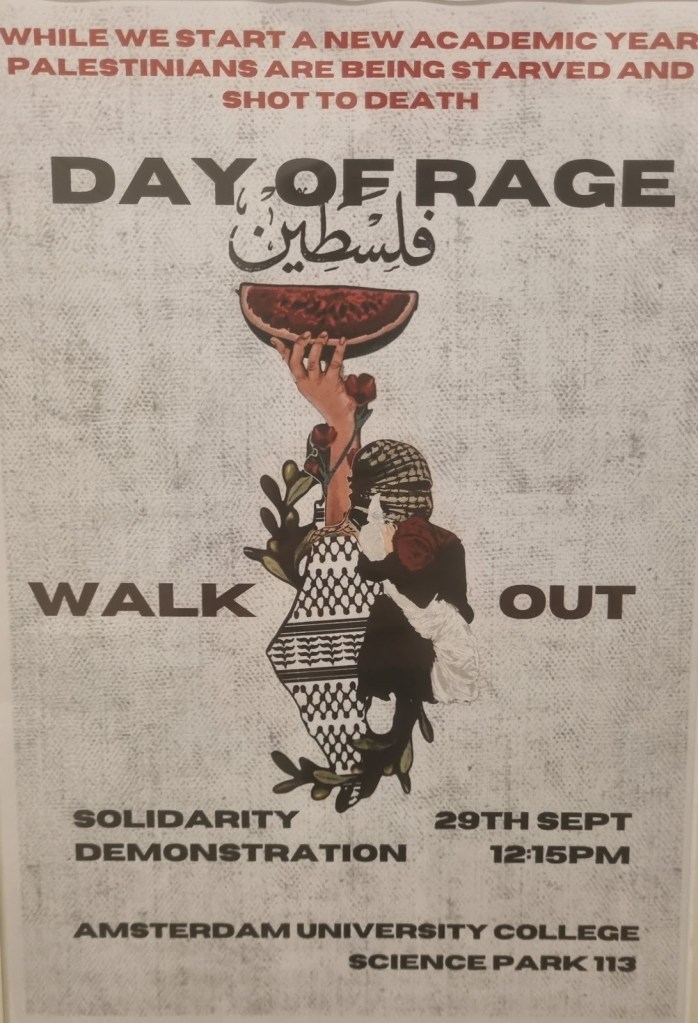
At 12:15 p.m. on the 29th of September, streams of AUC students filtered out of their classes and gathered outside the Academic Building. Chants began, being led by a megaphone. Demands rang out through the science park. “What do we want? Cut the ties! When do we want it? Now! If we don’t get it shut it down!”
AUFree Palestine (AUFP), a student organisation dedicated to “Palestinian liberation,” organised the event. In the caption of an Instagram post, they state: “With chants and speeches, we showed AUC there can be no studying as usual while Israel is committing genocide.”
A walkout is defined by AUFP’s online Student Zine as so: “At a specified time, we collectively leave our classes to express our disapproval with our universities’ response to the genocide in Palestine and their ongoing complicity. Walking out of classes not only disrupts them but also sends a message to fellow students who are not yet engaged to join the protests.”
“The walkout is an important tool for students to show that they care about the atrocities being committed,” says Oli Leppänen, a second-year humanities student who attended the walkout.
Consistently hearing about the event before it happened made Zoe Douglas, a social sciences exchange student, “much more likely to get involved.” Douglas and Leppänen both mentioned being made aware of the event through its promotion in AUC-related WhatsApp groups. The walkout was also promoted on the AUFP Instagram account and through various posters around campus.
Douglas had her Methods for Social Sciences Research class cut short by the walkout: “In comparison to a genocide, missing 20 minutes of class doesn’t seem all that significant,” says Douglas. Douglas and many of her classmates joined the crowd outside the Academic Building after leaving her class.
Oscar Hulley, a first-year science major, had an exam at the time of the walkout. He describes himself as “sympathetic” to the cause, but couldn’t justify missing an exam to attend. He doesn’t feel that his exam, in Introduction to Energy Transition, taught by Dr Misha Velthuis, was in any way disrupted by the demonstration. “I didn’t notice anyone leaving for the walkout, but there may have been people absent,” says Hulley.
The chants outside the AB stopped briefly for a speech from one of AUFP’s members before continuing again. The students stood outside the Academic Building until 12:45 PM, the beginning of the lunch break, then entered the building and assembled in the cafeteria area, many of them sitting on the stairs leading to the upper Common Room. “Marching into the building and taking over the entire lobby felt like a powerful statement,” says Leppänen.
There, they participated in rallying songs, such as “Bella Ciao,” a famous anti-fascist folk song, and “Rossa Palestina,” an anti-Zionist, pro-Palestinian song. Following this, there were three more speeches: first from AUC professor, Dr Misha Velthuis; then from a member of VU for Palestine, introduced only as Ibrahim; and finally from VU professor, Dr Younes Saramifar. The final speech concluded at 13:40, with members of AUFree Palestine then loudly playing drone noises, “They [the drone noises] are meant to signify what Palestinian people hear every day,” says Icarus, a prominent AUFP member and third-year humanities student who wishes to remain anonymous. The majority of the crowd had now dispersed, but shortly afterwards, more chants began, and the final 15 people had concluded their chants by 14:10.
The interim dean at the time, Dr Marianne Riphagen, was seen interacting with members of AUFP on multiple occasions throughout the event. ”The institution had its viewpoint and we had ours,” says Icarus. They stress that the interactions weren’t hostile: ”They weren’t happy about our use of a megaphone, but according to my interpretation, noise demonstrations fall under Dutch peaceful protest law.”
Article 9 of the Dutch Constitution states that “The right of assembly and demonstration shall be recognised, without prejudice to the responsibility of everyone under the law.” There is no mention of noise demonstration in the House Rules and Code of Conduct for the grounds and buildings of the University of Amsterdam (UvA), but it states that “Disturbing or disrupting lectures and examinations is not permitted.”
Icarus doesn’t view Riphagen’s tenure particularly positively: “There hasn’t been much progress in the last few years,” they say, addressing AUC’s continued lack of compliance with AUFP’s demands. Since the walkout, a new interim dean has been appointed: Dr Bruce Mutsvairo, who began his term on October 1st. The Herring staff writer Elea Jürß covered his meet and greet in her article A dean for everyone? – Mutsvairo‘s first event at AUC. The walkout was a significant topic within this event. “Dialogue without any kind of action or attempt is useless,” Icarus says, reacting to the emphasis Dean Mutsvairo had placed on opening a dialogue with students.
Icarus calls on the University to properly listen to its student body and their concerns: ”The entrance hall was full of students united in their demands to cut ties with Israeli institutions.” Douglas also mentions that she felt there was more of an activist atmosphere on campus here than at University College Dublin, her home university, which made it easier to get involved. Leppänen echoes a similar sentiment, saying that as the situation in Gaza has escalated, there has been a noticeable push around campus for students to show their support for the cause.
Icarus stresses that AUC is an institution of UvA and the VU. They note that regardless of whether AUC is directly tied to Israel, it still benefits from its connections: “[AUC] Students go to classes at UvA, do internships, or exchange programs. Living in different dorms or studying in a different building doesn’t change that. There are hundreds of students inside of your student body that you’re [AUC] not acknowledging by refusing to put pressure on UvA or the VU.”
 The Herring