
By Antoni Bańkowski
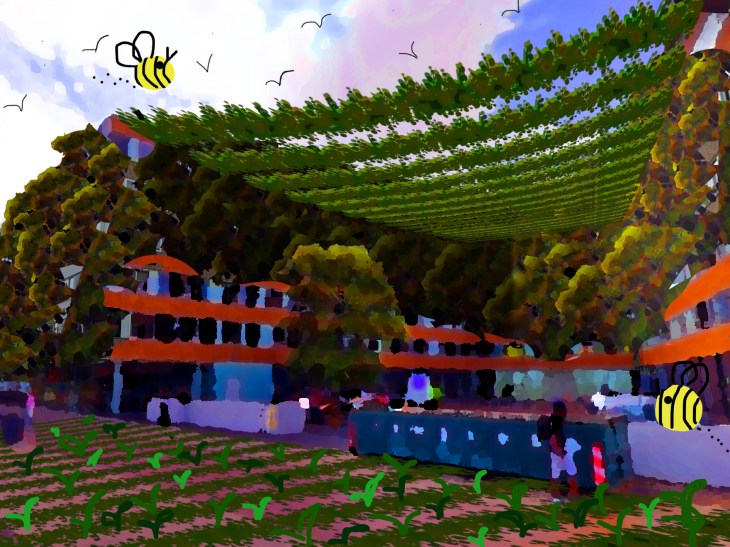
Ever since Carolina MacGillavrylaan was constructed two decades ago, it has been stuck in conceptual limbo. This changed last year, when the municipality officially scrapped its plan to turn the street into a main entryway to the city. Now its original design, meant to accommodate high-volume car and bus traffic, is finally subject to change. But it’s up to the residents to decide what future they want for their neighborhood.
When the street was originally built in 2005, the municipality wanted it to connect Oost district with the A10 ring and allow for a steady flow of cars and buses to enter the city. Currently, those who ride down the street past Science Park reach a dead end, where a short stretch of dirt road marks where the highway connection was meant to be. Amsterdam has failed to secure the necessary budget, and as of 2024, Carolina MacGillavrylaan’s wide, double-lane design remains the only reminder of these ambitions.
It takes one look to see that the original plan valued busy car traffic over resident well-being. The municipality equipped the street with a central bus lane laid on a thick layer of concrete to support frequent bus usage and the zebra crossings are intentionally scarce, so that car flow is not interrupted. The sidewalks are relatively narrow compared to the width of the street, and the bi-directional bike lanes on both sides make crossing the street a bold endeavor. The lack of greenery puts extra emphasis on the bareness of the area. It is no surprise that the neighborhood welcomed the cancellation of original plans with enthusiasm.
Half a year after the municipality’s announcement regarding the plan, residents have come up with a proposal of a redesign. The initiative is called Groene Carolina (Green Carolina), and it introduced itself back in January by distributing infographic flyers to every mailbox on the street. Titled “Residents’ Manifesto”, the brochure explained the proposal and the reasons behind it. Eight residents became members of the committee, each representing a different apartment building. They are facing a long list of issues to solve, but Arjen IJpelaar, who is a part of the team, considers lack of social spaces to be one of top priority. “We are missing the heart and the soul in this neighborhood”, he says. “All I see outside is trains, cars, and concrete.” The infrastructural bareness left the neighborhood with no areas to socialize, which, in his view, leads to lack of community ties. When interviewing residents he found that a lot of them go out to nearby districts, but wish they could socialize right here on their own street.
During my long conversation with IJpelaar more issues emerged, the majority of them stemming from the street’s poor design. He presented research, which shows the effects of lacking greenery – it leads to rising temperatures in summer, which are up to ten degrees higher at Carolina MacGillavrylaan than in nearby areas. Tall buildings on each side and lack of trees tunnel the Eastern winds down the street at extreme speeds. Noise is amplified by the concrete facades and lack of foliage, which would soften the sounds. According to IJpelaar, this leads to residents being often disturbed, especially with cars racing on the empty bus lane during the night. Additionally, Groene Carolina manifesto mentions that the traffic flow of the street is counterintuitive and the intersections unsafe for pedestrians, having allegedly caused multiple accidents in the past.
What is the solution? Groene Carolina considers removing the bus lane to be the key to it. The seven-meter-wide lane is used by only eight buses per hour – traffic that could be easily absorbed by the regular car lanes. The proposal is thus based on repurposing the central lanes into a “green belt” – an 800 meter long park running the full length of the street. This is meant to create a space for neighbors to socialize, as well as a place for trees and greenery to be introduced. Inspired by similar projects in Paris and New York City, the initiative also envisions science-themed artistic installations in the park. IJpelaar hopes the project will see contributions from De Onkruidenier, an artist collective focused on ecology-based fieldwork.

It seems like the residents are confident that the municipality will thoroughly consider their proposal. The official presentation of the manifesto in February was attended by Zeeger Ernsting, the Executive Official of Oost District, who, according to IJpelaar, said he is “very committed” to revitalizing the street and recognizes the concerns raised by residents. From its very beginning, Groene Carolina has been supported by Fred Scheepmaker, the district coordinator of Science Park, who organized multiple meetings where residents could connect and discuss their ideas. The initiative is aligned with the goals of Amsterdam Maakt Ruimte (Amsterdam Makes Space), a long term urban planning strategy launched by the municipality in 2023, which aims at making the city more sustainable and resident-friendly, prioritizing pedestrians and green spaces over car traffic. The changes municipality will make to Carolina MacGillavrylaan “might not be exactly what the residents want”, says IJpelaar, but the general plan for Amsterdam makes him believe that they will be a step in the right direction.
In the meantime, Carolina MacGillavrylaan proved to be problematic enough to become a case study for students at UvA. As part of an urban planning course titled “Placemaking”, multiple project groups were tasked with finding solutions to the street’s long list of flaws, and then attempting to address them with short term interventions. In February, Maurits Boer, a second year Natural and Social Sciences student at UvA taking the course, set off with his project group to interview residents around the area. According to him, one of the most common complaints was lack of social events. People hoped for more live music events, like karaoke, or social activities with an element of sport. Apart from enriching the social life, interviewees suggested introducing more greenery and benches, and removal of the bus lane, with some also hoping for a tram line.
Other students discovered that the “green belt” idea is not exactly in line with residents’ needs. “We really don’t understand why Groene Carolina chose to put it in the middle”, says Timo Linssen, who has also taken the course as part of his Natural and Social Sciences degree. His group has found that a lot of residents consider the pedestrian crossing to be unsafe, and thus having to cross the street to enter the park makes the plan illogical in his view. “You can’t use that greenery anymore. It’s just nice trees, nice bushes, but you can’t access it. You can’t have children play in it, because they need to cross the street, which has not changed in Groene Carolina’s proposal.”
This might not be the only flaw of residents’ plan. A shared lane for bikes and cars is another element of the plan that caught my eye as potentially controversial. When asked about this, IJpelaar assured that the plan “is not set in stone”, and may be adjusted in case residents prefer to have separate lanes. Allegedly, some aspects of the proposal were also contested by UvA, which owns a major portion of land in the Science Park area. IJpelaar does not consider this to be a threat to the initiative, saying that the university’s perspective is “not so different from ours.”
Disagreements between Carolina MacGillavrylaan’s institutions have been shaping the street since its early days, with one of them blocking a potential construction of a tram line. A lot of land in Science Park belongs to NWO (Dutch Research Council), who objected to a potential construction of a tram line, as it would disturb the experiments taking place at the AMOLF institute. “We were convinced that the tram would hurt science so much that we need to opt for other forms of public transport”, says Joost van Echtelt, a project manager at NWO. He explains that both the vibrations and electromagnetic radiation emitted by trams could interfere with the measuring instruments at AMOLF, which are sensitive enough to detect even the vibrations from passing buses. According to Anneke Gout, a project manager at Amsterdam municipality, another reason why the tram line cannot be built is that it would require the planned connection to A10 to be realized.
Despite the municipality and major institutions holding significant power over the street, “Placemaking” students have attempted to make change themselves. Linssen’s group experimented with improving pedestrian safety by pasting straps of white wallpaper at the intersection leading from AUC dorms up to the Flevopark, creating a temporary zebra crossing for around four hours. Unsurprisingly, the reactions they received were often quite tense. “Some people thought it was kind of a good idea, and other people were like: what the f**k are you doing to my neighborhood?” says Linssen. He also notes that some AUC students witnessed the intervention, often reacting with laughter, but generally approval. When Linssen and his group interviewed representatives of the municipality, they learnt that the lack of zebra crossings is another remnant of the original purpose of the street, a measure meant to maintain steady car traffic flow coming in from A10.
Boek’s group decided to focus on the social aspect, with their initiative taking the form of a WhatsApp community where residents could connect. While they were pleasantly surprised by 350 residents joining the group chat, they also experienced some difficulties in promoting it. “Posters with QR codes were taken down within 30 minutes”, says Boek, suspecting some unamused residents to be behind this. When interviewing people in the neighborhood, they reportedly received “plenty of hostile reactions”. One passer-by reportedly shouted “fuck off UvA” at the group, also calling the university a “links bolwerk” (leftist stronghold). This later became the title for a podcast about the street, recorded by the students.
Boek considers these experiences to be a result of a clear divide between students and the rest of residents in the area. When the group discussed this issue with IJpelaar, who they also reached out to when conducting their research, he was surprised to hear this. “Students make the area vivid, lively, they give it a nice vibe,” he says. He finds the lack of social spaces to be the reason for potential disconnection between residents and students, something he hopes Groene Carolina can change. But Boek remains skeptical, saying that “Arjen might be in a bubble of more open-minded residents”.
Carolina MacGillavrylaan was never meant to be a residential neighborhood with a tightly woven social fabric – it was built as an access road for delivery trucks headed to Science Park. Throughout the years, residential buildings were raised alongside it, each named after Greek islands: Samos, Milos, Andros and others. Yet the wide, bare street remained a barrier – difficult to cross both literally and socially.
“We feel like islands in a sea of concrete”, said one resident in a conversation with IJpelaar, rather poetically taking advantage of the buildings’ ironic naming scheme. It seems like the divide between students and working residents is only one instance of how disconnected the neighborhood is. Multiple actors and communities are deciding over the future of the street, but they rarely discuss it together. NWO’s van Echtelt was surprised when I asked him about Groene Carolina, as this was the first time he heard about it. UvA students found residents’ manifesto flawed, but never shared this view with its authors. A thousand AUC students live on the street, but they had little opportunity to contribute their ideas. The street will change – but those who live and work here need to connect, if they want to be the ones to decide what this change will be.
 The Herring