
By Malavika Libish and Weronika Szymańska
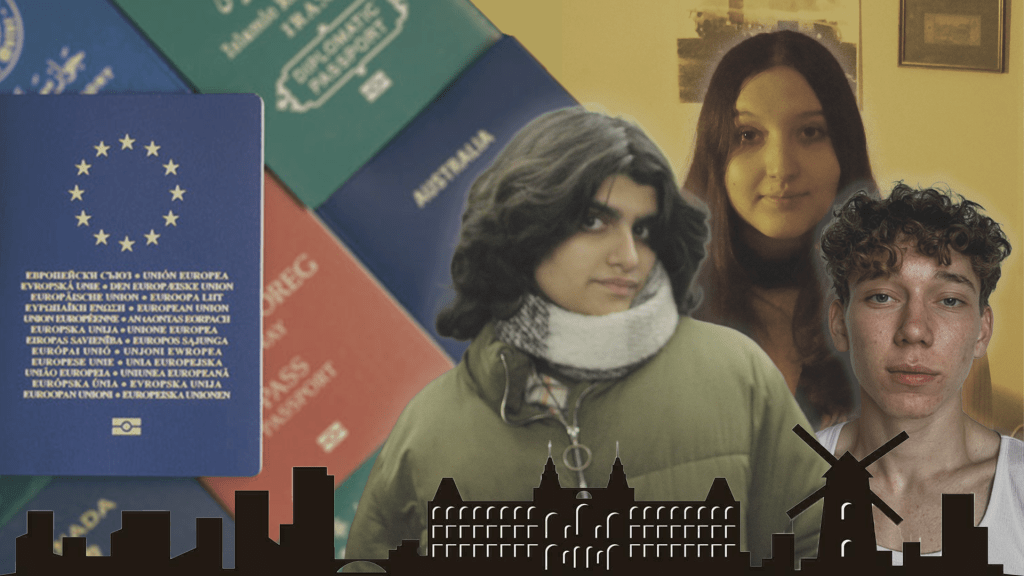
International students coming to Amsterdam have several formal processes to complete before they become residents of the country. Some of these are quick and easy to complete, while others might entail some complications. Students from outside the European Union (EU) have to go through various applications and processes, starting from the application and collection of their residence permits to even setting up their bank accounts and applying for their insurance.
“There are a lot of things you need to do before coming here and there are parts that you may not notice or forget in the process,” Agatha Zavadskaya, a first-year Science major from the USA, explains. “You have to stay on top of things a lot more than if you were coming from the European Union (EU) and make sure that everything is done, which is manageable if you do, but you can’t miss the deadlines,” she emphasizes, referring to the process of filing for residency permit, doing your biometrics and all documents regarding the emigration.
Zavadskaya notes that picking up the resident permit was a challenge once she arrived in the Netherlands. The pick-up point had a long waiting line, even though she made the necessary appointment beforehand. Hannah Wu, a first-year Science major from China, also faced issues with the collection of her residence permit. Wu was informed that her residence permit was ready for pick up, which turned out to be false when she reached the location. She had to later go back to pick up her permit from Utrecht. Despite these issues, it is important to note that the application process for the residence permit is made easier, as the UvA actually files for the permit, while the students just need to provide relevant details to the university.
The language barrier for international students coming to the Netherlands, even those from the EU, seems to be a major issue as well. With regards to setting up her bank account and getting a sim card, Wu says, “I didn’t know what to do and a lot of websites are in Dutch, which is not helpful.” The language differences, although expected and natural, do hinder the seamless process of integration within Dutch culture, posing possible anxieties and misunderstandings stemming from everything that is ‘lost in translation.’
The visa and immigration processes posed additional challenges to these students. Kaavya Malhotra, a second-year Humanities student from India, struggled with emigration processes already at the stage of getting her visa. “In India, if you are not from one of the cities where you can find the Dutch embassy, you need to take a two-hour flight just to get your visa,” she says. A day before her scheduled departure to Amsterdam she was still waiting to pick up her delayed passport, sitting in front of the embassy hoping to get an appointment. She was directed to the post office to ask if her document may be in one of the unshipped batches and miraculously was able to find it there.
Not only did she have to deal with the authorities’ malfunctions, but also unjust immigration procedures. Mandatory tuberculosis test that costs €50 she was obliged to take within the first three months of residency (paradoxical as infecting could actively happen throughout this time), bank statement provided by the parents that proves having assets worth the yearly tuition and additional monthly expenses, compulsory work permit. Regarding the latter, Malhotra comments: “I got turned down from a job because I wasn’t from the EU and the employer would need to apply for the work permit for me,” noticing how EU students are advantaged in the pursuit of work.
A series of unfortunate events made Nico Banda, a first-year Science major from the USA, discover the challenges of being a non-EU student to his cost. “While I was on the AUCSA weekend trip, my dorm got broken into and all my things got stolen,” he explains, listing the documents that the burglar claimed – passport, proof of enrollment, bank statement and documents with his BSN number on them. “All I had was my UvA card but it doesn’t have my date of birth on it. I was an unidentified individual.” Banda discloses. He couldn’t pick up his residence permit without the passport, nor open a Dutch bank account that would enable him to access the US government grant that he had earlier received. Although the Dutch authorities didn’t allow him to get his biometrics done with a scan of the stolen passport and a police report confirming the robbery, UvA turned out to be much more helpful. “The immigration service at UvA was able to put a pause on my grant,” Banda admits whilst currently finalizing the procedure of receiving his governmental support.
“I think it’s not to the point of struggling but it’s definitely annoying. Maybe struggling alongside other things you have to do with school,” Wu admits. This reflection resonates with the experience of international students grappling with issues that, while not insufferable, add an extra layer of inconvenience to the academic journey.
 The Herring