
By Pola Folwarczny and Kama Wojtuszko
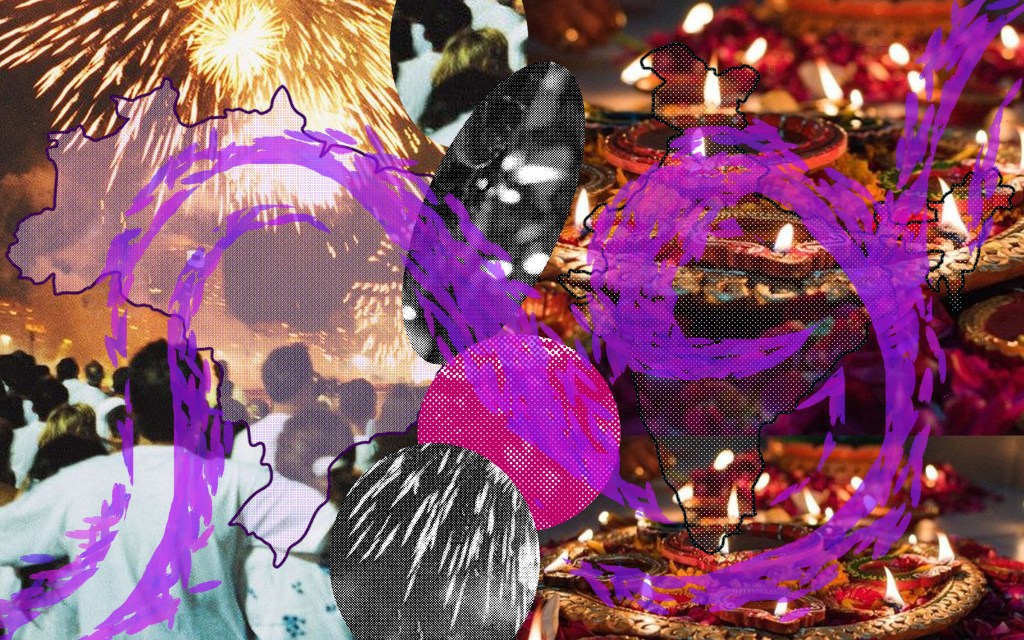
Collage by Sabine Besson
It’s late November, maybe early December. Last Christmas is blasting from your neighbour’s speakers, bright lights are flickering all over the city and the smell of oliebollen follows your every step. Regardless of whether you celebrate Christmas or not, you cannot escape that picture. But let’s not forget about the other wonderful winter celebrations that tend to be overshadowed by the Christmas culture, whether that is a huge Hanukkah at the dorms, a Diwali party, or jumping waves for wishes on New Year’s Eve.
While Christmas is celebrated in many countries, the tradition is not necessarily the same everywhere. In Brazil, one obvious difference is that Christmas happens during the summer. For Maia Pimenta, a third-year Science major, and Manoela Rutigliano, a third-year Social Science major, this greatly influences their experience of the holiday. Both Pimenta and Rutigliano feel a bit detached from European Christmas. Rutigliano never felt drawn to the idealised Christmas that you see in the media. “I never dreamed of that,” she says.
They view it more as an occasion to spend time with their family and have dinner together. Traditional Brazilian Christmas food usually includes turkey and rice with raisins. “In Brazil, you eat rice every single day. Then there’s this one day that suddenly you have to eat raisins with it,” Pimenta laughs.
“But there’s this added pressure that since it’s Christmas, it has to be amazing and perfect. I think that sometimes it makes it even a bit worse,” Rutigliano reflects. For Pimenta, her first winter in the Netherlands was difficult to cope with. She didn’t go back home to Brazil, instead, she travelled with her family around Europe. Although she enjoys some aspects of Christmas in Europe, such as Christmas markets and the cosiness of spending quality family time, she still misses the Brazilian weather. “Here, you hug each other because otherwise you’re going to freeze. In Brazil, we are sweaty because of the weather, but we hug because we love each other,” Pimenta jokes.

Manoela Rutigliano. Photo by Sabine Besson.
For both Pimenta and Rutigliano, New Year celebrations are more important than Christmas. “I feel like New Year’s is such a big deal for me,” they agree. There are a lot of rituals that have influences from an Afro-Brazilian religion, Candomblé, such as wearing white. “It just feels so lively,” Pimenta reminisces. “It’s such a nice way to start the New Year so lightly,” Rutigliano adds. Since New Year falls right in the middle of the summer break in Brazil, students, teenagers and children end and begin the year free of academic responsibilities. “You get to feel like you’ve begun [the year] amazingly, and it’s going to end relaxed,” Pimenta smiles.
Besides wearing white, it is common to wear new colourful underwear, with each colour symbolising a different manifestation for the coming year. “It’s just capitalism and religion really coming together. But it’s very fun,” Rutigliano giggles. She and Pimenta note that due to its African roots, Candomblé remains an oppressed religion in Brazil, and many people forget the origins of the traditions they engage in.
Another tradition that comes from Candomblé is going to the beach and jumping seven waves for seven wishes. In some regions, for instance Rio de Janeiro, it is common to throw white roses into the ocean. “Starting the New Year close to bodies of water makes it more refreshing,” Rutigliano says. Her heart feels closer to Brazilian beach traditions rather than European ones of going to clubs or having house parties. “Clubs are always a bit underwhelming. But if you see the sea, it’s never underwhelming,” she adds.

Maia Pimenta. Photo by Sabine Besson.
The winter time, however, is not only spent celebrating Christmas and New Year’s Eve. This year, the Hindu festival of lights, Diwali, was celebrated in the first half of November. Symbolising the triumph of good over evil, Diwali is the largest festival in India, celebrated mainly by Hindus, with Sikhs, Jains and some fractions of Buddhists partaking in their own variations of the holiday. The festivities last over five days, with each day devoted to different activities. The culmination of Diwali — the main celebration — happens on the third day. “We would dress up, we would light the house in candles, we’d put these candles and lanterns everywhere,” explains Sharwari Khare, a second-year Social Science student from India. “We would spend the whole day cooking and preparing this big feast. It’s just time for family to be together and to have fun.”
In India, Diwali is a national holiday, the festive spirit easily spreading throughout every city and village. In Amsterdam, however, it’s not that loudly celebrated — at least not in plain sight. On 17 November, South Asian students gathered in one of the common rooms in the AUC dorms to throw their own celebration of the festival. As many as a hundred students from AUC, UvA, and VU came together to share home-made South Asian food, dress in vibrant clothing and dance to traditional music. “I didn’t think I would miss it that much until I saw my parents celebrating it at home without me,” says Khare, admitting that Diwali is one of her favourite times of the year. She expresses joy that she has found friends at AUC who eagerly celebrate it with her.
Apart from the cheerful common room party, some students make sure to celebrate Diwali within their own four walls. Shree Dubey, a second-year Social Science major, decorated her room with fairy lights, setting up Albert Heijn bought candles and the little god statues her mom sent her for the occasion. Although growing up in a fairly religious household, Dubey has never felt particularly religious herself. When she moved away from home and came to Amsterdam, she started to embrace her desi culture. “I’ve never been more Indian than I am here and that’s quite amazing to me,” Dubey says, “That’s my culture, that’s my history, that’s my heritage, and I’m quite happy to be where I am, to be able to do these things with my friends.”
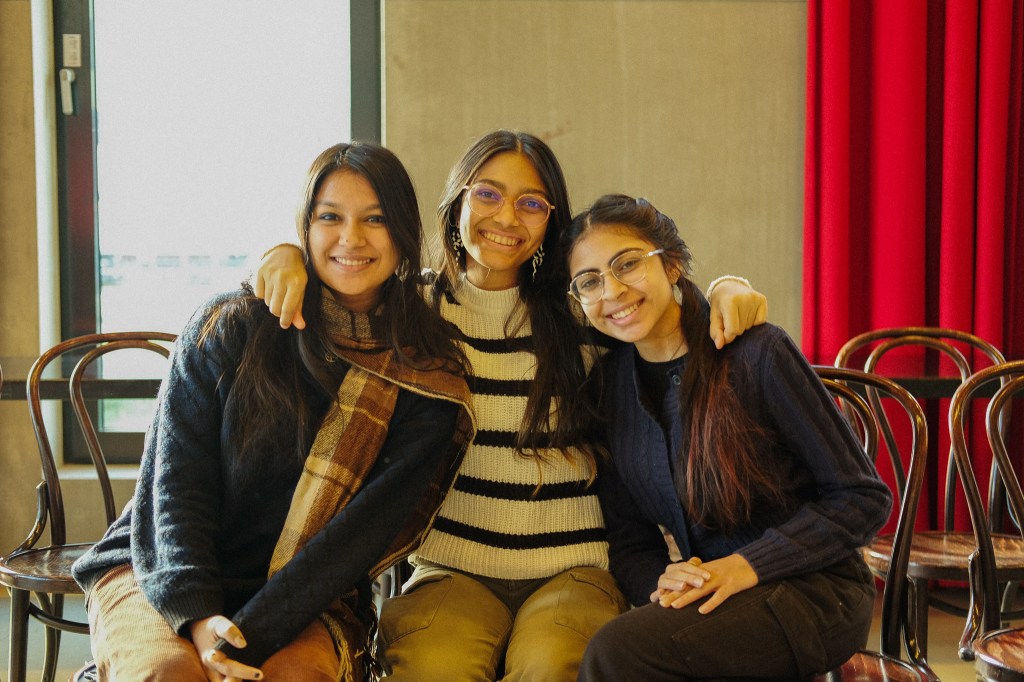
Shree Dubey, Sharwari Khare and Fatemah Muneeb Iqbal. Photo by Sabine Besson.
Not only does Diwali tighten the bonds between Indian students, but the celebration also provides an opportunity for other students to join in on the fun. Fatemah Muneeb Iqbal, a second-year Science major, was involved in the organisation of this year’s Diwali party, even though she has no religious ties to the tradition. She explains that being Muslim, her cultural celebration is Eid which happens in the spring, but there are not many Muslim students at AUC to celebrate with. “Diwali gives me an opportunity to connect with my own culture,” Iqbal says, “The language we speak is very similar, the songs that we listen to are the same, and our traditional clothes are very similar as well.” By celebrating Diwali, she feels like she is a part of a bigger community at AUC.
In contrast to the nation-wide celebration of Diwali, in Tamil Nadu, the southernmost state of India, people have their own winter-time celebration. The middle of December marks the beginning of the Margazhi festival, otherwise known as the season of music and dance. “Everywhere you go, you’re going to hear Indian classical music,” says NV Venkatesh, a second-year Science major, born and raised in Chennai, “Every temple and auditorium will have concerts, every evening and sometimes mornings.” The catering services of the auditoriums prepare Margazhi season specials which can be enjoyed alongside the performances. “Everyone will get dressed in traditional clothing every evening, go to the concert, watch, eat, go back home, talk about it for ten hours and watch recordings,” Venkatesh recalls. Every year, she watched the performances with her mom, excitedly discussing which of the special edition foods they should try first.
Last year, having just settled in Amsterdam, was the first time Venkatesh missed Margazhi season. The inability to go back home and join the celebrations filled them with great disappointment, especially since their mom shared videos from the concert. “Partially it’s homesickness, sure, but I can deal with homesickness now,” Venkatesh says, admitting that she feels greater unhappiness at the thought of missing another Margazhi festival rather than not seeing her family members.
These feelings are additionally strengthened by the Christmas spirit all around. “Everyone I know here goes home for Christmas, they have to be with their families,” Venkatesh says. Even though they have been invited to spend winter break with one of their friends, Venkatesh thinks it would hardly compensate for the unique atmosphere of the Margazhi season, which cannot be truly recreated.
 The Herring