
By Lou Boot

Within the walls of AUC, the first floor has transformed into a focal point of student activism, as sit-ins protest AUC’s perceived indifference to the ongoing Palestine-Israel conflict. To gauge the pulse of this movement, we conducted quick interviews to capture candid student opinions on the protests and the broader issues at play.

Gaia Hell, a first-year Social Science student, believes that it is definitely a good thing to protest. “Protests in the past have always been a very useful tool to have an impact on the government, to lead significant change,” she says.
And yet, Hell does express some concerns about the effectivity of the sit-ins at AUC, explaining that while protests have “always been a good thing, you also have to understand that if you do it in an environment such as AUC, you’re targeting a bunch of already extremely educated, extremely informed people.” She elaborates that in a predominantly left-leaning and educated university, there is a collective awareness of global events.
“If you want to contribute to actual change, you need to do it somewhere where it will make a difference,” Hell says. She contends that there are better environments to bring up these issues: “We have the panels that are being organised by UvA where we get to have these educated discussions. Those are useful because they bring people together in a way where you can discuss this topic in a sensible sort of environment,” she says. When they want to enact change, they should “go to the Dutch parliament, go to the Dutch government, write a letter to the Dutch government, protest in front of those sort of institutions,” she says.
While Hell does not know anyone who felt unsafe, she does feel frustrated with the disruption in education. “They do it during class times where I can’t focus on the teacher. They’re doing it right now when I’m trying to write my essay. It makes me, personally, more annoyed at the whole situation than feel like this is going to lead to any sort of change,” she says.
Regarding calls for a statement by AUC, she feels that “[AUC] should try to stay neutral” as it could make “people from the other side feel alienated.” She also acknowledges AUC’s stance with Ukraine a few years ago, stating that “I feel like it’s not fair [to compare them] because there’s a larger, more complex, more nuanced history between the Israel-Palestine region.”
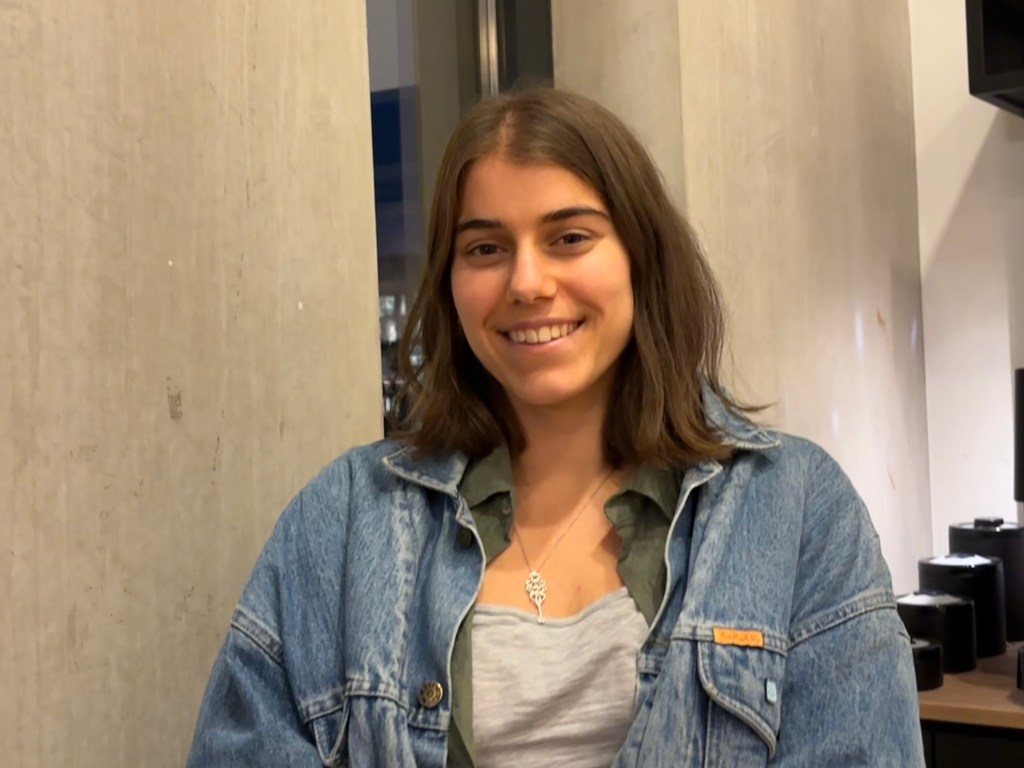
Mina Røhnebæk, a first-year Social Science major, is one of the students who participated in the sit-ins. While they do protest during the lunch break, “protests are meant to be disruptive,” she says. Røhnebæk does, however, acknowledge the negative sentiment among students. “I think it just makes people resent the whole thing when they are having classes. So, I think it’s best that it’s during common time,” she says.
Røhnebæk criticises the arguments that have erupted in the student group chats on Whatsapp in the recent weeks, believing that it is not the right place for such discussions. “I think it’s disrespectful to the whole issue that we’re fooling around with it on a group chat,” she says.
Røhnebæk thinks that AUC’s response to the sit-ins was “a cop out.” She understands that the university doesn’t want to cut ties with Israeli institutions, but at the same time believes it is important to see that sometimes the better decision is “the harder decision, the one that is not that profitable, because not everyone is supporting it.”
She also highlights the statement made by AUC on Ukraine, claiming that “political neutrality doesn’t make sense in this case.” If they do not release a statement on this crisis, “they should say it outright why they won’t condemn it,” she believes.

Nico Costa, a first-year Science student, takes a more critical perspective on the protest. He contends that the protests can be understood as a call for the extinction of Israel, which he condemns: “I understand there’s the right to protest, but I do understand that, as AUC policies clearly say, AUC should remain neutral especially because it’s a topic where there’s a war and they’re openly calling for the extinction of a country.”
He elaborates that the protests could be seen differently: “I’m not from Israel, and I don’t have any links [to it]. But I understand that if they were calling for the extinction of my country, I would feel threatened.”
While Costa does not feel physically threatened, the protests make him feel uncomfortable. “They are calling for the extinction of a state. I feel uncomfortable in that sense,” he explains. Costa also feels like the Academic Building is not a place for political expression. “I came here to just study. I don’t want to express my opinions here and I don’t want to hear other ones,” he says
When referring to the statement sent by AUC’s Management Team, Costa expresses complete agreement: “I totally agree with it. I do believe that students should have the right to go next to the building and protest. I would be okay with it, but I do believe that the institution should remain neutral.”
28.11.12 Correction: The article previously mistakenly identified the first interviewee as Gai Hell. The correct name is Gaia Hell, and the necessary corrections have been made.
 The Herring