
By Violet Domínguez and Ben Kiem
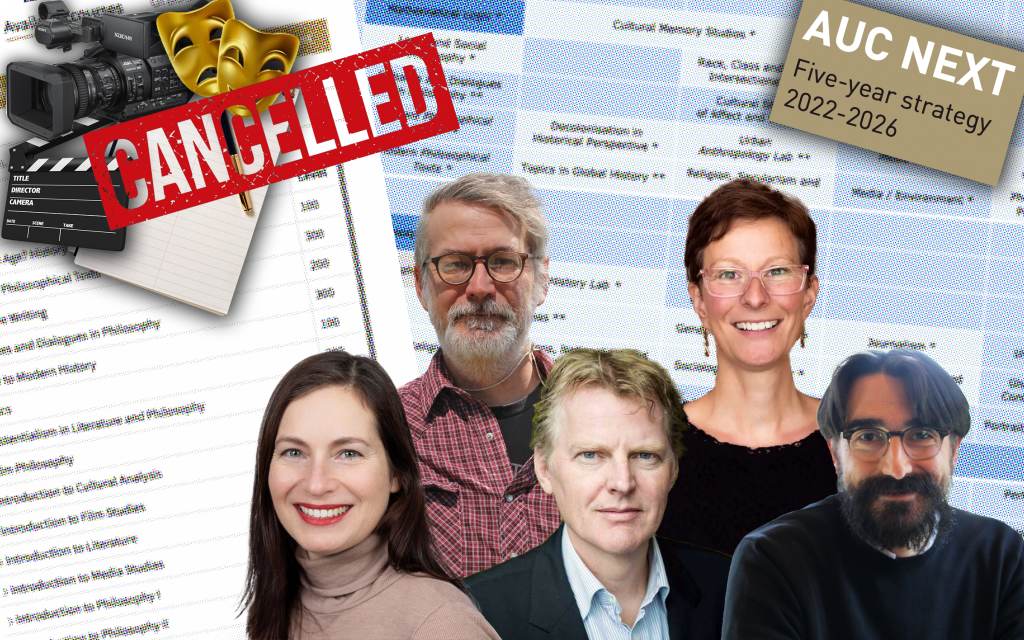
When course registrations opened, students were caught by surprise when they could not add the ‘creative courses,’ namely Film Lab, Creative Writing, Performing Arts: Music, and Theatre, to their schedule for next year. More than two weeks later, the official confirmation followed in a newsletter: the creative courses will not be offered — at least not in the upcoming year.
After many other adjustments to the curriculum were announced in the transition document, affecting especially the Humanities department, the cancellation of the creative courses took everyone by surprise as lecturers, students and the Student Council had not been previously notified of this change. Shocked by the news, first-year students Lea Cortas, Lena-May Khazami and Maria Toncheva felt encouraged to start a petition on 16 May to express their frustration and confusion around these changes as well as the lack of communication about the situation from the administration.
The petition quickly garnered 125 responses, showing how the cancellations have greatly affected the students that were eager to take the creative courses, since these courses in particular provided a unique aspect to AUC. In the petition, students shared emotional messages about their personal connections to the courses. Cortas herself was devastated by the cancellation of Film Lab, saying, “For film majors, this is the only practical course we are offered. I’m still in denial that they cancelled Film Lab because it was literally the reason why I chose AUC. It doesn’t feel real.”
Even after receiving responses from AUC’s Director of Education Dr. Marianne Riphagen and the dean, Prof. Dr. Martin van Hees, Khazami and Cortas felt angered by the vagueness of their messages, lacking a proper answer to their demands. “They encouraged us to look for courses outside of AUC. They basically kicked us out,” says Cortas.
The news also caused anxiety in lecturers, who suddenly saw themselves or their colleagues out of jobs. Sára Gutvill, who has been teaching Performing Arts: Music since 2014 and has been at AUC for over a decade, suddenly lost a considerable part of her income. She highlights how due to the temporariness of AUC contracts, contracts elsewhere are quite scarce as it is difficult to combine teaching full-time during singular months with other part-time jobs.
The same holds true for John Loughlin, who was teaching Film Lab – a course which has always been oversubscribed – since 2019. “Film Lab is valuable for AUC because it might help balance other classes in the track,” he says. With the cancellation, the only course with practical, rather than theoretical knowledge production, was lost.
The administration highlights that the decision was not an easy one to take. “We love these courses, they are very precious to us. It is heartbreaking not to run them,” says Erinç Salor, the Head of Humanities. Yet, the decision was not only difficult on the academic level but also personally. Salor elaborates, “I talked to all of the lecturers, it was not a fun conversation; I care for these people.”
The driving reason for the course cancellations is that UvA published a new policy in the summer of 2022, which disallowed AUC to hire lecturers on temporary contracts in the future. Riphagen emphasises that courses now cancelled have not been removed from the curriculum, meaning that they can be offered in the future again. This is not to be confused with AUCNext and normal curriculum development. “That was an altogether different decision,” says Riphagen.
After a meeting with Riphagen and the petition makers on 7 June, the 2022/23 Student Council member Miriam Crane shares that the creative courses were reliant on temporary contracts which the UvA policy is attempting to reduce. Due to a failure in finding teachers on permanent contracts to hire for these courses, they had to cancel them for “personnel issues” since there were no lectures at UvA or VU that could have taught these very specific courses. The problem with giving permanent contracts at AUC, to Crane’s knowledge, is that “they are not very sustainable” since “AUC has a small structure and limited resources.”
A solution to this problem would have been to hire the lecturers on permanent contracts. In response to this idea, van Hees says “that this is still something we are discussing, but it is something we have to consider carefully and in view of our entire policy. We need more time for that.” He lists many considerations, such as the planning of the teaching, the composition of the departments, and the consequences for HR.
As an alternative, AUC had requested an exception from UvA to the current policy to offer these courses, but the request is still pending. “The decision about our request has not been made yet. And we did not want to take the risk of having to cancel the courses later,” explains van Hees. Consequently, the administration decided to cancel the courses in question before the next semester starts.
Because of the pending request, there was a delay in openly recognizing that creative courses could not be offered in the next academic year, as Riphagen and van Hees waited in hopes that it would be approved.
Although the Student Council has been trying to make students’ voices heard, it could not provide advice on the creative courses because they were not part of AUCNext, and thus remained out of their range. This was yet another reason as to why the cancellations had not been properly communicated.
Whereas permanent contracts pose challenges for the administration, lecturers have in the past heavily criticized the frequency of temporary contracts, citing uncertainty regarding future employment caused by their temporariness. While the new policy was intended to improve their situation, in the short term it caused lecturers like Gutvill and Loughlin to be out of jobs – and AUC without the courses that make it special.
 The Herring