
By Maike van de Pavoordt
How the formal and informal complement each other in Amsterdam’s food aid
Just after noon, a volunteer wheels a cart piled high with broccoli through Muiderkerk, which for a few hours has served as Food Bank East’s distribution point. At first glance, the leftovers seem at odds with a year in which Food Banks Netherlands reported an 8% drop in donations. Some volunteers look uneasy about how such apparent abundance might be perceived. But the image is misleading: the Food Bank faces declining supplies, unpredictable turnout, and the daily challenge of matching whatever comes in with whoever shows up. And when those mismatches leave food behind, a tension emerges between the food that remains and the people who might need it – and where the two eventually meet.
Food banks receive products at several levels. Food Banks Netherlands has national donors who donate food on behalf of all 181 food banks in the country. Based on the number of mouths to feed, each individual food bank, including Food Bank Amsterdam, receives a share. However, it doesn’t end there. Marielle Sas, chair of the Amsterdam Food Bank’s Executive Board, explains: “We also have our own direct donors, companies in the region. Here in Amsterdam, we function as the distribution center.”
The Food Bank is now feeling the effects of reduced food waste. Between 2015 and 2023, waste decreased by 17%, due in part to better planning by suppliers and supermarkets and the discounting of products nearing their expiration dates. “What we’re really noticing is that producers are much sharper in their logistics and planning,” Sas says. “And on the other side, consumers are more accepting.”
The issue isn’t the purchase of discounted products – like the well-known Albert Heijn supermarket items with a 35 percent markdown under the tagline “throwing away is a waste” – but the shift behind what ends up in the stores in the first place. As supermarkets better anticipate consumers’ willingness to buy items with a short shelf life, there are fewer surpluses at distribution centers, and therefore less supply for food banks.
Meanwhile, Food Bank Amsterdam is working to reach more clients. The organisation currently supports about 4,500 people per week. “That should be many, many more,” Sas notes, referring to Centraal Bureau voor de Statestiek (CBS) data from 2023 showing that 60,596 Amsterdammers (6.6 percent of the city’s population) live below the poverty line. It is the highest percentage in the country and more than double the national average of 3.1 percent.
Some people do not know about the Food Bank or feel shame in asking for help, but there are also some who find it difficult to go to a Neighbourhood Team for their intake. At these Neighbourhood Teams, where all Amsterdammers can go with questions and for support, social workers determine how much someone has left after paying their fixed costs. The remaining amount, with set maximums for expenses like phone, internet, TV, and energy, is then assessed against Food Bank Netherlands’ living-expenses norm. Once this amount is exceeded, a person becomes ineligible for support. If it remains below the threshold – €325 for individuals under normal circumstances – they qualify for Food Bank assistance.
“They have to show all their finances, and some people aren’t used to that,” says Neighbourhood Team worker Judith van der Iest, visibly relieved after a busy day of intake interviews to not be dealing with criteria and numbers for a moment. Although this gives a complete picture of someone’s situation – and allows help-seekers to be referred to diverse organizations – it can be discouraging. “People think that if they tell the municipality everything, they might lose other benefits. That’s not true,” Sas adds.
Even once people have been screened and registered, attendance remains low. Recently, only 165 of the 212 registered clients for East’s distribution point actually showed up: one reason food is left over at day’s end. Margreet Lukkien, coordinator and volunteer at Food Bank East, describes the dilemma: “In the warehouse, the food distributor sometimes says, ‘I’ll just send fewer crates, because so much comes back.’” Despite the persistently low turnout, the Food Bank headquarters does not want to risk it and still calculates what to send to each distribution location based on the number of clients registered.
Just as it is a challenge to bring customers to the food, it is equally a challenge to bring the food to the customers. The crates aren’t the only issue. Clients, who receive a crate of long-lasting products at the start of the line, can walk on while volunteers offer vegetables, fruit, dairy, eggs, and meat – depending on what has been delivered. “It varies a lot”, Lukkien notes, “Today we had very little dairy; another time we had very little vegetables.”
These perishable items, the products most in demand and the scarcest, must be distributed as quickly as possible. Although the Food Bank tries to accept only what can realistically be handed out, sudden large deliveries often occur. “Sometimes there’s so much that the distribution center says: send as much as possible to the distribution points,” Lukkien says, looking at a cart full of leftover produce. It may look like a surplus, but in reality, supply and demand simply don’t match. She also notes that large quantities of a single product cannot be stored to be distributed gradually: “Sometimes we receive vegetables that were already kept at the central location for a while. Then they arrive here and are almost spoiled.”
When volunteers notice leftovers, they gladly place an extra head of broccoli in a customer’s bag or encourage them to take more. “On Tuesday, two rolling containers of fruit cups came in, with those cooling bags wrapped around them,” says Willem van Merle, a volunteer at Food Bank South. “All of it had to be given out that same day. So we told every customer: take as much as you can.” While some volunteers hesitate to talk about leftovers, Van Merle doesn’t understand why it should be swept under the rug. It is what it is: “People don’t take that much. One container goes to customers. One remains.”
Whether it’s a rolling container or just a few crates, the leftovers don’t go to waste. With the municipality reporting over six hundred food initiatives in Amsterdam, there are various organizations ready to make use of anything that remains. The cart of broccoli and other produce, for example, ends up in the van of Blije Buren (Happy Neighbours). It is the most prominent initiative using the remains of distribution points in East, South, and Central.
Blije Buren’s founding can be traced back to 2013, when Peter Hoeboer and his partner Francesca began cooking for Peter’s father, with a few neighbours joining in, to help him stay connected to the community after losing his wife. One day, while shopping in the Javastraat, they saw a box of overly ripe bananas being thrown away right in front of them. They then decided to start working with leftover food.
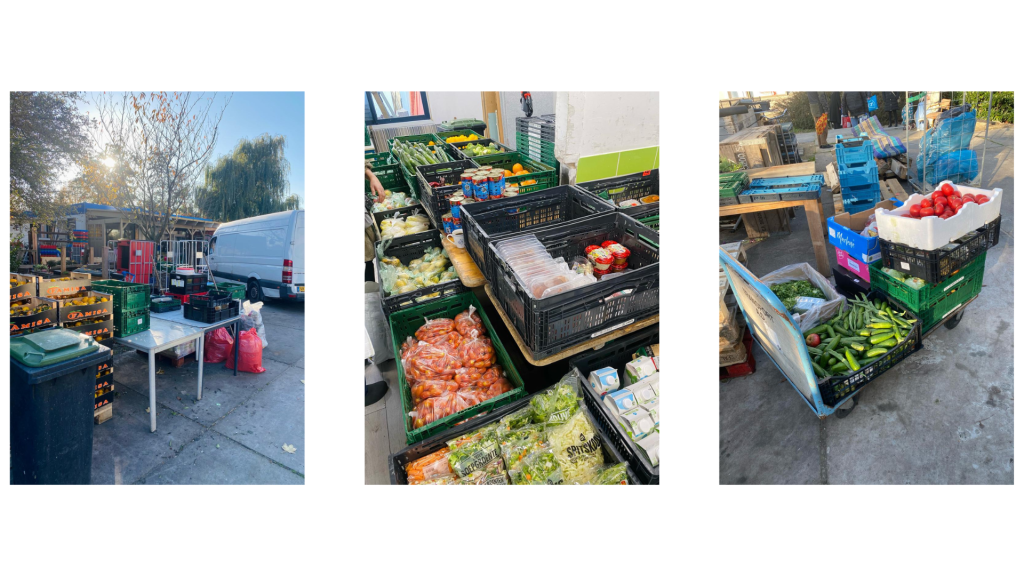
At supermarkets and wholesalers, but also at museums and local businesses: wherever there’s surplus, Blije Buren picks it up. “Also from the Food Bank. If they’re distributing one day and notice something has passed its expiration date, they call us. We pick it up and make sure it gets redistributed,” Hoeboer says. The success is visible at their site on Louwesweg in Nieuw-West, where pallets of rescued produce are displayed, and volunteers are busy sorting.
The Food Bank does not have formal agreements with initiatives like Blije Buren. Instead, volunteers at the distribution points have their own contacts. This informality makes Blije Buren more popular among people who do not go to the Food Bank due to shame or mistrust. “A lot of people say: ‘I don’t want to show that I’m poor. I don’t want to show my papers.’ At the Food Bank, you have to show your documents. With us, you don’t,” explains Latifa El Mesnaui, the general coordinator for nearly five years.
The municipality itself also makes use of the flexibility Blije Buren offers. Through the Neighbourhood Teams – which conduct the Food Bank intake interviews – the municipality, along with other social organisations, refers people to Blije Buren several times per week for emergency food assistance. These people are still in the intake process or will only be added to the Food Bank list for next week’s distribution moment. “[They] need a temporary bridge,” El Mesnaui says, adding that a crate is ready for them the same day.
Beyond emergency aid, Blije Buren distributes food in a way similar to the Food Bank. In East, for example, food is distributed three times a week to about 20 to 30 people. But food assistance is not all they provide. “We’re not just a food bank. We also started with social support,” says Hoeboer, who, as a social worker, emphasises the importance of a supportive community. In South, the distribution is preceded by a community gathering with information about, for example, mental healthcare or the national elections.
The success of Blije Buren hasn’t escaped the municipality. “Marjolein Moorman (former member of the city council and current Tweede Kamer member) came to us once. She asked: ‘How is it that you manage to reach everyone, and we don’t?’” Hoeboer gives the answer himself: “There are very few – maybe no – organisations that take such a broad approach as Blije Buren. We use a holistic approach, and that’s mainly because we have a very powerful tool: food.”
Though the informal network reaches new groups of Amsterdammers in need, it also partly masks the Food Bank’s limited reach – and shows what it might learn from Blije Buren in connecting with more people. At the same time, it does not change the deeper challenges the Food Bank faces: dwindling supplies caused by donors’ efficiency measures and the irregular flow of food that makes planning unpredictable. Even though the impression of abundance is far from true, leftovers still occur, and when they do, it matters that the food goes where it’s needed. Volunteer Van Merle captures the essence: “What’s important is that the food doesn’t get thrown away. The food gets to the people.”
 The Herring