
By Maria van Wijnen
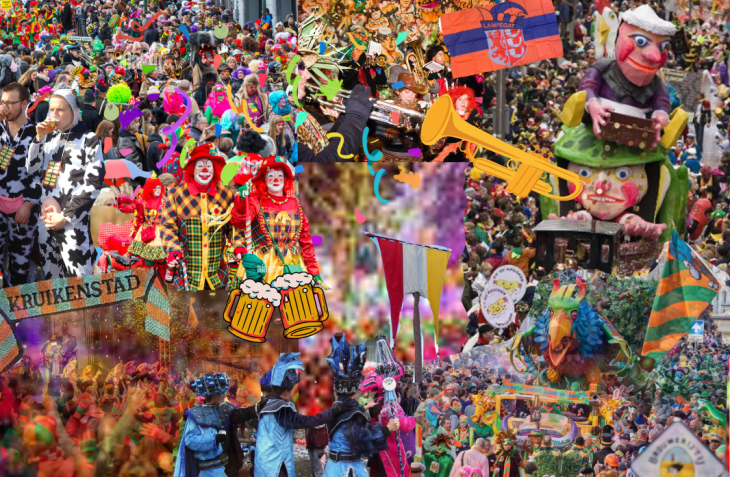
Chaotic block parties, colorful parades, insane festivities – you’ve heard of the carnival in Rio, but did you know that the Netherlands has its own version of the festivities? It’s just as spirited but slightly less glamorous. From February 13th to the 18th, carnival was celebrated in the Southern provinces of Limburg and North Brabant.
Rooted in Catholic tradition and held in the days leading up to Ash Wednesday, carnival marks the last chance to feast before the 40 days of Lent. The season officially kicks off on 11 November and builds toward the massive festivities in February.
During this time, cities adopt playful new names and colours to symbolize a temporary, joyful reversal of roles and a break from normal life. ‘s-Hertogenbosch becomes Oeteldonk, Bergen op Zoom turns into Krabbegat, Tilburg into Kruikenstad, and Eindhoven into Lampegat.
The highlight is the street parades. Months of work go into building massive floats that roll through towns, often poking fun at politicians, royalty, global headlines, and local gossip. In past years, papier-mâché floats have depicted caricatures of figures such as American President Donald Trump and the leader of the Dutch PVV party, Geert Wilders.
Dressing up is non-negotiable, and you are guaranteed to see wildly creative costumes and face paint. Each year also brings a new batch of carnavalskrakers, which are humorous Dutch songs written especially for the celebrations. By day, children in bright costumes line the parade route; by night, everyone parties hard in the streets and pubs, from high schoolers to elderly people.
Jules Van Elderen, third-year Sciences major, grew up in Eindhoven and says she never misses the carnival festivities. “When you’re young and at school you dress up, watch the parade, and it’s exciting,” she says, joking that when you’re older, the carnival turns into “an excuse to party” where you can “pretend you’re a different person” and “drink yourself into oblivion for five days straight.” After she moved away from home, the carnival has become even more special as “everyone flocks down to the South,” and she gets to see all her hometown friends.
Those who didn’t grow up in the Netherlands experience carnival differently. Ana Vladescu, a third-year Humanities major, went to a carnival parade for the first time this year in Maastricht with a group of friends. She compares it to Mardi Gras, a similar carnival festival in New Orleans, in the U.S., but says, laughing, that carnival is “soooo Dutch,” referencing the music and demographic. Block parties and bars will hardly ever play English music during carnival, and a majority of attendees are from the region. Still, she says she will take “any excuse to dress up” and encourages others to experience it at least once.
Marianna Schwartz, a third-year Sciences student, has a similar sentiment. She encourages everyone to go to a carnival parade, as it’s “not something you find everywhere,” adding that it’s best to go with someone from the region who knows the tradition. She says that she loves “how creative everyone is with the costumes.” Schwartz has been to carnival in Maastricht twice and says it’s more fun now that she recognizes some of the songs, because it can be “a bit awkward if everyone’s singing their hearts out and you have no idea what’s going on.”
Luckily, you have around 11 months to prepare for the carnival of 2027. Here’s a playlist of almost 500 songs that better be on your Spotify Wrapped next year if you want to sing along to every lyric — or practice your Dutch. Start working on your costume too!
 The Herring