
By Cadence Chua
Warning: This article may contain themes that readers may find distressing. Please proceed with caution and reach out to the Student Life Officers if you need someone to talk to.
2026 has begun with multiple headline events, including the capture of Venezuelan dictator Maduro by Trump. This is probably making you curious about other important events in politics to keep an eye out for this year, so here is your 2026 Politics Playbook.
The first weeks of January and February have been hectic, from a ‘regime change’ in Venezuela triggered by an American military operation, the killing of American citizen Renee Good by Immigration and Customs Enforcement (ICE) officers, the protests in Iran, and the announcement of the next Dutch cabinet.
Venezuela
Nicolás Maduro, the dictator who has ruled Venezuela for more than a decade, has been unseated, as the US captured and extradited Maduro and his wife to the States under drug and weapons charges.
Venezuelans all over the world have been rejoicing, though some are more cautious than others, stating that it is difficult to justify the methods used in Maduro’s capture, codenamed Operation Absolute Resolve, echoing what many leaders in the world have said. In particular, neighbouring Latin American countries, though affected by drugs flowing into their countries from Venezuela, have criticised the attacks. UN Secretary General Antonio Guterres has also questioned whether international law was respected in the attacks. Indeed, Trump has said that the US could “run” the country for years.
These next few weeks are crucial for Venezuela: Rodríguez, the former Vice President, is now the interim President, and her government is being closely watched. New elections might be held, and oil would likely be handed over to the US, with American investment flowing into the country. All these mean that the situation would be in flux for a while, and this could breed more instability.
Renee Good and ICE
Moving on to domestic politics in the US, the country has been divided over how ICE agents operate within the country. ICE is a law enforcement agency focused on immigration, and has been used by the US government since its founding in 2003 to deport illegal immigrants. However, under Trump, the agency saw a historical increase in its funding and is being used to push the Trump administration’s hardline immigration policy.
On 7 January, American citizen Renee Good was attempting to drive away from ICE agents in Minneapolis when one of them, Jonathan Ross, fatally shot her three times, before calling her “f*cking b*tch”. This happened in front of Good’s wife and their dog. The incident has sparked protests all over the country, with the Minneapolis mayor calling for ICE to “get the f*ck out” of the city. Despite video and audio analysis disproving the theory, Trump officials have repeatedly claimed that Ross acted in self-defence and that Good was attempting to run him over with his car.
On 24 January, Alex Pretti, also an American citizen, was fatally shot by ICE agents as he was trying to help civilians being confronted by them. He was shot ten times. This incident also happened in Minneapolis, and has intensified the protests against ICE in the city and around the country.
Ever since Trump took office, ICE and the Department of Homeland Security (DHS) have been criticised widely for detaining documented residents, inhumane treatment in prisons, and for targeting people of colour and even Native Americans. Many, including Minnesota Governor Tim Walz, have characterised ICE as the Nazi Gestapo. ICE overreach has been seen as unconstitutional, and the broadening of their powers is something to watch out for this year.
Protests in Iran
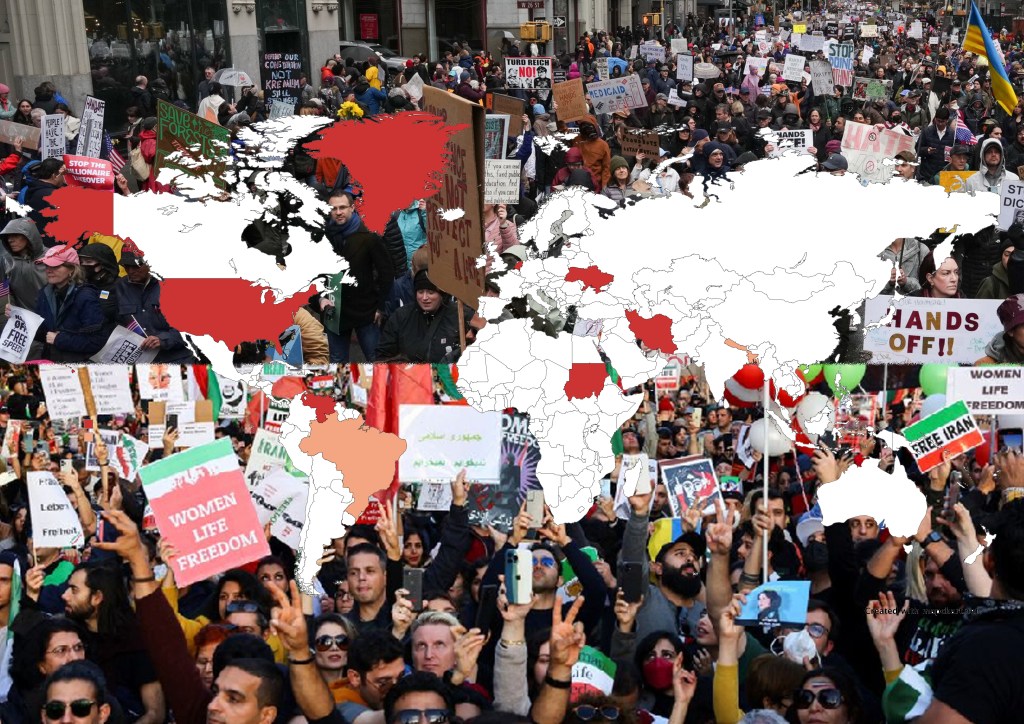
Protests in Iran have broken out since last December, as the Iranian economy has worsened, and protestors are advocating for an end to Supreme Leader Ali Khamenei’s authoritarian rule. Some protestors hope for a return of Reza Pahlavi, Iran’s Crown Prince, who has encouraged the demonstrations and positioned himself as the leader of the future Iran. However, his family’s rule before the 1979 Iranian Revolution was brutal, marked by economic inequality and the torture of dissidents. Other protestors have criticised Pahlavi’s backing by the US and Israel, and have instead focused on first bringing down Khamenei’s regime.
So far, Khamenei and his government have tried to shut down protests by cutting off Internet access across the country, as well as by mobilising security forces. Protestors are facing the death penalty, with some already executed. The official death toll released by the regime confirms that at least 3,000 protestors have been killed so far, and many more arrested. However, due to the lack of access by journalists, the death toll has been impossible to verify, with The Guardian suggesting that the actual count could exceed 30,000. Certain news outlets and eyewitnesses have labelled the situation in Iran as “massacres”.
Trump has said that the US is ready to “help” the Iranians. However, the key issue at hand between the US and Iran is still the Iranian nuclear programme, and the protests are an afterthought for American leaders. Talks between the Iranian government and the US regarding this are ongoing.
Dutch coalition formation
On 9 January, the largest party, the centrist Democrats 66 (D66), together with the centre-right Christian Democratic Appeal (CDA) and right-wing People’s Party for Freedom and Democracy (VVD), announced that they are aiming for a minority coalition government. If this succeeds, the coalition would hold 66 seats out of 150 seats in the Dutch parliament’s lower house, de Tweede Kamer.
A minority coalition government is rare in the Netherlands, but not unexpected given the increasing difficulty of forming a majority coalition. This is because the number of votes is fractured among a great number of parties. The main reason why a majority coalition was not reached this time was that the VVD ruled out working with the left-wing GroenLinks due to political differences, and the D66 wanted to keep the VVD in their coalition. This is due to the VVD having a sizable number of seats compared to GroenLinks. Whether or not this D66-CDA-VVD coalition would succeed in governing is something that citizens and residents alike will have to watch. If it doesn’t, the Netherlands will be headed back to the polls. The coalition cabinet will be sworn in on 23 February and is to be led by D66 party leader, Rob Jetten, who will be the Prime Minister.
Ukraine
As the war effort in Ukraine continues, Russian attacks on Kyiv in the first week of January have left tens of thousands of people without heating. January is usually one of the harshest winter months in the country, and Russia’s targeting of power grids has worsened the living conditions of Kyiv residents.
There have not been any actual ceasefire or peace talks between Russia and Ukraine. The EU has pledged to support Ukraine with 90 billion euros in 2026 and 2027, yet the question of Ukraine acceding to the EU is still up in the air. This means that the future of Ukraine after the war remains uncertain. February will bring about the fifth year of the war. As morale decreases amongst troops, Ukraine might have to negotiate an end to it.
Greenland
After months of threatening to take Greenland over by force if necessary, US Vice President JD Vance and Secretary of State Marco Rubio met with Denmark and Greenland’s foreign ministers at the White House on 14 January. Vance has long had a history of animosity with the European Union (EU), with some EU diplomats claiming that “Vance hates us”. The White House talks concluded unsuccessfully, with the Danish foreign minister saying that they have a “fundamental disagreement” with the US. As the US floats around the idea of annexing Greenland, European countries have begun sending troops to the territory; France, Germany, Sweden, Norway, Finland, the UK, and the Netherlands have all deployed their armies as of 15 January. In response, Trump has threatened more tariffs on countries opposing a US takeover of Greenland.
Why is Trump risking the North Atlantic Treaty Organisation (NATO) alliance and the American relationship with the EU (and with the UK, known for its special relationship with the US) for Greenland? Natural resources in the territory, including rare earth minerals, might become easier to access in the near future due to global warming melting the ice sheet that covers Greenland. These resources are valuable. In addition, Greenland’s strategic position, between North America and the Arctic, allows it to conduct monitoring for missiles. As the world becomes more volatile, and the US perceives Chinese and Russian ambitions to be threatening American security, the possibility of missile attacks against the US is not zero.
Should the US remain firm on its stance on Greenland, there are chances of a military conflict between the EU and the US, which would be unprecedented in today’s world.
Sudan
The Sudanese Armed Forces (SAF) and the paramilitary Rapid Support Forces (RSF) are continuing to fight a brutal war in Sudan. The war has seen actions that could constitute a genocide in Darfur being committed by the United Arab Emirates (UAE)-backed RSF.
Meanwhile, on 11 January, Sudan’s Prime Minister Kamil Idris announced the government’s return to the country’s capital, Khartoum, since the city was taken by rival troops in 2023. This is good news for the residents of Khartoum, as reconstruction efforts by the government are starting in the city. However, in the rest of the country, more than 11 million people have been displaced by the civil war.
Yet, as the civil war marked its 1000th day on 9 January, aid from other countries has been scarce compared to aid to other areas like Gaza and Ukraine. No end is in sight for this war, and the country’s humanitarian situation is worsening by the day. No one has a roadmap for Sudan’s future.
An update on Gaza
Israel has continued to strike Gaza even after their ceasefire with Hamas, as strikes on 8 January killed at least 13 people. Last December, Trump and Netanyahu met, with Trump claiming that Israel is fulfilling its commitments under the Gaza Peace Plan. The Plan, apart from calling for a ceasefire, also called for the demilitarisation of the Gaza Strip, the deployment of a UN peacekeeping force, a transitional non-Hamas government in Gaza, reconstruction, and a pathway towards Palestinian self-determination and statehood being recognised. Israel and Hamas have both been accused of violating the terms of the ceasefire.
On 14 January, the White House announced the start of the next phase of the Gaza Peace Plan, though that depends on the cooperation of both Israel and Hamas. This would include installing a technocratic Palestinian government in Gaza, reconstructing and demilitarising the Gaza Strip fully, and disarming Hamas. However, many major points of the first phase of the Plan have not been realised yet, as the ceasefire has been reportedly breached multiple times, and Israel is still refusing aid into Gaza. This could hinder the implementation of the second phase. Another thing to take into account is the Israeli legislative elections coming up in October, which could influence Israeli actions in Gaza.
Elections
Many important elections are coming up this year, including the aforementioned Israeli elections.
Israeli legislative elections
Israel’s next legislative election is due by late 2026, and will be a reflection of public opinion on Netanyahu’s leadership in the war in Gaza, as well as his moves to reduce judicial oversight on government decisions. So far, opinion polls have shown that Likud, Netanyahu’s party, will retain the largest number of seats. Should this scenario prevail in the elections, Netanyahu will likely continue pursuing actions that erode democracy in Israel and the repression of Palestinians in the occupied territories.
US midterms
The American midterms are set to be held on 3 November, with all 435 seats in the House and a third of the 100 Senate seats being contested. Opinion polls suggest that Republicans could lose control of the House and have their Senate majority decreased. If Democrats win back control of the House, Trump would find it more difficult to pass his legislation with Democratic oversight.
Bangladeshi general elections
On 12 February, following the August 2025 Gen Z protests that forced autocrat Sheikh Hasina to flee to India, Bangladesh went to the polls. This is an important election that could dictate how the country rebuilds its democracy following more than a decade of democratic backsliding. The Bangladesh Nationalist Party (BNP), the main rival of Sheikh Hasina’s Awami League for decades, won in a landslide. Now, it seeks to establish itself as a liberal democratic party, breaking away from the biggest Islamist party in the country, Jamaat-e-Islami (JI). This is a huge shift in South Asian politics – for the first time since the start of autocratic rule in 2009, Bangladeshis have been able to vote in an election largely classified as free and fair.
Nepalese general elections
Similarly, Nepal will be going to elections on 5 March, after the Gen Z protests in September 2025, which forced the resignation of Prime Minister K. P. Sharma Oli and top officials. This was due to excessive displays of wealth by these officials and their families, leading to accusations of corruption and mismanagement of public funds. As the country gears up for the elections, many are supporting more liberal parties and even the restoration of the monarchy, which was abolished in 2008. An installation of a liberal government would have consequences for Nepalese diplomacy with China, their neighbouring country, and Russia. China and Russia have had friendly relations with Nepal, which could be strained should a West-favouring government be elected.
Brazilian general elections
Moving on to Latin America, the upcoming general elections in Brazil on 4 October are key to watch as an indicator of the functioning of democracy in the country. Current President Lula is set to go up against Flavio Bolsonaro, the son of former President Jair Bolsonaro. This will be a litmus test for whether Jair Bolsonaro’s political movement can find a resurgence in support. This comes as Bolsonaro has been sentenced to 27 years in jail for staging a failed coup in early 2023 against Lula. Opinions in the country on Lula’s performance are divided, and this could be reflected in the votes.
And that was your 2026 Politics Playbook! There are many more important political topics not covered in this article, so for further reading, here are some useful links:
Elections to watch globally in 2026
2026 for Ukraine, the Middle East and China
 The Herring