
By Cadence Chua
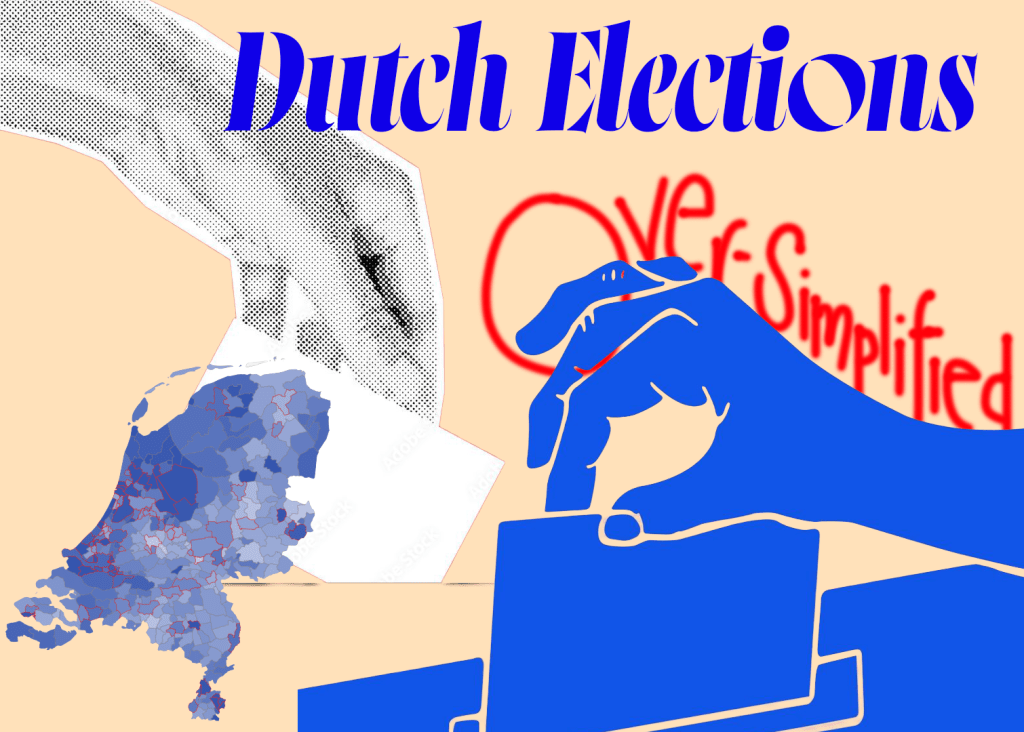
This Wednesday, on 29 October from 07:00 to 21:30, Dutch citizens across the Netherlands will head to the polls for the second time in less than two years. They will be voting for their preferred candidates to have a seat in de Tweede Kamer (the House of Representatives), following the collapse of the government in June. All citizens aged 18 and above who are not excluded from voting are eligible to cast their ballot. If you’re an eligible voter, make your voice heard and vote! As campaigns are in full swing, here’s what you need to know to make your voice count.
How do elections in the Netherlands work?
Elections were announced after the current Prime Minister (PM), Dick Schoof’s, government collapsed. In the Netherlands, the government typically entails a coalition of parties that form the government, breaking up due to policy or other disagreements. In this case, the largest party in de Tweede Kamer, the far-right Party for Freedom, Partij voor de Vrijheid (PVV), led by Geert Wilders, left Schoof’s coalition government due to other parties refusing to sign on to their asylum policies. Without a majority in de Tweede Kamer, the coalition failed, and elections, originally slated for 2028, were called early.
The Dutch electoral system works rather differently from that of other countries, and is key to understanding the upcoming elections. The 150-seat Tweede Kamer is elected through the party-list proportional representation system. Based on the number of votes received, each party is allocated a certain number of seats in de Tweede Kamer.
Instead of voting on the party as a whole, voters are provided a list of candidates from every political party ranked from first (usually the party leader) to last. This is known as the “preference vote”, voorkeurstem. Although most vote for the top candidate on the party’s list, some voters wish to vote for others in the party, such as to support women’s representation in de Tweede Kamer. Therefore, a candidate can be elected to de Tweede Kamer even if they are ranked low on their party’s list.
Additionally, candidates do not run to represent particular constituencies. Instead, provincial elections are held to elect members for the provincial councils and are separate from the elections for de Tweede Kamer.
This year, 27 parties are fielding candidates for the elections, of which 15 parties already have seats in de Tweede Kamer.
Prominent parties to watch this election season, in order of the number of seats
The political parties listed below are an inconclusive list and only include the parties that will most likely gain the most seats on election night.
PVV
The PVV gained a record number of 20 seats in the 2023 elections and became the largest party in de Tweede Kamer, holding 37 seats in total. This follows a trend of far-right parties making gains throughout Europe in recent years. In Poland, the far-right bloc gained a total of 50 percent of the vote in the 2025 presidential elections. Meanwhile, the far-right National Rally in France gained a historic 81 seats in parliament in 2022 and 71 seats in 2024. From the east to the west of Europe, the far-right has been increasingly popular with voters.
In the Netherlands, the PVV has aligned itself with the far-right movement, and the party is known for its critique of Islam and migration. In PVV’s manifesto, their ten-point plan includes closing borders to asylum seekers, stopping family reunification, abolishing social housing priority for non-Dutch residents, and supporting tougher law enforcement. In short, the manifesto states that “We want a strong, socially right-wing Netherlands to be proud of, where it becomes pleasant to live, work, and reside again. Tough on asylum, immigration, and law and order – but socially focused on purchasing power, healthcare, and public housing.”
GL/PvdA
The GreenLeft–Labour alliance, GroenLinks–PvdA (GL/PvdA), the largest left-wing group in de Tweede Kamer currently, contested as a joint alliance in the 2023 elections and is led by Frans Timmermans. The group will be fully merged as a new political party in 2026, following internal referendums this year. As a bloc, they gained eight seats in 2023 and hold 25 seats in de Tweede Kamer. GL/PvdA jointly advocate for a ‘new’ welfare state in the country. GroenLinks, which considers itself a social reform party, focuses on the rights of marginalised groups in society, including single parents and workers with short-term contracts, in addition to the rights of Dutch citizens. Meanwhile, the PvdA emphasises issues including employment, social security, and welfare. Together, the two parties’ election manifesto focuses on building more houses, fighting climate change, and providing reasonable wages.
VVD
The People’s Party for Freedom and Democracy, Volkspartij voor Vrijheid en Democratie (VVD), a centre-right party, has long been a key player in Dutch politics. Former PM Mark Rutte, now the Secretary General of NATO, led the party from 2006 to 2023 and was PM from 2010 to 2024. Currently, the party is led by Dilan Yeşilgöz, and was also part of the coalition government. They lost ten seats in the last elections and currently hold 24 seats, with analysts suggesting that this loss could be attributed in part to Yeşilgöz normalising the PVV’s image when campaigning. The VVD’s manifesto for the 2025 elections includes promoting economic growth, ensuring income growth and homes for all, investing in defence, a stricter asylum policy, and small government.

NSC
The New Social Contract, Nieuw Sociaal Contract (NSC), is an anti-establishment party described as a centre to centre-right party. It is a relatively new party, founded only in 2023 by Pieter Omtzigt after he left the CDA. It will be led by Eddy van Hijum for the upcoming elections. The party is socially conservative but economically aligns with many policies that the centre-left GreenLeft–Labour alliance puts forth. It won 20 seats in the 2023 elections, becoming the fourth-largest party in de Tweede Kamer, despite it being founded just months before the elections. Some highlights from the NSC’s manifesto for 2025 include policies for affordable housing and healthcare for all Dutch citizens, a strong military, and managing migration flows.
D66
The Democrats 66, Democraten 66 (D66) is another establishment party and it lies on the centre-left of the political spectrum. They are socially liberal and advocate for a mixed economy combining free market economics and government intervention. The party lost 15 seats in the 2023 elections, as all left-wing parties lost seats, with the exception of the GreenLeft–Labour alliance. They have a total of nine seats in de Tweede Kamer. It has been led by Rob Jetten since 2023, who had previously led the party from 2018 to 2021 as well, and was the youngest ever D66 party leader. D66’s 2025 election manifesto (linked here in English!) focuses on the following areas: building ten new cities for new homes, tailor-made education for every Dutch citizen, affordable, green energy, creating a smart economy, and healthcare–including decriminalising abortion and introducing legislation on assisted dying.

BBB
The Farmer–Citizen Movement, BoerBurgerBeweging (BBB), is a relatively new political party formed in 2019. It is a right-wing populist party focusing on farmers’ rights and was part of the PVV’s coalition government. Under the leadership of founder Caroline van der Plas, they gained six seats in the last elections, and hold a total of seven seats currently. The party is seen as Eurosceptic, or against increasing the European Union’s (EU) powers. In their manifesto, they also emphasise measures against asylum seekers coming to the country, with stricter entry requirements and more border controls, as well as criminalising illegal residence. They advocate against climate regulations, in favour of economic gains, and highlight the importance of local Dutch culture.
CDA
The Christian Democratic Appeal, Christen-Democratisch Appèl (CDA), lies in the centre to centre-right of the political spectrum. It has been led by Henri Bontenbal since 2023. The party holds five seats in de Tweede Kamer, after losing ten seats in the 2023 elections. For the 2025 elections, the CDA believes military conscription can be reinstated to make society more resilient, but it should not be mandatory. Their policies regarding asylum seekers can be described as moderate and comparable to those of the VVD.
Key election topics
Apart from these parties, it might also be useful to discover the key issues discussed during the elections. According to polls, the key topics voters are concerned about this year are the housing market, immigration, and healthcare.
The housing situation in the Netherlands has been worsening, with prices rising year on year due to a myriad of causes, including shortages of housing, construction bottlenecks, investor speculation, zoning laws, and, some might say, immigration. Long waiting lists for social housing are also an issue that many Dutch residents have faced for years. Parties across the political spectrum have suggested different ways to mitigate this problem. Those who align themselves more to the left propose an increase in the number of housing units, while those to the right propose, on top of increasing the number of units, restricting the flow of immigrants.
The topic of immigration is also extremely contentious within the country. Just a few weeks ago, on 20 September, protests against immigration in The Hague turned violent as protestors clashed with police and targeted the headquarters of D66. On 12 October, anti-immigration protestors marched through Amsterdam, and counter-protests were also held on the same day. These protests demonstrate the divided opinions among residents regarding immigration, and election results will be a good gauge as to whether Dutch voters believe in more restrictions when it comes to the issue.
Healthcare has also been a longstanding bread-and-butter topic that voters are concerned about. Long waiting times, rising costs, and a shortage of healthcare workers are among the problems in the Dutch healthcare system. Some left-wing parties have proposed more government intervention in ensuring that collaboration between healthcare providers is prioritised over competition in the free market economy.
Polls have shown that the PVV continues to lead over other parties in terms of projected seat share in de Tweede Kamer, followed by CDA and PvdA/GL, and then VVD and D66, both pairs tied.
The above is a brief explainer of the upcoming Dutch elections. For more, you may check out the links below.
Manifestos of major parties (in Dutch)
A list of upcoming debates and where you can watch them (in Dutch)
 The Herring