
By Maria van Wijnen
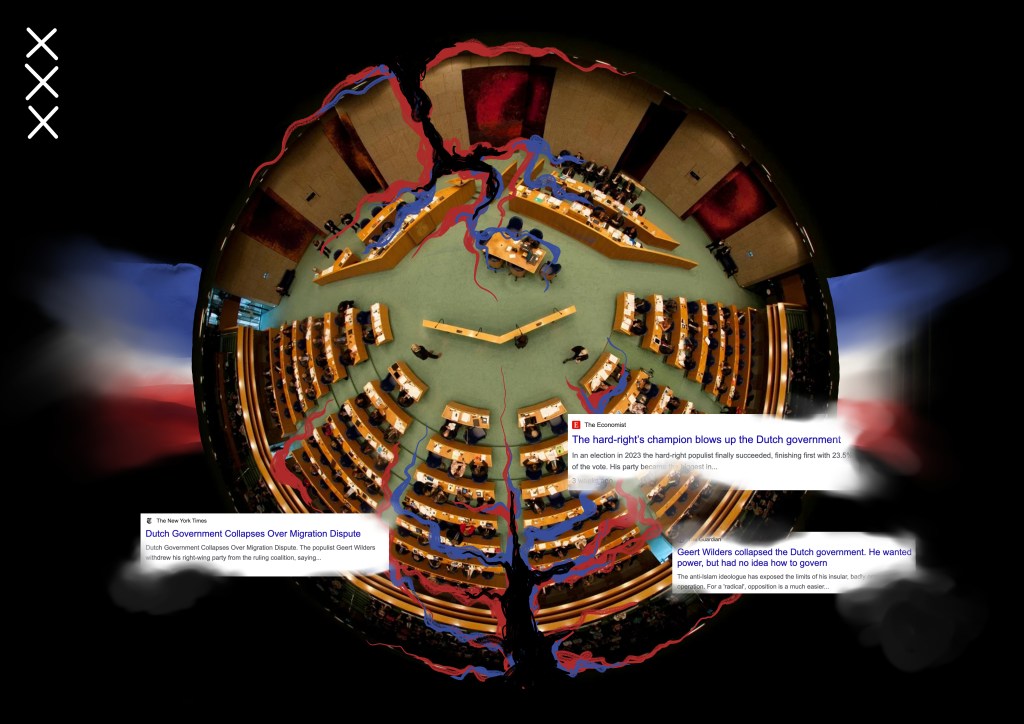
Three weeks ago, the Dutch government collapsed after key political parties failed to agree on major issues, forcing Prime Minister Dick Schoof to resign. The far-right Party for Freedom (PVV), led by Geert Wilders, pulled out of the coalition over disagreements on immigration policy. This move effectively ended the government, and new elections are scheduled for October 29, 2025. Until then, the government will operate in a caretaker capacity, maintaining basic functions but unable to introduce new laws or major policies.
If you’re not familiar with how the Dutch government works, here’s a simple explanation for context: In the Netherlands, it’s very rare for a single political party to win enough seats in Parliament to rule on its own. So, multiple parties team up to form a coalition—a group that agrees to work together. Because each party has its own ideas and priorities, they have to find common ground and agree on important issues to keep the government running smoothly. If one party leaves the coalition due to disagreements, the whole government usually falls apart, which is exactly what happened recently. For a deeper explanation, check out the Parliament website.
The root cause of the government’s collapse was a dispute over immigration policy. Geert Wilders and his party, the PVV, demanded the suspension or sharp reduction of asylum claims, the closure of asylum centers, the revocation of dual citizenship for criminals, and other strict measures. They pushed for these proposals to be passed swiftly, even calling for emergency powers and unilateral action. The other coalition parties (VVD, NSC, and BBB) rejected these plans, arguing that they violated EU law and could lead to serious constitutional issues. Wilders then issued an ultimatum: either his asylum package was adopted, or the PVV would withdraw its support. On June 3, 2025, he followed through on this threat. Since the PVV’s backing was essential to the government’s majority, its exit caused the entire coalition to collapse.
This political turmoil means no major new laws or reforms can move forward, causing delays in healthcare, housing, climate change, and other key areas until new elections in October. For international students, the collapse is significant because the previous government had proposed reducing English-taught courses, increasing Dutch-language education, limiting international admissions, and raising tuition fees for non-EU students. Now, with the government in ‘caretaker’ mode, these proposals are paused and could be kept, revised, or fully abandoned depending on the election results. The Dutch Student Union hopes the government’s fall will stop cuts, raise student grants, and boost affordable housing. If you’re staying in the Netherlands, keep an eye on how these developments unfold in the months ahead.
 The Herring