
By Anna Schuhmann
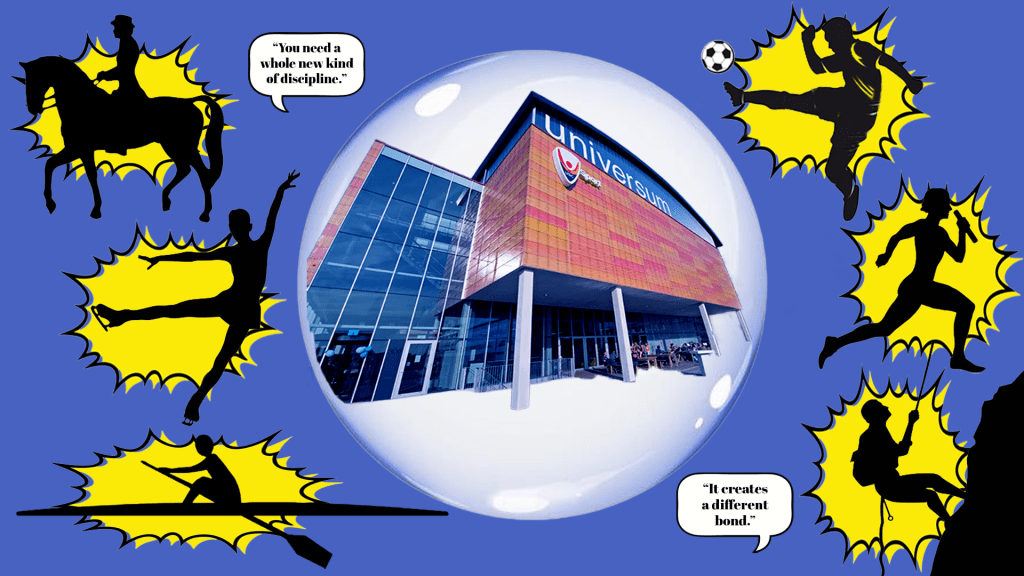
AUC students are heading off-campus to join sports teams across Amsterdam, pushing their limits, meeting new people, and experiencing student life beyond their bubble. They join new communities by balancing demanding schedules and getting out of their comfort zone. What motivates them? What challenges do they face? And could this be the next step for you?
At AUC, there is no shortage of ways to get moving. From Catch’s football, volleyball, or basketball training to gymnastics, karate, yoga, and the endless dance styles featured in AUCandance’s weekly classes, the committees make sure something sporty is always going on. It is convenient to be able to do sport just two minutes from your dorm, and it feels special to sweat it out with fellow students.
But while the comfort of the bubble is real, so is its limit, especially if you are looking for more specialized sports, a higher level of training, or a commitment that goes beyond what is offered on campus. For students who want to branch out, whether that is to continue a passion, pick up something new, or just meet people outside of the AUC ecosystem, sports may be a perfect way to do it.
After all, we live in Amsterdam: a vibrant, chaotic, diverse city bursting with activity. And AUC students are taking full advantage of it. From rowing and horse riding to track running – you name it, someone here is doing it. Whether through local clubs, student sports associations, or informal teams that train in the park, getting involved in sports beyond AUC opens up a completely different side of student life.
For many students, the motivation to do sports outside AUC is personal, sometimes deeply so. Charlotte Schnitger, a first-year Social Sciences major, joined a student rowing association to connect with Dutch students and try something new. “I had never rowed before,” she says, adding that “diving into something new felt right as I started university.”
Others, like Veronika Szabo, a first-year Sciences major, had already spent years training their sport. Szabo competes in national-level horseback riding and has trained at the same stable for six years. “Seeing my horse almost every day gives me a sense of purpose and provides stability in my life,” she explains.
Meanwhile, Giulia Cenni, a first-year Sciences major, engages in more alternative forms of movement. She trains at “Crazy Monkey”, a movement space in the city that blends elements of acrobatics, floorwork, improvisation, and strength training. More than a gym, it is a creative environment focused on body awareness, playful experimentation, and personal expression through movement. She describes it as one of her “most vital spaces, physically, emotionally, and socially.”
Doing a sport outside of AUC is not just a physical commitment – it is a logistical one. From early wake-ups to long commutes, students have to carefully structure their lives to make it work. For Schnitger, who trains with her rowing team before most people are even awake, it is all about routine and restraint. “You really need to plan well, and if your studies aren’t going well, you have to quit,” she says. Her days begin at dawn and end with a strict 10 PM bedtime.
Szabo takes a strategic approach, relying on precise scheduling to keep her academics and horse riding in balance. “Fitting riding into a full academic week makes 24 hours feel short,” she admits. Knowing how long every task takes, including the three-hour round trip to the stables, helps her stay on track.
The commute is also a major factor of consideration for Lynn Visser, a first-year Science major, who runs track twice a week. “It takes about 45 minutes each way to get there, so it ends up being a serious time commitment,” she says. Despite the effort, she finds it manageable – and says the benefits outweigh the occasional chaos.
Then there is Cenni whose schedule layers yoga teaching, intensive training, and a full course load. “It leaves little time for rest or social life,” she says. “I definitely stumble sometimes, but movement gives me clarity and energy.” For her, the structure is not just a necessity, it is a grounding force. The takeaway from all these situations is the same: doing sports outside of AUC requires deliberate planning. But for those who are committed, the structure becomes part of what sustains them.
That said, it is not just about discipline and schedules. For many students, sports open the door to something else – a second community. Schnitger has formed a unique bond with her rowing team, which varies from the friendships formed on campus. “We share the same sports life,” she says. “It creates a different bond.” She explains that being part of a group that trains together, competes together, and makes sacrifices together builds something powerful.
For Visser, friendships in her track team do not come as effortlessly as they do at AUC, but that effort brings its own value. “At AUC, you see people every day. With track, it takes effort to meet up, but that makes it special,” she says. She adds that the distance and planning involved do not weaken the bond but instead deepen it, as it is rooted in a shared commitment beyond academics.
Szabo calls her stable a second home. After six years of riding there, the people around her have become more than teammates. “I practically know everyone,” she says. The stable offers familiarity and a sense of continuity – something that stands in contrast to the ever-shifting nature of university life at AUC, where courses and classmates constantly change.
Although Cenni doesn’t always feel fully part of the AUC social loop, she does not see this as a loss. Instead, she finds a meaningful sense of connection elsewhere: at Crazy Monkey. It’s not about escaping the bubble, but about building something separate: a space where she can move without pressure, explore creatively, and engage with people through shared curiosity rather than academics.
But while students enjoy joining new communities through sports, they feel like AUC does not fully acknowledge their off-campus commitments. “It would be wonderful to see more recognition or logistical support,” says Cenni. Szabo agrees but is not sure what exactly AUC could offer. Visser is more direct “I don’t think AUC recognizes them at all, to be honest,” she says. For many, support from professors varies by case, and while some are understanding, there is also a need for a formal structure.
Logistical challenges are individual. Szabo, who owns her horse, can plan freely. Visser, on the other hand, has to sprint out of class sometimes to make it to training. “Sometimes classes and practice overlap, and it gets chaotic.”
Stepping outside the AUC bubble to pursue sport is not just a physical challenge. It is a learning experience that reshapes how students relate to time, pressure, and even themselves. For Schnitger, the biggest lesson came through discipline and collective effort. Rowing with a team showed her how far persistence can take you. “Motivation isn’t enough, you need a whole new kind of discipline,” she says, explaining that it is not just about showing up for yourself, but about pushing through for others too.
Szabo has learned to live between two demanding worlds. Balancing high-level riding with university has forced her to become both practical and precise. “It’s taught me how to be efficient and organized with my time,” she reflects. “University and riding are like two different worlds I try to balance.”
For others, sports opened unexpected doors. Visser points to the social growth that came with joining a track club: “There is a lot more going on than at AUC,” she says. “I’ve gone to events and met people I never would have otherwise.”
For Cenni, the lesson is more internal, less about time management and more about self-connection. “It’s not about being the best,” she explains, “it’s about creating a rhythm that sustains you, intellectually, physically, and emotionally.” In her practice, movement is not a break from her student life – it is a way of living it more fully.
What connects all these stories is that sports outside AUC do not just complement university life, they transform it. Whether in discipline, perspective, or connection, each student carries what they have learned back into the classroom and beyond.
If you are considering trying a sport outside AUC, all students I spoke to had the same advice: do it. It does not matter if you are just starting out or still figuring things out, sometimes the best experiences come when you step a little outside your usual routine.
Worried about the language barrier? That is a common concern. Visser and Szabo both emphasized that while many sports circles are Dutch-speaking, you can still find your place, especially in such an international city like Amsterdam. And if you are shy? Starting at a student association is often easier. “It is where you will meet people who are in the same situation as you,” Schnitger adds.
The real challenge is time. Between training, classes, and everything else, you will need to plan carefully. But with a little structure and some commitment, it is more than doable – and what you may gain in return goes far beyond fitness. So if you are looking to stretch past Science Park, sports might just be the healthiest and most rewarding way to do it.
 The Herring