
By Antek Bańkowski and Sophie Staal
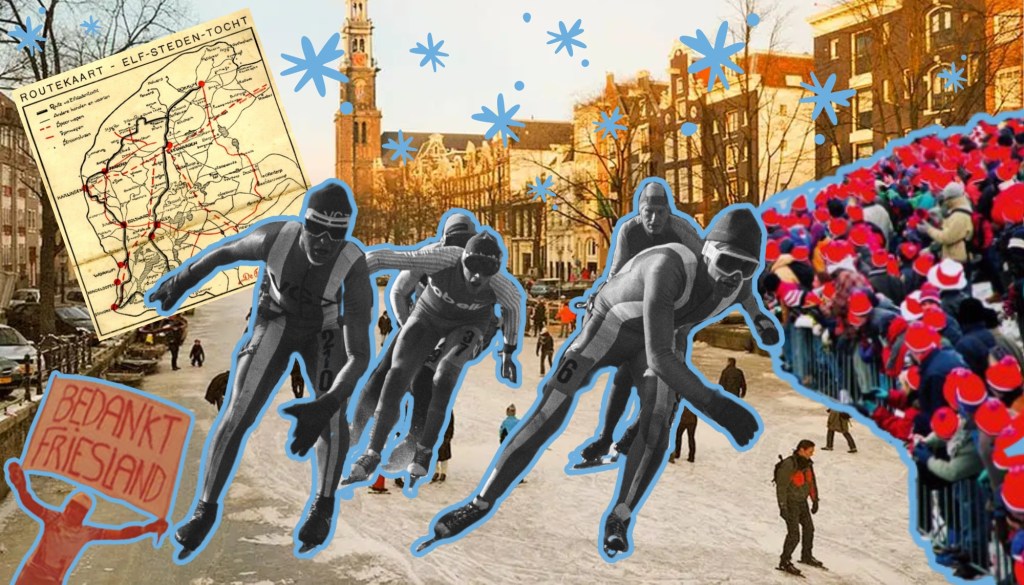
In February 2012, the Netherlands was gripped by a high fever of excitement and anticipation. For the first time in years, the country was struck by multiple days of consistent frost and snow. Bikers struggled not to slip and fall, and trains got cancelled due to tracks being buried in a thick layer of snow. But these inconveniences were merely that when there was the prospect of “the tour of all tours” (de tocht der tochten) – De Elfstedentocht.
This phenomenon translates to “The Eleven Cities Tour” and is a Dutch ice-skating marathon across eleven cities in Friesland, the most northern province of the Netherlands. The tour spans nearly 200 kilometres, challenging skaters to navigate frozen waterways winding through meadows and fields, over frozen ditches and under low bridges, all while enduring harsh winds and freezing temperatures. And yet, despite being a physically demanding sports event, it is first and foremost a cultural tradition.
The first edition of De Elfstedentocht was held in 1909, with only 23 participants. Since then, the event has grown exponentially – in numbers, but also in cultural significance. Every time it takes place, spectators gather throughout the eleven Frisian cities, standing alongside the frozen canals in orange ‘Unox hats’, ringing bells, waving flags, and cheering on the ice-skaters. Local vendors set up stalls where they serve ‘koek-en-zopie’, typical food and drinks, to keep the ice-skaters fuelled and the supporters warm. Songs are chanted, blisters are being tended to, hot-chocolate is poured. Everyone is involved in this celebration of resilience and love of ice-skating.
The event only takes place when the ice is at least 15 centimetres thick. Nowadays, it is rarely cold enough for this condition to be met, and so the last time the Elfstedentocht took place was in 1997. Nevertheless, the memory of the legendary tour continues to live on, and the country bursts with excitement whenever there is the slightest chance of one taking place. This frenzied anticipation has earned itself the name ‘Elfsteden Fever.’
This fever got particularly high in February 2012. The Netherlands was freezing and the ice went from eight, to ten, to eleven centimetres. Live blogs reported on ice thickness and weather forecasts became a point of mass interest. Just a couple of extra centimetres and the event would have been put together in no-time. The entire country was anticipating the 16th edition of the Elfstedentocht. To much disappointment, the ice never reached the requirement of 15 centimetres, leaving the event as a mere memory, and the possibility of another edition – a dream.
In that way, anticipation and hope keep the tradition alive. Even the generation of those who were born after the last one took place recognizes it as an important part of Dutch culture. Kathelijne Lips, a first-year Humanities student, attests to this. “I’ve known about it my whole life, almost as if it happens every year, because people talk about it so much,” she says.
There is a very small chance it will ever happen again, but even without a huge event, the Dutch culture of ice skating remains one of a kind. People go through shared ecstasy every time ice forms on even the smallest ditches and lakes. We asked AUC students who participated in this national tradition to share their memories.
“It would be this big fuss: are we going to be able to go on natural ice this year?” Lips says, remembering her excitement as a child. She lived in Amsterdam and had a lake close to her house. She used to practice ice-skating as an actual sport at the Jaap-Eden Baan, but admits that gliding across the lake was a joyful break from usual training. “This would be just skating around randomly, not timing your speed, or improving your skills, just enjoying the beauty and the people,” she explains.
Kayte Philips, a first-year Humanities student, who grew up in a village just north of Amsterdam, talks about her experience from when she was a kid. She lived in a very rural area, surrounded by grasslands and multiple lakes and canals. Philips reminisces the universal excitement that occurred in the local community when the nearby lakes would freeze. “Everyone wakes up at six in the morning because that’s when the ice is the best. People wouldn’t go to work,” she recalls.
One of the most unique ice skating experiences in The Netherlands has to be skating the canals of Amsterdam. Lucian Jonker, a first-year Social Science major, remembers skating them as a child in 2012 and more recently in 2021, which up to date has been the last year the canals froze. The stability of the ice was not guaranteed in all places. Underneath the bridges or near the walls, the ice was weaker, adding an element of exciting danger. In 2012, the temperatures were a lot lower. “Whole canals were frozen, you could go under bridges as well,” Jonker recalls. Tygo Asin, a second-year Social Science student, also got to skate on the canals that year. “Being able to stand on the canals and see the city from a different angle that you wouldn’t see it from normally was really cool,” he admits.
Wherever one decided to ice skate, safety concerns were always a part of the experience. “Parents would test the ice. If the sides of the pond or lake were slushy, it wasn’t safe enough, but if it was a certain amount of centimetres thick, then it was okay,” Lips explains, adding that usually the most reliable approach would be to choose ice that was already skated on.
In Philips’ area, determining the safety of the ice is more institutionalized. “We have an ice committee in my village, they decide if the ice is thick enough, and then they would send a text to everyone,” she explains. But one could never be sure of how many people the ice would support. “The funniest thing is, when you stand on the ice and chat with people, and then your friend comes, and then another friend comes, and then another one. You’re standing there and you hear [a cracking noise]. And you all skate away so fast, because you know that if you stay there it’s going to crack,” she says, laughing nostalgically.
Despite the risks, it would always be worth it in the end. “It’s just very beautiful and silent,” Lips reminisces. Philips shared her vivid memory of the incredible silence, which would only be interrupted by blades scraping the ice. Ironically, it was fundamentally a social experience as well. Lips remembers that ice skating would usually end by “getting all wet and cold, and then running inside someone’s house for a cup of tea.” She would often meet other people on the ice, with everyone eager to make friends in the thrill of excitement. For Philips, the rarity of the event made all other things in life less important for the day. “It’s a once-in-ten-years event. So then you’re just ice skating. There you are, with your friends or your family,” she reminisces.
 The Herring