
By Pola Folwarczny and Lou Boot
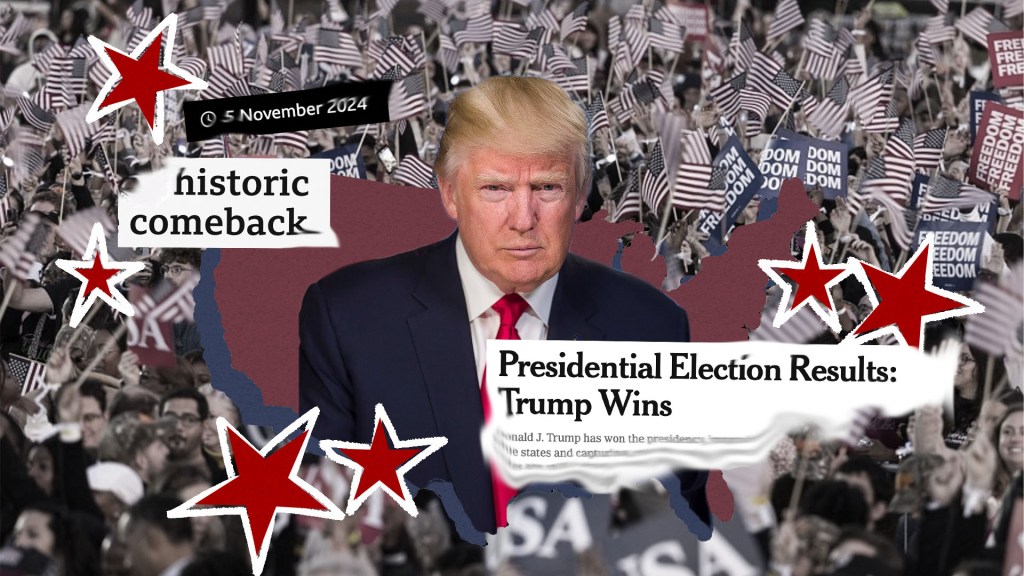
On 6 November, American students at AUC woke up to the news of Donald Trump’s sweeping victory in the 2024 presidential election. Disappointment, fear, anxiety, relief, numbness – a multitude of sensations flooded their systems, welcoming them into this new reality. In the aftermath of the election, some have come forward to share their thoughts, feelings, and plans for the future.
Alena Cooper, a first-year Social Science student from Virginia, describes the months leading up to the election as a “weird transition from hopefulness to nervousness.” It began when Kamala Harris replaced Joe Biden in the race, gradually veering towards agitation as November, and with that the polls, neared. “Leading up, it was a little bit of dread. But still hope and confidence that things would turn out okay,” says Liam Macreery, a second-year Humanities major from Colorado, explaining the bundle of feelings that accompanied them over the course of the campaign.
Because of the six to eleven-hour time difference between Amsterdam and the United States, the night of the election proved to be restless for some students. Cooper recalls setting her alarm at hourly intervals to closely follow the results, Macreery woke up in the middle of the night to check for updates. “I kept looking for consolation somewhere and there just was none,” Ava Weld, a second-year Humanities student from New Hampshire, says about checking for updates.
“I screamed really loud. I was really upset,” says River Rain, a third-year Science student originally from Oregon, describing her initial reaction to the results upon waking up. However, not everyone reacted the same way. Quinn Seward, a first-year Humanities major from New Mexico, recalls mostly relief. “Both sides [Trump’s and Harris’ supporters] are very angry, very boiled up about this [election]. There was a lot of tension around this moment, and now that tension is kind of released,” he elaborates.
Most American students at AUC acknowledge that they will not be directly affected by Trump’s presidency as they do not actually live in the US at the moment. “I almost feel guilty for being here while everyone else has to go through it over there,” says Agatha Zavadsky, a second-year Science major from Massachusetts, admitting that the thought of having the choice to stay in the Netherlands fills her with relief and guilt in equal measure. She acknowledges the comfort that the liberal environment at AUC has given her in the aftermath of the election night, explaining that it’s a different kind of atmosphere from the one she would have experienced in the US.
Even though some don’t feel directly affected by the American elections in the Netherlands, they do feel for their friends and family back home. Weld shares about how she still worries for her trans friends, uncertain if they will receive healthcare, or her father who works in public education and does not know if the Department of Education will keep existing. “Just because it’s not impacting me doesn’t mean that I’m not affected by the people in my life it does impact,” she says. According to PBS and abc news, Donald Trump has both threatened rolling back on trangender rights and removing the Department Education completely.
Weld also shares that when President Biden was elected her mother had made her two younger sisters, ten and eight years old at the time, watch Harris’ speech at inauguration, so that they could see the very first woman become vice president. She feels that not only does Harris not being appointed President take away that opportunity to show a new female role model, but also that “it’s been replaced by someone who actively trespasses against the rights of women and clearly doesn’t respect them at all.”
Rain expresses fear over Trump’s potential policies. She believes they will have the harshest effects on particular groups – such as immigrants, women and the LGBTQ+ community. “There’s this feeling that my country has betrayed those people who are in vulnerable positions,” she says, “and that we have just made a decision that I can’t be proud of.”
“Part of my distress comes from the feeling that my country just proved its immorality by making the wrong choice,” Rain continues, reflecting on the impact this election’s results will have both in the US and on the international scene. She elaborates that the election of Trump as the next president indicates a larger global shift towards right-wing, or generally more conservative policies. Along with Rain, Kristýna Marinov, a second-year Humanities major from Ohio, expresses her concern over the Palestinian-Israeli war, as well as the conflict in Ukraine, in which the US has been greatly involved. Marinov believes that while the effects of Trump’s presidency will not be felt as immediately by the rest of the world as in the US, they will nonetheless manifest themselves in the end.
Despite the sentiment shared by the majority of American students at AUC, Seward remains hopeful. “I do have some trust in the US government, that it will continue to represent the people and pass legislation that helps them, but also helps the government or helps the country, helps the world,” he says.
The election’s results loom over the students’ plans for the future. Zavadsky admits that her academic aspirations were largely dependent on this year’s election. “If it [the country’s situation] is still salvageable, then maybe I’ll return to the US for my Ph. D.,” she says, reflecting on her former, now highly uncertain, plans to complete her education in Boston, her hometown, “But if not, then I might try to get Dutch citizenship and renounce my US citizenship.”
Some still feel the need to return, such as Sophie Meissner, a second-year Sciences student from Michigan, who will keep visiting family in the US, but also help locally: “I [still] want to be part of my community there.” Others are more certain about their status, such as Weld who states “I’ll never live there again long-term. This has become more solidified with [what’s] happening.”
Macreery finds themselves in a similar situation, well-aware that their return to the US for the winter break is probably the last visit before a long hiatus. They explain that as a queer non-binary person they would be “severely concerned for [their] safety” in the US, adding that as soon as the results were finalised, they started looking into ways to apply for asylum in the Netherlands. Despite their initial uncertainty about the future, Macreery is now sure that staying abroad seems like a more probable option.
In contrast, Marinov does not eliminate the option of living in the US at some point in her life. Motivated by the sense of helplessness that overcame her after the results had been announced, she has started to consider getting more involved in American politics. She could see herself pursuing a career that would enable her to make a decisive impact in the field. And if not that, then at least she plans to educate herself more extensively on American politics and to spread that knowledge.
Some students also share their advice, like Weld who suggests for students who are struggling with the election to “find people that you can talk to about this that can empathise, not just sympathise.”
 The Herring