
By Hilla Dayan
Opinion
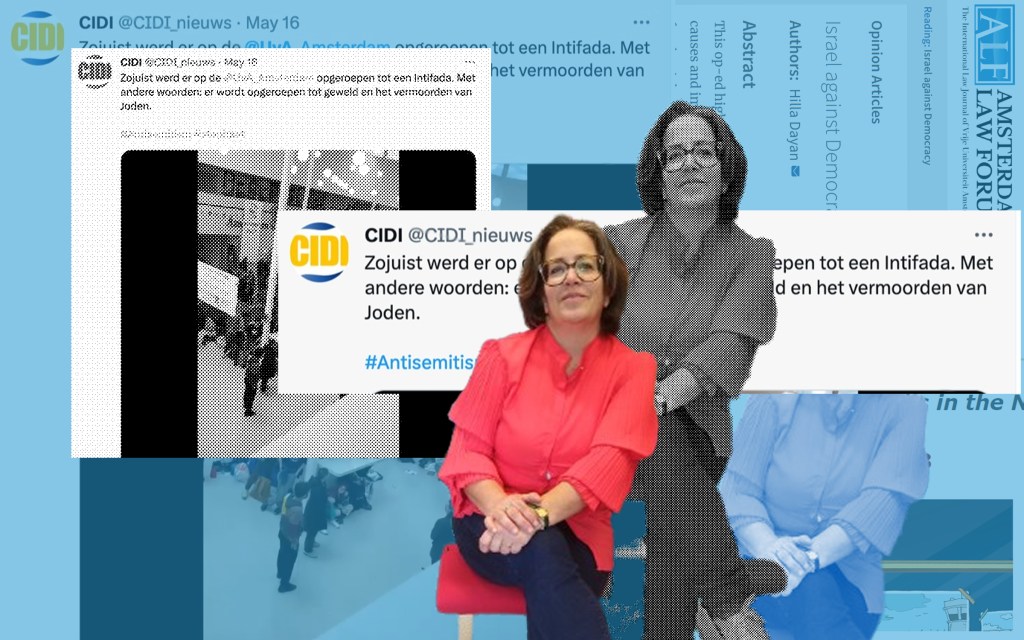
In the pro-Israel activism field, there is a growing concern with the nascent network of pro-Palestinian student groups and staff support for cutting ties with Israel, which these groups advocate as part of their agenda to decolonise the university. Recent student protests at the UvA included slogans and banners against Israeli apartheid. The Center for Information and Documentation Israel (CIDI) tweeted the protests with a caption: “They are calling for Intifada. In other words, they are calling for violence and the murder of Jews.” The conclusion goes beyond the pale. In all my years in Dutch academia, I have never encountered anyone who fits this outrageous, hateful description.
The backdrop of this, for those not familiar with the European politics around Israel/Palestine (where I am originally from), was the recent European Jewish Associations (EJA) summit. At the summit, chief Rabbi of the Netherlands Binyomin Jacobs complained about Dutch authorities’ indifference to the Jewish community. In particular, he commented that “antisemitism in the Netherlands is on the rise. It is a virus that started in the Middle Ages, continued with the Nazi racial ideology and finds expression today in anti-Zionism.” Anti-Zionism has been identified by pro-Israel groups as “the new antisemitism” a long time ago but the conference concluded with a fresh resolution rejecting “intersectionality”. The principle of intersectionality, it was argued, “excludes Zionism” and is therefore an expression of lack of solidarity with Jewish people. Hilarious, I thought, reading this. Did the elderly EJA leadership really deliberate intersectionality like we do at AUC?
Of course, you won’t find the exclusion of Zionism in any textbook definition of intersectionality, but the religiously conservative European Jewish establishment organisations who form the EJA are obviously informed by the right wing crusade against “wokism” in academia. The EJA summit concluded with a decision to erect a task force to tackle the “rise of antisemitism on European campuses” and fellowships to support Jewish students and staff “under attack.” This is an interesting development since there are no explicitly Jewish or pro-Israel groups active on Dutch campuses. The Dutch-Jewish group Oy Vey, which is part of a Jewish cultural revival movement led by a younger generation, has actually enthusiastically adopted intersectionality seeking to ally with the anti-racism movement in the Netherlands.
In a recent letter sent to the VU by the CIJO, the youth group of CIDI, support for “Boycott, Divestment, and Sanctions” (BDS) is also framed as threatening Jewish students’ safety. The letter associates protesting Israeli apartheid with spreading conspiracy theories, since it is “factually untrue.” Yet, as a matter of fact, Israeli apartheid is an established human rights, scholarly and legal claim that has nothing to do with conspiracy. In the framework of the Israeli organisation “Academia for Equality”, I participated in weeks-long discussions among top scholars who are experts of settler-colonialism and the apartheid/Israel question. The products of these scholarly deliberations are available in the form of an extensive reading list and in the two-part Zoom symposium we organised called “Concerning Palestine/Israel: thinking with Achille Mbembe.” The symposium was organised in solidarity with Professor Achille Mbembe, the eminent South African philosopher who became a target of Israel’s propaganda war around “antisemitism” in Germany just a few years ago.
The VU letter is citing a report of pro-Israel groups, which claims that 80% of Jews identify as Zionist and are pro-Israel. The report concludes that anti-Zionist and anti-Israel groups are not targeting official policies but European Jews, causing a “wave of antisemitism.” UvA and VU administrations must know that this is a tautological claim presented without any evidential basis for this alleged “targeting”. For CIJO and CIDI, pro-Palestinian activism on campus is never about Palestine and Palestinians, but only about Jews in the Netherlands. The message to the university is clear – if you don’t silence these groups, you are at best indifferent to Jews, and at worst contribute to the “rise” of antisemitism.
It is difficult to understand what the indifference charge is about when 19 European countries have established national plans to combat antisemitism. The Netherlands has a national coordinator for antisemitism, a position of a state ombudsmen that no other minority group enjoys. For years, the claim is that official complaints recorded by CIDI’s “Antisemitism monitor” are just the tip of the iceberg, but their petty content makes clear why this is the case. Street harassment, particularly of ultra-orthodox Jews is a well-documented ugly phenomenon that regularly recurs when Israel catches headline news. During the latest round of violence, the Israeli Defense Force “shield and arrow” Gaza campaign that killed a dozen of bystanders, including women and children, two young boys in Amsterdam shouted towards Rabbi Jacobs “free Palestine.” This incident was reported as “antisemitism in the Netherlands” in the Israeli news coverage of the EJA summit.
The attempt to portray UvA and VU student groups supporting Palestine as if they are terrorists is alarming. The slogan “Free Palestine” is not a conspiracy or a call to murder Jews. The call “Intifada” pertains to its original meaning — to resist oppression and for popular mobilisation. Since the entanglement with Israel/Palestine is inevitable and is the very raison d’être of pro-Israel groups such as CIJO and CIDI, it is worth noting how they are associating Jews in the Netherlands with Israel.
Clearly, there is an upping of the ante and levels of hysteria. In 2016, gate48, a platform for critical Israelis I co-founded, organised a conference at the CREA on the Israeli global security industry. There, we saw the first sign of a propaganda war spilling over to our campuses when CIDI complained to UvA that the event is harming the safety of anonymous Jewish students of the UvA. The university authorities brushed it off back then. In today’s climate, CIDI would have framed our conference as spreading conspiracy theories.
The current antisemitism campaign targeting UvA and VU exploits a critical moment of mobilisations for all kinds of just causes. Cutting ties with Israel is one of them. It puts enormous pressure on Dutch universities to respond to those speaking on behalf of Jewish communities who are neither stakeholders nor targets of student campus mobilisations. Considering the damage done by the controversial definition of antisemitism that frames critique of Israel as antisemitism by the International Holocaust Remembrance Alliance (IHRA), a campaign that resulted in a wave of anti-Palestinian racism across Europe, it remains to be seen whether organisations like EJA will erect top-down Jewish chapters stalking a campus war.
The last thing pro-Israel groups want to see at the university is an informed and democratic debate. They know perfectly well that “anti-Israel antisemitism” is the most effective way to kill it. A good example is the excellent contributions of an expert panel I assembled at the UvA to discuss historian Arie Dubnov’s lecture on the roots of Antisemitism and the Palestine question in the British context. For me, an Israeli scholar in the Netherlands who closely follows the attack on democracy in the Israeli context there is a bitter irony in this. The Israeli government is hell bent on dismantling anything that stands in its way of expanding the colonisation and brutal occupation of Palestine including fundamental pillars of “democracy for Jews only.” Even protesters in Israel, born and sworn Zionists, understand very well what the real threat is for their political existence – their own racist government.
Editor’s note: This article is a guest contribution by Dr. Hilla Dayan. She has been a lecturer at AUC since 2011. Dr. Dayan is a co-founder of gate48, Platform for critical Israelis in the Netherlands, Academia for Equality for the democratisation of academia and society in Israel, and is active with the Mizrahi Civic Collective. She has published extensively on the crisis of democracy in the Israel/Palestine context. Her article (in Dutch), a product of ASPASIA grant collaboration with Prof. Yolande Jansen titled “Antisemitism, Anti-Palestinian Racism and Europe: for a critical and democratic debate” will appear in the June print edition of the Dutch Review of Books.
 The Herring