
By Kama Wojtuszko
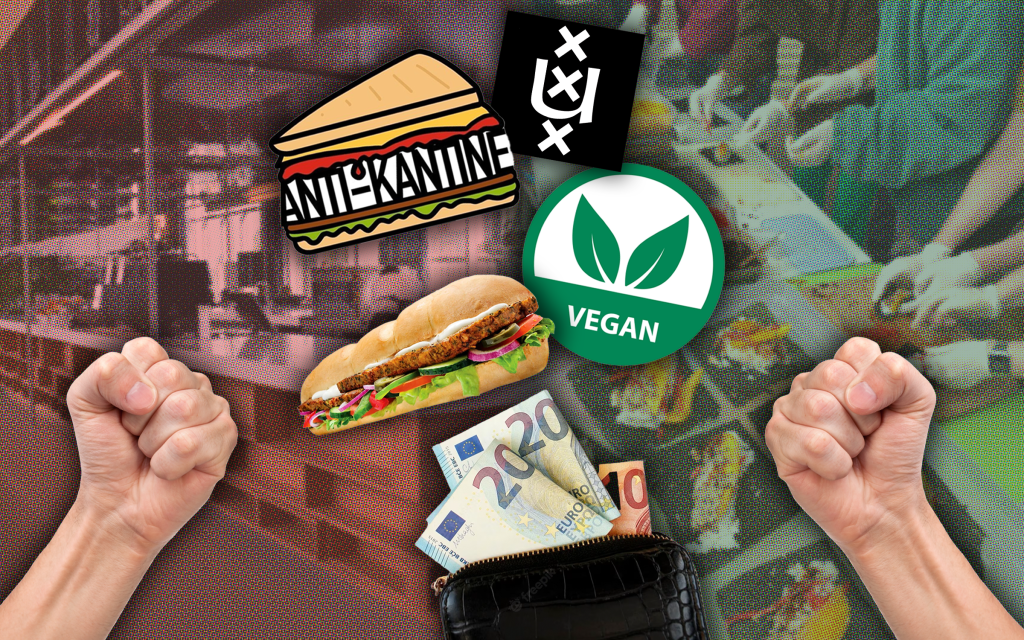
To eat or not to eat – a question that students ask themselves before every canteen purchase. With almost five euros for a sandwich, not every student can afford to eat at the Academic Building, but with finals approaching, it becomes difficult both time- and energy-wise to cook for every meal. Here comes the remedy, the Antikantine: as an action to encourage UvA to lower the prices, students handed out free vegan sandwiches!
Antikantine is an UvA student initiative which aims to address the issues of affordability, sustainability and democracy of the privatised UvA canteens, which, including the AUC canteen, are owned by Cirfood. As a protest against it, students gave out fifteen hundred vegan sandwiches at the Roeterseiland campus over five days in March. The action was funded by Centrale Studentenraad (CSR). The demands of the action are for UvA to transform the canteen into a more affordable and plant-based one, as well as to deprivatize it and make it non-profit. Antikantine was also present at the recent UvA occupation, where students handed out complimentary vegan sushi rolls to the protesters. The students’ response to Antikantine’s action was positive – everyone seemed to agree that the canteen prices were too high.

The March action was held in front of the cafeteria inside a Roeterseiland campus building. On the third day of the action, Antikantine was kicked out and had to move outside. The university legitimised this decision by Antikantine’s lack of appropriate health certificates to distribute food. Titus van der Valk, an UvA student and Antikantine co-founder, suspects that instead, it was the Cirfood entrepreneurs that were displeased with Antikantine “taking away their business.”
The motivation for Antikantine was initially related to sustainability and establishing a vegan canteen. “As long as we keep blaming individuals for their choices, we’re not gonna make any change. But once institutions, especially large ones in schools start taking this responsibility, we can really make a change happen,” van der Valk explains. As a group of students assembled together and created Antikantine, more issues related to the canteen came up. “It became not just about a plant-based agenda, but also about the prices. The entire food system at our university is not accessible,” he adds.
Miriam Crane, a second year Social Science major and a member of the current Student Council board, met with a Cirfood representative in November 2022 and presented a similar to Antikantine’s proposition of a vegan, cheaper canteen at AUC. “In short, they said no and no to both propositions,” she says.
Cirfood’s response to potentially rethinking the prices was that they are fixed and due to the losses the company made during COVID, they are not willing to change anything. To the proposition of a vegan canteen, Cirfood replied that this is against their contract with UvA until 2026, as it assures them the “freedom of choice.” Cirfood stated that they closely monitor the sales and that meat sales make only six percent of all sales. When Crane suggested resigning at least from meat options, Cirfood expressed a concern that their lack would encourage students to turn to nearby alternatives, such as Spar or Science Doner.
Emma Ricci, a second year Social Science student and a member of the 2023/24 Student Council Board, thinks that although AUC cannot do anything independently about the canteen, “it’s the perfect chance to join [Antikantine] and advocate for similar things.” She addresses the issue of whether, considering the close proximity of Spar and the dorms, there even is a need for changing the way the AUC canteen operates. She reminds that it’s not just about affordability, but also about sustainability and working conditions for the employees of the canteen: “I think it’s a bigger discussion that AUC can be supportive of.” She adds that with the constant pressure of the assignments and busy social life, AUC students would benefit from the support of affordable and nutritious meals.
A food discount was implemented thanks to UvA’s subsidy in early April until the end of June: students can purchase a vegetarian or a vegan meal for €3,50 between either 11:30 and 13:30 or 17:00 and 19:00, depending on the campus. However, the future of the canteen for the 2023/24 academic year is unknown, and negotiations between the university and Antikantine are still ongoing. According to van der Valk, one of the possible approaches of realising the sustainability goal is to set a default plant-based option, as a means for a “softer transition.”
“The food doesn’t have to be fancy, it just has to be food so we can study without being hungry,” van der Valk explains, “And we can make it happen.”
 The Herring